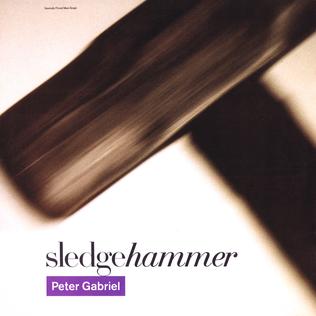
An art-rock loner who had spent a decade being called intense and eccentric wrote the funkiest, most cheerfully filthy song of his life, then spent sixteen hours lying under a sheet of glass while a team of animators moved dead chickens around his head one frame at a time. The result knocked his old band off the top of the charts. Peter Gabriel's "Sledgehammer" was a tribute to the 1960s soul that made him fall in love with music, wrapped in the most labor-intensive video of the MTV era, and both halves of that story have been told for forty years.
"Sledgehammer" was written by Peter Gabriel for his 1986 album So as a deliberate homage to 1960s Stax soul, inspired by seeing Otis Redding live in London in 1967. He hired the Memphis Horns to play on it. Released in April 1986, it became his only US number 1, knocking his former band Genesis and their song "Invisible Touch" off the top. Its groundbreaking stop-motion video, directed by Stephen R. Johnson with Aardman Animations and the Quay Brothers, won a record nine MTV Video Music Awards.
The soul band and the Otis Redding gig
Long before Genesis, Gabriel was a bad drummer in a soul band, and "Sledgehammer" is where he went back to that. "I began as a drummer, a pretty bad drummer," he told Ray Hammond of Sound On Sound in January 1987. "I used to play in a soul band and we used to do a lot of this type of material. It's still very exciting for me." The specific memory driving the song was a single night in south London. "The best gig of my life was when I went to the Ram Jam Club in Brixton to see Otis Redding in 1967," Gabriel said. "That hasn't ever been surpassed for me, it was an amazing night."
That night stuck for a reason: Redding's trumpet player was Wayne Jackson of the Memphis Horns, the Stax house band. Almost twenty years later, Gabriel tracked Jackson down and asked him to assemble a horn section for "Sledgehammer," with Mark Rivera on saxophone and Don Mikkelsen on trombone. Gabriel wanted real brass for what a synthesizer could not do, the slow horn swells and human phrasing of a Stax record. "I think there's still something magical that happens when you get the interaction between live players," he told Sound On Sound. "No amount of good programming can replace that."
The song nobody was expecting to record
"Sledgehammer" was the last track cut for So, and it almost missed the sessions entirely. The album was produced by Daniel Lanois at Gabriel's home studio, Ashcombe House near Bath, a facility built into a converted cow shed. The musicians were literally packing up to leave when Gabriel brought the song in. Drummer Manu Katché had already called a taxi for his trip back to Paris when Gabriel coaxed him back into the room, and Katché nailed the drum part in a single take. Bassist Tony Levin played his part on a fretless bass with a pick.
The song was a deliberate hinge in Gabriel's career, the moment he swung from prog-rock strangeness into full pop without losing his oddness. That did not go uncriticized. Because Gabriel used horns and a soul groove, some accused him of copying his former Genesis bandmate Phil Collins, who was scoring hits with brass-driven songs like "Sussudio." Gabriel has said the borrowing ran the other way, that he was more an influence on Collins than the reverse.
What the song is actually about
Beneath the horns, "Sledgehammer" is a parade of innuendo, and Gabriel has never pretended otherwise. The lyric offers a steam train, an airplane, bumper cars, and a "big dipper," which is a wooden roller coaster at Blackpool Pleasure Beach, all of it standing in for something else. Gabriel framed the sexual content as communication rather than shock. "Sometimes sex can break through barriers when other forms of communication are not working too well," he is quoted as saying on Songfacts. The second half of the song turns toward transformation, "I kicked the habit, shed my skin," a man molting an old identity, which is exactly what Gabriel was doing as an artist.
He also credited the song's runaway success to a quality people did not associate with him. "I think it had a sense of both humor and fun, neither of which were particularly associated with me," he told Rolling Stone. He had spent years being seen, he said, as "a fairly intense, eccentric Englishman."
Where the title came from, depending on who is telling it
Here the tellings split, and both are worth keeping. Gabriel's account roots the whole song in soul tradition, where a "sledgehammer" is one more piece of the R&B innuendo vocabulary. But producer Daniel Lanois has told a more mundane and funnier origin for the actual word. During the So sessions, Lanois said, the team adopted a gimmick to break tension. "We had a bit of fun with the idea that we were turning up for work as if we were constructions workers," Lanois said in a Songfacts interview. "We'd wear these yellow hardhats! We'd show up for work wearing the hardhats, and I'd always say, 'Let's hit with a sledgehammer!' We'd get through the work day, and there were a lot of references to the sledgehammer. I think that's where Peter got the title." The concept came from Memphis. The word, in Lanois's telling, came from a running joke in a Somerset cow shed.
The video that ate a week of Gabriel's life
If the song is a soul homage, the video is a feat of endurance. It was directed by Stephen R. Johnson, who had made Talking Heads' "Road to Nowhere" the year before, and it combined claymation, pixilation, and stop-motion from Aardman Animations and the British duo the Quay Brothers. Every image in the song was made literal: fruit, a model train, and an orange orbiting Gabriel's head, all shot one frame at a time while Gabriel held still beneath a heavy sheet of glass. "It took a lot of hard work," Gabriel recalled, per MusicRadar. "I was thinking at the time, 'If anyone wants to try and copy this video, good luck to them'." He lay under that glass for a total of sixteen hours.
The most famous few seconds, the headless roast chickens dancing to the flute solo, were animated by Nick Park of Aardman, who would later create Wallace and Gromit. The chickens were the real grocery-store kind, and they were supposed to perform a more elaborate dance, but the raw birds spoiled fast under the lights, so the routine got simpler. The director himself was not even a fan of the song at first. "I thought it was just another white boy trying to sound black," Johnson admitted in the oral history "I Want My MTV." The finished clip has been declared MTV's most-played video and its greatest animated video, and at the 1987 MTV Video Music Awards it took a record nine trophies from a record ten nominations.
The Genesis irony, both ways
The chart story has a perfect symmetry. When "Sledgehammer" hit number 1 on the Billboard Hot 100 on July 26, 1986, the song it replaced at the top was "Invisible Touch" by Genesis, the band Gabriel had fronted a decade earlier. Genesis fell to number 3. Phil Collins took it in good humor. "We weren't aware of that at the time," Collins told The Guardian in 2014. "If we had been, we'd probably have sent him a telegram saying: 'Congratulations ... bastard!'"
The irony ran in reverse at the Grammys. "Sledgehammer" lost Best Concept Music Video to Genesis and their puppet-driven "Land of Confusion" clip, which remains, per Songfacts, the only Grammy Genesis ever won. Gabriel's most celebrated video lost its award to the band he had just dethroned.
How the telling has grown over the decades
The spine of this story has never wavered: a soul obsessive paid tribute to the music of his youth and accidentally made a pop landmark. The earliest detailed telling, Gabriel's January 1987 Sound On Sound interview, established the load-bearing facts, the bad-drummer soul-band past, the Otis Redding gig at the Ram Jam Club, and the insistence on live horns over synthesized ones. Later tellings filled in the edges. Daniel Lanois supplied the hardhat origin of the title. Kevin Killen and David Sancious described the studio sound-building and the nightmare of reproducing the horns live from samplers. The 2011 oral history "I Want My MTV" revealed that the video's own director disliked the song, and Gabriel recounted the sixteen hours under glass on BBC Radio 2 years later.
One genuine discrepancy sits at the center, and it is worth preserving rather than smoothing. Gabriel consistently frames the song as a soul homage in which the sledgehammer image belongs to R&B tradition. Lanois just as consistently says the word itself came from his own studio catchphrase. These do not have to cancel out, the feel of the song and the choice of that one word can have separate origins, but the two men who were in the room describe the title's birth differently, and both have stuck to their versions for decades.
The honest bottom line
Strip away the animation and "Sledgehammer" is a very smart piece of pop revivalism, a prog-rock intellectual borrowing a soul groove and a truckload of innuendo to prove he could have fun. Cynics called it a bid for Phil Collins money, and it did make Gabriel a star on exactly the mainstream terms he had spent a career avoiding. None of that has aged the record. The horns are real, the joy is real, and the video remains a genuinely handmade wonder from a moment before computers made such things cheap. Gabriel built a monument to the night Otis Redding blew his mind in 1967, and it turned out to be the biggest hit he ever had. On the same album, In Your Eyes aimed at something holier and ended up pinned to a boombox in a driveway, which is the kind of irony Gabriel has spent forty years learning to carry.
FAQ
What is "Sledgehammer" by Peter Gabriel about? On the surface it is a soul-styled song packed with sexual innuendo, using images like a steam train, bumper cars, and a roller coaster. Gabriel described the sexual theme as a way for communication to break through when other forms fail. The song's second half turns toward shedding an old identity, mirroring Gabriel's own move from art rock to pop.
Who played on "Sledgehammer"? Peter Gabriel wrote and sang it, with Manu Katché on drums, Tony Levin on fretless bass, and a real horn section led by Wayne Jackson of the Memphis Horns, the Stax house band Gabriel had first heard backing Otis Redding in 1967. Daniel Lanois produced it.
How was the "Sledgehammer" video made? Director Stephen R. Johnson used claymation, pixilation, and stop-motion animation from Aardman Animations and the Quay Brothers, shooting one frame at a time. Gabriel had to lie under a sheet of glass for about sixteen hours. The dancing headless chickens were animated by Nick Park, later the creator of Wallace and Gromit.
Did "Sledgehammer" really knock Genesis off number 1? Yes. It reached number 1 on the Billboard Hot 100 on July 26, 1986, replacing "Invisible Touch" by Genesis, Gabriel's former band. It was Peter Gabriel's only US number 1 single.
How many awards did the "Sledgehammer" video win? It won a record nine MTV Video Music Awards at the 1987 ceremony, from a record ten nominations, and has been named MTV's most-played and greatest animated video.
Sources
- Sound On Sound, Peter Gabriel interview (Ray Hammond), January 1987 (soul roots, Otis Redding, live players)
- Songfacts, "Sledgehammer by Peter Gabriel" (Daniel Lanois, David Sancious, and Kevin Killen interviews; song facts; Rolling Stone quote)
- Craig Marks and Rob Tannenbaum, "I Want My MTV" (Stephen R. Johnson quote)
- The Guardian, Phil Collins interview (Laura Barnett), 2014, as quoted by MusicRadar
- MusicRadar, "How '60s soul music, African rhythms and a groundbreaking video fuelled Peter Gabriel's biggest hit," March 31, 2025
- Billboard Hot 100 weekly charts, 1986, and Wikipedia "Sledgehammer (Peter Gabriel song)" (chart and MTV award facts)
We hit claims with the verification sledgehammer.
Part of Stories Behind the Songs. See also In the Air Tonight and Sweet Dreams (Are Made of This).