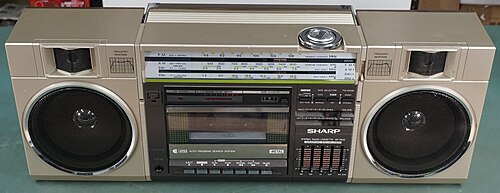
It sat on a shoulder, the size of a small suitcase, chrome and black with the speaker grilles facing out at the world. When someone walked down the street with a boombox, the music was not for them. It was for everyone within a block. In the 1980s the boombox turned radio from a private thing in your bedroom into a public declaration, and for a while it was the loudest object in American culture.
The boombox was a large, portable stereo with a radio, a cassette deck, and powerful built-in speakers, designed to be carried and played out loud in public. It arrived in the late 1970s and peaked through the 1980s, becoming central to hip-hop culture and a symbol of the decade. It let you take the radio anywhere and share it, or impose it, on everyone around you.
Radio you could carry
The radio had always been portable in a small way, a transistor you held to your ear. The boombox blew that up, literally. It combined an AM/FM radio and one or two cassette decks with real speakers and enough amplification to fill a street corner, all in one carry-handle box. Suddenly the radio was not tethered to a wall or a car. You could take the station with you to the park, the stoop, the beach, the subway platform, and everyone there heard what you heard.
That portability changed what radio was for. It stopped being something you consumed alone and became something you performed with. The songs you played out loud said something about you, and the boombox made that statement as loud as you wanted it.
The bass wars
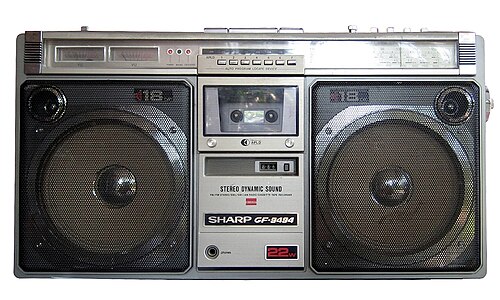
The competition was in the volume and the low end. Manufacturers kept building bigger, heavier boxes with more speakers and more power, because buyers wanted to be the loudest one on the block. Certain models became legends. The JVC RC-M90 and the Sharp GF-777 were known as boombox kings, prized for their ability to drown out everyone else. The Lasonic TRC-931 and the Panasonic RX-5600 had the same reputation. Brands like Panasonic, Sharp, Fisher, Aiwa, Toshiba, and JVC pushed the arms race forward year after year.
By the mid-1980s some boomboxes had grown to the size of a piece of luggage, and hauling one around was a workout. That was part of the appeal. The sheer size announced your presence before the music even started.
The symbol of a culture
The boombox became inseparable from the rise of hip-hop. As the music spread out of New York in the early 1980s, the boombox was how it traveled, block to block and city to city, played loud in public spaces that had no other soundtrack. It got tagged with the nickname "ghetto blaster," a term that carried a real edge of backlash against the urban, largely Black and Hispanic youth culture the boombox represented.
Its most enduring image came in 1989, when Spike Lee gave the character Radio Raheem a massive boombox in "Do the Right Thing," carried through a Brooklyn neighborhood blasting Public Enemy's "Fight the Power." That boombox became a symbol of the whole era, so much so that the film's prop later entered the collection of the Smithsonian's National Museum of African American History and Culture. It was radio, hip-hop, defiance, and public space all bundled into one object on one shoulder.
The honest bottom line
Let us be honest about what the boombox actually was on a crowded street: an imposition. Playing your music at that volume in a public space forced it on everyone nearby whether they wanted it or not, and plenty of people found it obnoxious, which is exactly where "ghetto blaster" and the backlash came from. The boombox was not polite. But that was also its whole point and its power. It was a working-class, portable, unapologetic way to claim public space with sound, at a time when a lot of young people had no other stage. It gave a voice a body and a set of speakers, and for a decade it made the radio impossible to ignore.
FAQ
What is a boombox? A boombox is a large portable stereo combining a radio, one or two cassette decks, and powerful built-in speakers, built to be carried and played out loud in public.
When were boomboxes popular? Boomboxes arrived in the American market in the late 1970s and peaked in popularity through the 1980s and into the early 1990s.
Why was the boombox called a ghetto blaster? The nickname came from the boombox's strong association with urban youth culture and hip-hop, and it carried an edge of backlash against that culture playing music loudly in public.
What are the most iconic boombox models? Legendary models include the JVC RC-M90, the Sharp GF-777, the Lasonic TRC-931, and the Panasonic RX-5600, all prized for their power and volume.
What boombox was in Do the Right Thing? The character Radio Raheem carried a massive boombox in Spike Lee's 1989 film "Do the Right Thing," playing Public Enemy's "Fight the Power." The prop later joined the Smithsonian's collection.
We carried those boomboxes ourselves, meet the shoulders.
Part of 80s Radio. Read next: taping songs off the radio.