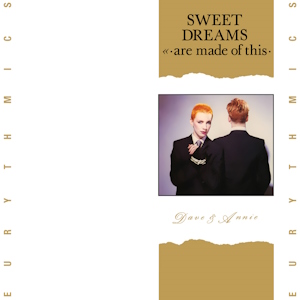
Their band had just collapsed. Their romance had just ended. They had almost no money, one microphone, an attic they were living in, and a drum machine so rare that they had to sleep at the manufacturer's flat while it was built. One of them was manic after nearly dying in surgery. The other was on the floor, too depressed to get up. Out of that came one of the most recognizable records of the decade, and forty years later Annie Lennox and Dave Stewart still do not fully agree on who played the riff.
"Sweet Dreams (Are Made of This)" was written by Annie Lennox and Dave Stewart of Eurythmics in 1982, after their previous band the Tourists broke up and the two of them broke up as a couple but kept working together. They cut it in a tiny attic studio in North London on second-hand gear bought with a bank loan. Their label did not even think it was a single. It reached number two in the UK in March 1983 and number one on the US Billboard Hot 100 on September 3, 1983, their first American release.
The band broke up, the couple broke up
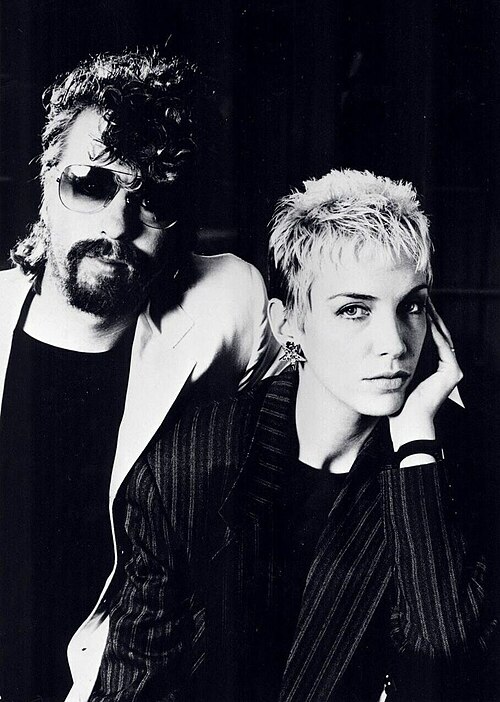
Almost nothing about Eurythmics should have survived its own beginning. Lennox and Stewart had been a couple for about three years while playing in a band called the Tourists. When the Tourists fell apart, they formed Eurythmics as a duo, and then, a short time later, they broke up romantically too. Most people would have walked away. They did the opposite.
Stewart has written about that strange refusal to separate. "When we broke up as a couple for some strange reason it was like we were always going to be together, no matter what," he wrote in The Dave Stewart Songbook. "We couldn't really break that spell so we just carried on making music. This causes many problems, yet through all of this we ended up writing a lot of great songs, some were about 'our' relationship and some were about our relationship with the world around us. Whatever we wrote always had a dark side and a light side and in a way I describe it as 'realistic music,' full of the ups and downs of real relationships and life itself."
That is the engine under "Sweet Dreams." It was written by two people who had every reason to stop being in a room together and could not make themselves leave.
A bank loan and an attic
Their first album had barely registered, so there was no budget for the second. What there was, remarkably, was a bank willing to gamble on them. Lennox and Stewart took out a loan of 5,000 pounds and spent it on second-hand equipment: an eight-track tape machine, a mixer, a spring reverb, and a single utilitarian microphone that would end up recording everything, including Lennox's vocals. They built the record in a small project studio in the attic of an old warehouse in the Chalk Farm district of North London, where they were also living.
The strangest purchase was the rhythm. Part of the loan went to a 2,000-pound Movement Systems drum computer, one of only around thirty ever built. To get it, the pair had to sleep for a few days at the manufacturer's flat in Bridgwater while their prototype was assembled. That machine did more than keep time. It triggered a sequence on a Roland SH-101 synthesizer that became the song's low, hypnotic pulse. Lennox filled out the sound on a borrowed Oberheim synthesizer. Two broke musicians, one borrowed keyboard, one microphone, and a drum computer that barely existed yet: that is the entire architecture of the record.
The riff, and who actually played it
The two writers were in opposite emotional states the day it happened. Stewart was manic, running high because he had just survived surgery on a punctured lung and felt he had been handed a new life. Lennox was sunk in depression, worn down by how little her music had achieved so far. By the account both have given, she was down on the floor when Stewart started building the track, and something in the sound pulled her up. She "leaped off the floor," as the story goes, and started filling in the song.
Here is where the tellings quietly split. In one version, repeated by Stewart, he had already produced the beat and the riff on a synthesizer, and Lennox, hearing it, said "What the hell is that?" and grabbed another keyboard, so the song emerged from two dueling synths. In another version Lennox has given, Stewart came up with the beat and she improvised the synthesizer riff herself. The detailed studio accounts put the sequenced hook on Stewart's SH-101 and Lennox on the Oberheim, which supports his telling. But the two of them have never scrubbed the story into one clean line, and the small disagreement over who owns that riff has followed the song for four decades. What is not in doubt is that the moment it started playing, the depression in the room lifted.
Not a Disney world
For a song that fills dance floors, "Sweet Dreams" is unusually bleak underneath. Stewart is clear-eyed about the gap between how it feels and what it says. "A lot of people use it as a very uplifting dance record at EDM festivals and raves and parties," he told Songfacts in 2022. "When the DJ puts that on there's always a lot of hands in the air. But it's actually a very sort of existential, spooky record asking if this is what the world has come to. Is this what our dreams are made of? And then some people want to use you, some want to abuse you." His summary was blunt: "I suppose it was reality, basically, what we were writing about. It wasn't a Disney kind of world."
They did build one door out of the gloom. Stewart insisted the song needed a lift. "I suggested there had to be another bit, and that bit should be positive," he told Songfacts in 2008. "So in the middle we added these chord changes rising upwards with 'Hold your head up, moving on.' To us it was a major breakthrough. It just goes from beginning to end and the whole song is a chorus, there is not one note that is not a hook." Lennox, for her part, has resisted calling it a song at all, describing it instead as a kind of mantra open to whatever the listener brings.
Number one in America
The record almost did not come out as a single. "We thought we'd made something really special but we had no idea, really, the impact it would have," Stewart told Songfacts. "Neither did the record label, which didn't even think it was a single." RCA released three other songs from the album first. When they finally put "Sweet Dreams" out, it climbed to number two in the UK in March 1983, held off the top by Bonnie Tyler's "Total Eclipse of the Heart."
Then America took it. "Sweet Dreams" was the first Eurythmics single released in the US, entering the Billboard Hot 100 at number 90 on May 14, 1983. It rose all summer, spent four weeks stuck at number two, and finally reached number one on September 3, 1983, edging out Michael Sembello's "Maniac." Billboard credits the song to Lennox and Stewart. What broke it in America was MTV, where the video's images, Lennox with close-cropped orange hair in a man's suit and a cow wandering through a boardroom, were impossible to ignore. Lennox summed up the video plainly in the book I Want My MTV: "The video is a statement about the different forms of existence. Here are humans, with our dreams of industry and achievement and success. And here is a cow."
How the telling has grown over the decades
The two halves of Eurythmics have told this story from inside their own memories, and the seams show in a way that is honest rather than damaging. The sharpest example is the mood of the writing itself. Lennox has said flatly that the song came right after a bad fight. "I thought it was the end of the road and that was that," she told The New York Times in 2007. "We were trying to write, and I was miserable. And he just went, well, 'I'll do this anyway.'" Stewart, years later, told American Songwriter something that sits oddly beside that: "Funny enough, Annie and I have never really had an argument." Both statements are on the record. Whether you call that day a fight or not seems to depend on which of them is remembering it.
The same is true of the riff. Stewart's tellings tend to put the beat and the riff in his hands first, with Lennox reacting; Lennox's tellings give her the improvised riff. Neither has ever forced the other version to disappear. That refusal to smooth it over is very much in keeping with two people who broke up, kept working, and built a career on the friction.
The honest bottom line
Take away the myth and "Sweet Dreams" is a survival record made by two people who probably should not have been speaking to each other. The band was dead, the romance was dead, the money came from a bank, the studio was an attic, and the gear was second-hand or barely built. The lyric is not a celebration, it is an existential shrug about being used and abused in a world that is not a Disney kind of world. And the writers still disagree, gently, on who did what. None of that has dulled it. The riff still lands the second it starts, the song still fills rooms that have no idea how sad it is, and the duo who could not stay together could not stop making it work either. That contradiction is the song. That same year, New Order carried a similar contradiction to an even stranger extreme with Blue Monday, a twelve-inch single too long for radio, wrapped in a sleeve that may have lost money on each copy, and the two records between them drew the boundary of what synth music could mean in 1983.
FAQ
What is "Sweet Dreams (Are Made of This)" about? It is a darker song than its danceable sound suggests. Dave Stewart has described it as an existential, spooky record asking whether this is what the world has come to, with the line about some people wanting to use you and some wanting to abuse you. Annie Lennox has called it less a song than a mantra open to interpretation.
Who wrote "Sweet Dreams" by Eurythmics? Annie Lennox and Dave Stewart wrote it together, and Billboard credits both. They wrote and recorded it in 1982 in a small attic studio in North London after their band the Tourists broke up and they formed Eurythmics as a duo.
How was "Sweet Dreams" recorded? On a tiny budget. Lennox and Stewart took a 5,000-pound bank loan and bought second-hand equipment, including an eight-track recorder and a rare Movement Systems drum computer that triggered the song's synth sequence. They cut it in the attic of a North London warehouse where they were living, using a single microphone for everything.
Were Annie Lennox and Dave Stewart a couple? Yes. They were romantically involved for about three years while in their earlier band the Tourists. They broke up as a couple around the time they formed Eurythmics but chose to keep working together, and much of Eurythmics' music grew out of that tension.
When did "Sweet Dreams" reach number one? It reached number one on the US Billboard Hot 100 on September 3, 1983, the first Eurythmics single released in America. In the UK it had earlier peaked at number two in March 1983, kept from the top by Bonnie Tyler's "Total Eclipse of the Heart."
Did the record label believe in "Sweet Dreams"? No. Stewart has said the label did not even think it was a single, and RCA released three other songs from the album before it. Only after "Sweet Dreams" became a hit in Britain did the label issue it in the US, where it went to number one.
Sources
- Songfacts, "Sweet Dreams (Are Made Of This)" song page, including Songfacts interviews with Dave Stewart from 2008 and 2022
- The Dave Stewart Songbook, as quoted by Songfacts
- The New York Times, October 30, 2007, Annie Lennox interview, as quoted by Songfacts
- American Songwriter, "Behind the Songwriting Duo of Annie Lennox and Dave Stewart" (Alex Hopper), August 2, 2023
- I Want My MTV (book), Annie Lennox on the video, as quoted by Songfacts
- Wikipedia, "Sweet Dreams (Are Made of This)," for recording gear, the writing account, and chart history
- Billboard Hot 100, week of September 3, 1983
Sweet dreams are made of verified tellings.
Part of Stories Behind the Songs. See also Eurythmics and Total Eclipse of the Heart.