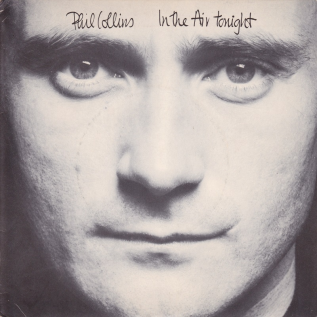
Everyone knows the story. Phil Collins saw a man let another man drown, tracked him down years later, mailed him a concert ticket, and sang this song straight at him under a spotlight until he confessed or fled. It is one of the most retold origin stories in music history, and every single version of it is false. The man who wrote "In the Air Tonight" has spent more than forty years saying the same thing: there was no drowning, and he is not even sure what the song is about.
"In the Air Tonight" was written by Phil Collins in 1980 out of the anger of his divorce from his first wife, Andrea Bertorelli. He built it from a Roland CR-78 drum machine pattern and improvised the lyrics in a single take. The famous drowning story is an urban legend Collins has repeatedly denied. Released in January 1981, it reached number two in the UK and number nineteen in the US.
The song that fell out in one take
Collins wrote it in the wreckage of his first marriage, and the writing was almost involuntary. Home from tour with the house empty, he sent for his drum machine. "I had to start writing some of this music that was inside me," he told Mix magazine. "In the Air Tonight" started as a pattern lifted off a Roland CR-78, with Collins programming a bass drum part and adding a Fender electric piano.
The words were not written so much as caught. "I was just fooling around. I got these chords that I liked, so I turned the mic on and started singing," Collins told an interviewer, in an account preserved on Wikipedia. "The lyrics you hear are what I wrote spontaneously. That frightens me a bit, but I'm quite proud of the fact that I sang 99.9 percent of those lyrics spontaneously." He put it even more plainly to Mix: "The lyrics you hear for 'In the Air Tonight,' I just sang. I opened my mouth and they came out."
The drum sound that ate the decade
The other thing everybody knows about this song arrives at the 3:40 mark: the drum fill that turned a slow, brooding track into an explosion. It leans on a studio effect called gated reverb, which engineer Hugh Padgham had discovered during 1979 sessions for Peter Gabriel's third album, sessions Collins played on. Collins bonded with Padgham and brought him in to produce Face Value, and the sound became a fingerprint of the entire decade.
The fill itself was not engineered for drama. "I didn't think about the drum fill, I just did it that particular take and that's the one we used," Collins told Uncut. "We didn't sit there thinking, 'Oh boy, their mouths are going to be dropping when they hear this!' It was nothing like that." The most famous drum moment of the 80s was a first instinct that happened to get kept.

The story that never happened
The lyrics are vague and menacing, full of lines like "if you told me you were drowning I would not lend a hand," and the vagueness became a vacuum that the public filled with a horror story. In the legend, Collins witnesses a drowning that a bystander could have prevented, then exposes the guilty man from the stage. Over the years the tale mutated to include rape, murder, a hired detective, an anonymous front-row ticket, and an arrest mid-concert.
Collins has denied all of it, consistently, for decades. In a BBC World Service interview he laid it out flat: "I don't know what this song is about. When I was writing this I was going through a divorce. And the only thing I can say about it is that it's obviously in anger." The drowning question came up so often it amused him. People would ask, he said, "Did you really see someone drowning?" and his answer never changed: "No, wrong." As he put it, "this is one song out of all the songs probably that I've ever written that I really don't know what it's about." The drowning line is a metaphor for the bitterness of a marriage ending, nothing more.
What "In the Air Tonight" did
Here is the fact that surprises people: it was never a number one. Released on January 9, 1981, as the lead single from Face Value, it reached number two on the UK Singles Chart. In the United States it was the second single, after "I Missed Again," and it peaked at number nineteen on the Billboard Hot 100, though it climbed to number two on the Rock Tracks chart and went gold. It topped the charts in Austria, Sweden, Switzerland, and West Germany.
Chart position never captured its reach. The Stuart Orme video, an extreme close-up of Collins's face fading in from the Face Value cover, was in heavy rotation when MTV launched in August 1981. Collins played the song at both the London and Philadelphia stages of Live Aid in 1985. In 2007 a Cadbury advert of a gorilla drumming along to the fill sent the song back into the UK top 20, more than a quarter century after its release.
How the telling has grown over the decades
Most origin stories drift because the artist's memory softens. This one is the opposite. Collins's account has barely moved in forty years, while the public's version grew wilder every year. The Snopes fact-checkers logged variant after variant through the 1990s, one reader insisting in 1993 that it was "true," others adding a raped wife, a summer camp, a capsized boat, a private detective. In 2000, Eminem cemented the myth for a new generation in "Stan," rapping about "that guy who coulda saved that other guy from drownin'."
Through all of it, Collins said the same three things: it came out of his divorce, the lyrics were improvised, and there was no drowning. As Snopes concluded, "As Phil Collins has explained numerous times over the years," the song "deals with his bitterness and frustration over the end of his marriage to his first wife, and the lyrics do not reference any specific real-life event." The one small discrepancy in the record is not about the drowning at all. Collins has said he offered the song to Genesis and was told it was too simple; his bandmate Tony Banks has said Collins never played it to them. On the drowning, there was never any drift, only denial.
The honest bottom line
Strip the legend away and "In the Air Tonight" is a divorced man alone in a house, pointing a drum machine at his own anger and singing whatever came out, with no plan, no plot, and by his own admission no clear idea what he meant. It did not top the American chart. It has no true crime behind it. The story people tell about it is more dramatic than anything that happened, which is the whole lesson: a song this open pulls listeners into finishing it themselves, and forty years of denials have never been as satisfying as the myth. The myth is wrong. The song is better for having none. Five years later Collins would help Genesis top the American chart with Invisible Touch, a song that needed no myth at all, just a hook and a handclap, and the contrast says everything about the two halves of his career.
FAQ
Is the drowning story behind "In the Air Tonight" true? No. Phil Collins has denied it for decades. There was no drowning, no witnessed murder, no man exposed from the stage. Collins wrote the song out of the anger of his divorce, and the drowning line is a metaphor.
What is "In the Air Tonight" actually about? The end of Collins's first marriage. He has said it is "obviously in anger," about the bitter side of a separation, and that he improvised the lyrics without fully knowing what they meant.
Did Phil Collins really write the lyrics in one take? Essentially, yes. He has said he turned the microphone on and sang, keeping what came out. "I opened my mouth and they came out," he told Mix magazine, adding that he sang "99.9 percent of those lyrics spontaneously."
Why is the drum fill in "In the Air Tonight" so famous? It uses gated reverb, a sound engineer Hugh Padgham discovered in 1979, which gives the drums a huge, cut-off punch. Collins has said he did the fill in the take they used without planning it for effect.
Was "In the Air Tonight" a number one hit? No. It reached number two in the UK and number nineteen on the US Billboard Hot 100. It was number one in several European countries and became far more iconic than its chart peak suggests.
Did Eminem reference "In the Air Tonight"? Yes. His 2000 song "Stan" repeats the drowning urban legend, which helped keep the false story alive for a new generation.
Sources
- Wikipedia, "In the Air Tonight," quoting Phil Collins's BBC World Service interview, a 2016 interview, and Mix magazine, plus release, chart, and gated-reverb facts (citing Billboard and the Official Charts Company)
- Songfacts, "In The Air Tonight" song page, quoting Collins via Mix magazine and Uncut, and detailing the urban legend and the Hugh Padgham gated-reverb discovery
- Snopes, "In the Air Tonight" fact check, documenting the urban legend's variants and Collins's repeated denials
- Billboard Hot 100 and UK Official Charts, 1981 (US number nineteen, UK number two)
We have been waiting for this telling all our lives, checked and all.
Part of Stories Behind the Songs. See also The Story Behind Africa by Toto and The Story Behind Eye of the Tiger.