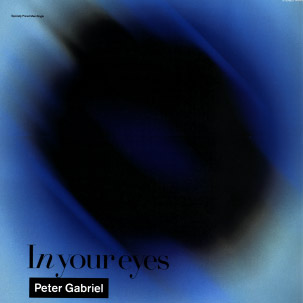
It took six reels of tape to assemble. Its verse is a transplant from a completely different song, one about a half finished cathedral in Barcelona. And the reason most of America knows it at all is a phone call in which Peter Gabriel turned the song down for a movie he had never seen, because someone had sent him the wrong film.
"In Your Eyes" was written by Peter Gabriel for his 1986 album So, produced by Gabriel with Daniel Lanois. The song was rebuilt repeatedly during the sessions, needed six reels of tape to piece together, and had its original groove verse thrown out and replaced with the vocal melody and chords of an abandoned song called "Sagrada." Youssou N'Dour improvised the Wolof vocal at the end. It peaked at number 26 on the Billboard Hot 100 on 25 October 1986.
A love song aimed at two things at once
Gabriel has been consistent about what the lyric is doing, and he said it plainly to Armando Gallo in 1986: "there is a tradition in Africa that intrigued me; that of writing love songs so they can be heard as love God or the love between men and women. None seems to do that in Western lyrics so I thought I would try mixing images. The eyes are clearly a focus point for the soul."
Daniel Lanois, who produced So with him, has told the same idea from the other chair. Asked about the song by Songfacts in a 2021 interview with Greg Prato, Lanois said: "'In Your Eyes,' Peter had this idea that by looking into someone's eyes, you would see, quite specifically in the lyric, the doorway to a thousand churches." He added his own reading of it: "Yeah, you can stand in a church and it might have a gilded ceiling and statues, but you might speak to God by looking at someone's eyes who loves you, or you love them. I think it's as simple as that, the power of commitment and care and love will be stronger."
The verse came out of a song about a cathedral
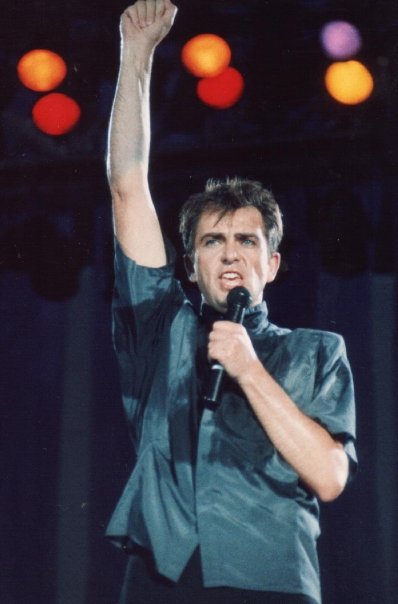
The version everybody knows is a repair job. Wikipedia's account of the sessions, drawing on Gallo's 1986 book and Durrell Bowman's 2016 study of Gabriel's work, describes a song restructured several times and requiring six reels of tape to piece together. The original verse was, in Gabriel's description, "groove-based." He decided it was not working and cut it.
What replaced it came from a song he had already given up on. "Sagrada" was written after a trip to Barcelona, built around the Sagrada Familia and the endless construction of the Winchester Mystery House in California. Gabriel played it live a few times, never finished it, and dropped it from So early on. Its vocal melody and chord changes were then moved into "In Your Eyes."
He was also protective of the track while it was in progress. The same account records that Gabriel refused to play "In Your Eyes" for any record company executive until he had made it more experimental.
The drums, the beatbox and the dance
Everything on So started mechanical. Lanois told Songfacts: "Everything on that record was cut to a beatbox initially, as was the case with 'In Your Eyes.'" He credits the feel to the drummer who replaced the machine: "And Manu Katche from Paris, a great drummer, played that beautiful drum part. So that 'down push,' it's an old carnival beat, it keeps it motoring along. Even though it's quite a contemplative song, it has a little bit of carnival in its engine that keeps the zip in the step going and keeps you interested in the lyrics."
Katché was new to Gabriel's world at the time, and this was one of the first songs they worked on together. When he could not find the feel, Gabriel got up and danced next to the kit to show him. Katché's account of that moment, quoted in Wikipedia's summary of his interviews, is about trust rather than rhythm: "He was awkward, because he couldn't really dance. But if Peter, who didn't know me very well, because it was only the third or fourth day in the studio, tried to help me like that, then there was a message there. With that dance, that was [what] he wanted me to feel."
Two drummers ended up on the record, Katché and Jerry Marotta, with Katché also overdubbing talking drum and percussion.
The guitar credit has quietly moved as well. The So liner notes credit all guitars to David Rhodes. Wikipedia's account cites Daniel Lanois saying in a 2023 interview with Rick Beato that it was actually Lanois playing the acoustic twelve string on the chorus, on an instrument he did not think much of, calling it "not a very nice instrument." In a 2026 interview cited in the same article, Rhodes says he played the twelve string parts on an old Shergold: "it was a dog to play, but it had a nice sound."
Rhodes has never minded being buried in the mix. Asked by Guitar Player whether it bothered him that his twelve string sat under the synthesizers, he answered: "I think that's fine. Often, I prefer that. I think sometimes it can be unnecessary to have a lot of definition between instruments. All the instruments should blend to make the song work, to build the atmosphere. The fact that you can't hear your part, a particular sound, shouldn't worry you at all."
Youssou N'Dour, several hours late
The voice that closes the record was not planned as a Wolof part at all. Gabriel invited Youssou N'Dour to his house at Ashcombe, played him a demo, and expected him to sing in English. N'Dour translated lines into Wolof and improvised instead.
Jenny Cathcart, the BBC researcher who was interpreting that day, described the room afterwards: "everybody was incredibly uplifted that afternoon. Youssou didn't even know he was going to do this; it was as if it was meant to be."
Jerry Marotta's memory of the actual session is less mystical. In the account collected on Ethan Hein's blog and summarised by Wikipedia, N'Dour turned up several hours late and cut the vocal in thirty minutes.
The phone call that nearly killed it
Three years after the record came out, a first time director went looking for a song for a scene he had already shot twice and hated both times.
Cameron Crowe wrote the boombox scene in Say Anything for a different record entirely. "I wrote that scene for Billy Idol's 'To Be a Lover,' if you can believe it," he has said. "There was one day I liked that song, and that was the day I wrote the scene. By the next day, I knew it was a hideously wrong choice."
John Cusack did not want to hold the boombox up at all. "John felt that Lloyd was kowtowing too much by holding up the boombox, and that it was too subservient a move," Crowe said in a 2002 interview. "He wanted to be more laid-back." Cusack's counterproposal, in his own words: "I wanted to just have the boombox be on top of the car and him sitting on the roof." That version was shot and did not work. To get Cusack to try it as written, Crowe told him the boombox would be playing Fishbone, a band Cusack loved.
The song that finally fit came off a cassette in Crowe's car, left over from his 1986 wedding to Nancy Wilson of Heart. "I hear Peter Gabriel singing about driving in his car, thinking of this girl, and I'm like, 'Wait a minute!' I ran into the editing room, we played the song to the scene, and it was perfect."
Then Gabriel said no. Crowe's account of the call: "I was given a day to call him at his studio. And he got on and there was this kind of you know, ethereal voice, Peter Gabriel, really nice, and he said, 'I appreciate you asking for the song. It's a very personal song to me and I just hope you don't mind that I have to turn you down.'"
Crowe pushed for a reason. "I pulled the phone back up and I go, 'Why? I got to ask you why. Why can't we have the song? Why was it wrong?'" Gabriel's answer made no sense: "Well, when he takes the overdose, it just didn't feel like the right kind of use of the song."
There is no overdose in Say Anything. Gabriel had been watching Wired, the John Belushi biopic, which had also been asking to license "In Your Eyes." When Crowe explained that his film was a high school romance, Gabriel's reply was the sound of a mix-up unravelling: "Oh, the high school movie. We haven't watched that yet." He watched the right film and cleared the song.
What the charts did, twice
The Billboard Hot 100 tables show "In Your Eyes" debuting at number 86 on 30 August 1986 and reaching its peak of number 26 on the chart dated 25 October 1986. It held at 26 the following week and fell to 36 on 8 November. It performed far better on rock radio, reaching number one on Billboard's rock chart in September 1986.
Then the film brought it back. Three years later, in its twenty second week on the Hot 100 across both runs, the reissued single climbed to number 41 on the chart dated 8 July 1989, a placing it never held in the 80s until a movie put it there.
Gabriel has been wry about what that scene did to a song he wrote about God and love. He told Rolling Stone in 2012: "It definitely gave [the song] a second life, because now it's so often parodied in comedy shows and it is one of the modern day Romeo and Juliet balcony cliches. I've talked to John Cusack about that. We're sort of trapped together in a minuscule moment of contemporary culture."
In October 2012, playing the first bars of the song at the Hollywood Bowl, Gabriel watched Cusack walk on stage, hand him a boombox, bow, and walk off.
How the telling has grown over the decades
The song has two separate origin stories that grew in parallel: how it was built, and how it became a cultural artifact. The makers control the first one. The second one has been told mostly by the director who took it.
1986, Armando Gallo. Gabriel explains the double meaning of the lyric, the African tradition of writing love songs that point at God and at a person at the same time. This is the earliest telling and it has not changed since.
1987 onward, the drummers and the players. Manu Katché's account of Gabriel dancing beside the kit, and Marotta's blunter memory of N'Dour arriving hours late and finishing in half an hour, come from drumming press interviews rather than from Gabriel. The mystical version and the workmanlike version of the same afternoon sit side by side, and both are true.
2009 and after, Cameron Crowe. The Wired mix-up story enters circulation through Crowe telling it repeatedly, from a 2009 Entertainment Weekly anniversary piece onward. The versions differ in one detail worth naming: Songfacts's account of the licensing says Gabriel initially refused because the song was too personal, then approved after seeing a tape, with no wrong film in it at all. Crowe's own telling has both the personal refusal and the overdose confusion, in that order. The sums differ too, with Songfacts putting the licence at about $200,000 and Mental Floss reporting a range of $200,000 to $300,000.
2012, Rolling Stone. Gabriel, at the 25th anniversary of So, gives the boombox scene his blessing and his sigh in one sentence, being trapped in a minuscule moment of contemporary culture with John Cusack.
2021 to 2026, the production credits. Lanois says he played the acoustic twelve string on the chorus. The album's liner notes credit every guitar to David Rhodes, and Rhodes in 2026 describes playing the twelve string parts on an old Shergold. Forty years on, a record this carefully documented still has an instrument two people remember playing.
The honest bottom line
"In Your Eyes" is a patched record. Its verse belongs to a song about a cathedral that was never finished, it was cut apart and reassembled across six reels of tape, its most famous vocal came from a guest who was hours late and improvised in a language nobody else in the room spoke, and its author would not play it to his own label until he had made it stranger. It was a modest chart single that only reached the mass audience because a director found it on his wedding tape and then fought a mix-up with a Belushi biopic to use it. None of that is how a classic is supposed to happen, and the reason it works anyway is that the two things Gabriel was aiming the lyric at, a person and God, land in the same line whichever one you happen to be thinking about. On the same album, Sledgehammer had already given Gabriel his first number one by doing the opposite, borrowing a soul groove and a truckload of innuendo to prove he could have fun; this was the song that proved the fun was not all he had.
FAQ
What is "In Your Eyes" by Peter Gabriel about? Two things at once, by design. Gabriel told Armando Gallo in 1986 that he was borrowing an African tradition of writing love songs that can be heard as being about God or about love between people, and that "The eyes are clearly a focus point for the soul."
Who sings the part at the end of "In Your Eyes"? Youssou N'Dour, the Senegalese singer. Gabriel played him a demo at his house expecting an English vocal. N'Dour translated lines into his own language, Wolof, and improvised his part.
Was "In Your Eyes" written for Say Anything? No. It was released on the album So in 1986, three years before the film. Cameron Crowe found it on a cassette from his own 1986 wedding while looking for a replacement song for a scene he had already shot.
Why did Peter Gabriel almost refuse to let Say Anything use the song? He had been sent the wrong film. Gabriel told Crowe the song did not fit because of "the overdose" in the movie, which does not exist in Say Anything. He had watched Wired, the John Belushi biopic, which had also asked to license the song. After Crowe explained, Gabriel watched the correct film and approved it.
How high did "In Your Eyes" reach on the charts? Number 26 on the Billboard Hot 100, on the chart dated 25 October 1986. It was much bigger on rock radio, hitting number one on Billboard's rock chart in September 1986. After Say Anything, the reissued single reached number 41 on the chart dated 8 July 1989.
What is "Sagrada" and what does it have to do with "In Your Eyes"? "Sagrada" was a separate Gabriel song inspired by the Sagrada Familia in Barcelona and the Winchester Mystery House in California. He left it unfinished and cut it from So, then moved its vocal melody and chord changes into "In Your Eyes" to replace a groove based verse he had discarded.
Sources
- Wikipedia, "In Your Eyes (Peter Gabriel song)", Background, Recording and Say Anything sections, drawing on Armando Gallo's 1986 Peter Gabriel, Durrell Bowman's Experiencing Peter Gabriel (2016), Modern Drummer interviews with Manu Katche, Guitar Player's David Rhodes interview, and Daniel Lanois's 2023 Rick Beato interview
- Songfacts, "Daniel Lanois: Songwriter Interviews", Greg Prato, 9 April 2021
- Songfacts, "In Your Eyes by Peter Gabriel", including the David Sancious and Daniel Lanois interview quotes and the licensing account
- Ultimate Classic Rock, "Why 'Say Anything''s Boombox Scene Almost Never Happened", quoting Cameron Crowe, John Cusack and Ione Skye
- Mental Floss, "Why the Boombox Scene in Say Anything Almost Didn't Happen", 6 April 2017
- Rolling Stone Q&A with Peter Gabriel on the 25th anniversary of So, 2012, as quoted by Songfacts and Wikipedia
- Billboard Hot 100 weekly charts, 1 and 8 November 1986, and 1, 8 and 15 July 1989
Boombox held high, facts held higher.
Part of Stories Behind the Songs. See also Don't You Want Me and Blue Monday.