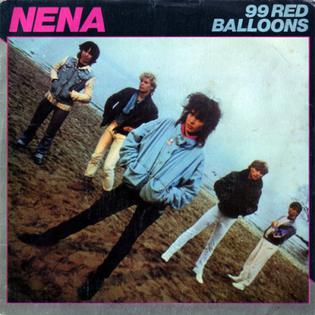
A guitarist stood in a West Berlin amphitheater in 1982, watched the Rolling Stones release a cloud of balloons over the crowd, and imagined the end of the world. A synthesizer player showed up to rehearsal with a funk bass riff and a melody stuck in his head, and the two ideas turned out to fit each other exactly. The song they built had no chorus, a record label that begged them not to release it, and lyrics about accidental nuclear armageddon. It went to number one in Germany, number one in Britain, and number two in America, sung in a language most of its listeners could not understand.
"99 Luftballons" was written by Nena's guitarist Carlo Karges (lyrics) and keyboardist Uwe Fahrenkrog-Petersen (music) in autumn 1982. The idea came to Karges at a 1982 Rolling Stones concert in West Berlin, watching released balloons drift toward the Wall and imagining them mistaken for a nuclear attack. The German original reached number 2 on the US Billboard Hot 100 in 1984, and the English "99 Red Balloons" hit number 1 in the UK.
The balloons over the Waldbühne
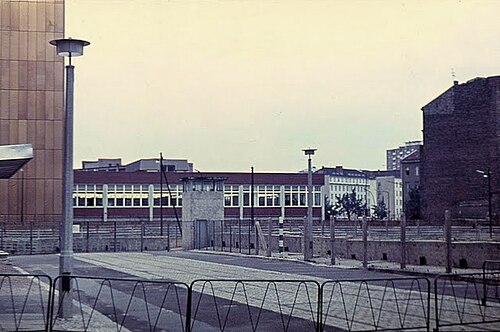
The origin is a real night that two surviving band members were both present for. In the summer of 1982, Nena went to see the Rolling Stones at West Berlin's Waldbühne amphitheater, and her bandmates were there too. As the Stones closed, they released a huge quantity of helium balloons into the sky, where the wind pushed them toward the divided city's eastern half. To guitarist Carlo Karges, that cloud of balloons looked like something else entirely.
Uwe Fahrenkrog-Petersen, who wrote the music and was at the concert, has laid out Karges's chain of thought in his own account of the song. "Within minutes, Carlo realised, those balloons would be detected by Soviet radar in one of the Russian missile platforms stationed around Berlin," Fahrenkrog-Petersen wrote. "Would Russian radar control be smart enough to spot the difference between a bunch of harmless balloons and a swarm of short-range nuclear missiles? Or would they press the red button, launch a counter attack and accidentally bring about worldwide nuclear annihilation?" That paranoid what-if became the whole song.
The riff and the words that already fit
The music came from a different place and nearly did not connect to the lyric at all. Fahrenkrog-Petersen was 22, living in a city he knew sat in the crosshairs of the Cold War. "Inspired by Stevie Wonder, I composed a Unisono synth bass riff, with a hard funky sound that really appealed to me," he wrote. "The question was: how to make it work in a German New Wave pop song?" A few days later he arrived at rehearsal with a melody he could not shake and recorded it onto a cassette so he would not lose it. Bassist Jürgen Dehmel urged him to try the funk riff and the punk-pop tune together. "The switch from halftime funk to fast punk pop was way out of the ordinary, but he seemed to think it would work," Fahrenkrog-Petersen wrote. "Sure enough, the combination had a magic that we felt at once."
Then Karges walked in. "He listened for a while, fascinated, then started rummaging around in the black ring binder in which he scribbled his lyrics," Fahrenkrog-Petersen recalled. "With a mischievous smile he told us that some words he had written a few weeks before would fit my tune exactly!" The Stones-concert lyric and the Stevie Wonder riff, written independently, locked together on the first try. There was only one snag. "His text was too long! He had written six whole verses! We cut one verse with a heavy heart," Fahrenkrog-Petersen wrote.
Nena reads it for the first time
Nena remembers the handoff from the singer's side, and she was at the concert with Karges when the idea was born. "The lyrics came first," she told MusicRadar in 2025. "That same night, he wrote the lyrics by hand and gave me the sheet the next day at rehearsal, grinning as he said, 'Read this.' I read aloud: 'Hast du etwas Zeit für mich, dann singe ich ein Lied für dich, von 99 Luftballons auf ihrem Weg zum Horizont.' I was instantly moved, and at that moment, I somehow knew this was going to be something big. We both did."
She describes the writing itself as something closer to reception than construction. "That song wanted to be written! You don't plan something like that," Nena told MusicRadar. "You experience something that deeply inspires you. It's like a vision or an inner calling. You sit down, and words simply flow through you, and within minutes, a fully formed text appears on the page. Carlo completely surrendered to that inspiration and created the perfect words."
The song with no chorus
By the time the band wanted "99 Luftballons" as a single, the label balked, and the reason was structural. The song does not have a conventional chorus. It rides a rising and falling, nursery-rhyme melody through verse after verse without the hook a pop single is supposed to have. Nena still finds the objection funny. "For us as a band, 99 Luftballons was clearly meant to be our third single. However, our record label panicked when we made that decision," she told MusicRadar. "Their main argument was that the song didn't have a chorus and therefore wasn't commercial enough! To this day, I still laugh out loud when I tell that story. Thank God we stuck to our decision. The label couldn't stop us. Shortly after, 99 Luftballons earned gold records all over the world, and even now, wherever I perform, people sing every word of it, even though, as you know, it has no chorus!"
The German version beat the English one
America made the strangest choice of all: it fell for a song in German. A DJ at KROQ in Los Angeles started playing the original, and US radio largely stuck with the German version rather than the English "99 Red Balloons." The German original climbed to number 2 on the Billboard Hot 100 in the week of March 3, 1984, held off the top by Van Halen's "Jump." In Britain, the English rewrite went the other way, hitting number one for three weeks.
The band never warmed to that English version. "From the outset, Nena, the lead singer, and other members of the band expressed mild disapproval of the English version," and Fahrenkrog-Petersen said flatly in March 1984, as quoted by Wikipedia, "We made a mistake there. I think the song loses something in translation and even sounds silly." The English "99 Red Balloons" swaps in a reference to Captain Kirk and loosens the meaning, and the band felt it turned their nuclear parable into something more blatant than they wanted.
How the telling has grown over the decades
The person who saw the balloons and wrote the words, Carlo Karges, died in 2002, so the story now lives in the memories of the two bandmates who were standing beside him. That is not a weakness in the telling; it is why the two accounts are worth comparing. Fahrenkrog-Petersen's version, told on the record over the years, is a maker's technical memoir: the Stevie Wonder riff, the cassette demo, Dehmel's encouragement, the six verses cut to five. Nena's version, told most recently to MusicRadar in 2025, is about feeling: the handwritten sheet, the grin, the instant certainty that it was big.
The drift is in the balloons themselves. Some tellings, including Songfacts, describe Karges watching a single balloon drift over the Wall and imagining that one blip on a radar screen. Fahrenkrog-Petersen and Nena describe a whole released mass, a swarm that could be mistaken for an incoming fleet. The song split the difference and settled on 99. What none of the accounts dispute is the core: a peace-scare born from a rock concert, a lyric and a riff written apart and married by accident, and a hit that broke every rule a label could name.
The honest bottom line
Strip away the myth and "99 Luftballons" should not have worked. It has no chorus, its lyric is a grim Cold War fable, and its biggest American success came in a language most of its audience could not follow. The band even disowned the English version that topped the UK chart. None of that stopped it. Karges turned a balloon drop into a nightmare, Fahrenkrog-Petersen turned a funk riff into new wave, and Nena sang it like she believed every word, because the fear behind it was real to everyone living in Berlin in 1982. It remains the most successful German pop song ever recorded, and people still sing all of it, chorus or no chorus.
FAQ
What is "99 Luftballons" about? It is a Cold War parable. In the lyric, 99 balloons are released and mistaken for a threat on military radar, triggering a chain of overreactions that ends in a pointless nuclear war and a devastated, victorless world. It was inspired by real balloons released at a 1982 Rolling Stones concert in West Berlin.
Who wrote "99 Luftballons"? Guitarist Carlo Karges wrote the German lyrics and keyboardist Uwe Fahrenkrog-Petersen wrote the music, both members of the band Nena. The idea came from Karges at the Stones concert; the music grew from a funk-inspired synth riff Fahrenkrog-Petersen brought to rehearsal.
Is "99 Luftballons" a real story? The inspiration is real. Members of the band, including singer Nena, attended a 1982 Rolling Stones concert in West Berlin where a mass of balloons was released. Karges imagined those balloons being mistaken for an attack, and wrote the lyric that night.
Did "99 Luftballons" have a chorus? No. The song has no conventional chorus, which is exactly why the band's record label did not want to release it as a single. Nena has said the label argued it was not commercial enough. It became a worldwide hit anyway.
Why was the German version a hit in America instead of the English one? A KROQ DJ in Los Angeles began playing the original German recording, and US radio embraced it, sending "99 Luftballons" to number 2 on the Billboard Hot 100 in 1984. The English "99 Red Balloons" was the hit in the UK instead, where it reached number one. The band preferred the German original.
Sources
- MusicRadar, "Nena speaks to us about the making of 99 Red Balloons," 18 November 2025
- Uwe Fahrenkrog-Petersen, "The Story of 99 Red Balloons," the composer's own account at uwefahrenkrogpetersen.com
- Songfacts, "99 Luftballons by Nena"
- Wikipedia, "99 Luftballons," including the band's 1984 comments on the English version and chart tables citing Billboard and the Official Charts Company
- Billboard Hot 100, week of March 3, 1984 (99 Luftballons at number 2, behind Van Halen's "Jump")
Ninety-nine facts, all checked, zero fuzz.
Part of Stories Behind the Songs. For the German-versus-English chart split and what the lyric says line by line, see our companion piece on 99 Luftballons. See also I Melt With You and The Safety Dance.