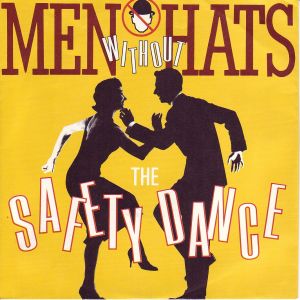
A guy kept getting thrown out of nightclubs for jumping up and down. Not for fighting, not for being drunk, just for pogoing to the wrong records while the disco crowd glared. So he went home and wrote a song telling everyone they could dance if they wanted to. It was not even meant to be a single. Then a remix went out, and the man who could not get past a bouncer ended up with a number three hit and one of the strangest videos MTV ever played, full of maypoles and Morris dancers. Ivan Doroschuk has been explaining The Safety Dance for over forty years, and the real story is exactly as petty and as human as it sounds.
"The Safety Dance" was written by Ivan Doroschuk of Men Without Hats after he was repeatedly ejected from clubs for pogo dancing to new wave records at a time when bouncers were protecting the disco floor. The song is a protest, a call for the freedom to dance how you want. Released in 1982 off the album Rhythm of Youth, it was not even the band's first-choice single, yet it spent four weeks at number 3 on the Billboard Hot 100 in 1983.
The bouncer who started it
The whole thing came from getting kicked out. Doroschuk was a punk-scene kid in Montreal who loved to pogo, the up-and-down thrash that new wave crowds did alone instead of in disco couples, and it kept getting him ejected. "It originated when I was getting kicked out of clubs for pogoing," he told Time Out in 2016, naming the culprits as records like Blondie's "Heart of Glass" and the B-52s' "Rock Lobster." In a Toronto radio interview with Boom 97.3, he pinned it to one night: "The song was really written about me after I got kicked out of a bar in Ottawa. I got kicked out for pogoing to The B-52s, I think, 'Rock Lobster.' It was the dying days of disco. I got kicked out of the bar and went home and wrote this."
His deeper point is that this was a real cultural fight, not a joke. Disco dancing needed partners and space; pogoing was solitary and looked violent to everyone else on the floor, so bouncers treated pogoers as a hazard and threw them out. Doroschuk took it personally and turned it into a manifesto. "Slam dancing and the mosh pit all kind of grew out of pogoing," he told the writer Sam Tweedle in a 2012 interview. "I got thrown out of a lot of clubs because of that. So, that's basically the origin. I was kind of mad that they wouldn't let me dance if I wanted to, so I took matters in my own hands and wrote an anthem for it."
Not the meaning people wanted it to be
Because the lyric spells out S-A-F-E-T-Y and the video ends with a flash of apocalyptic imagery, two theories attached themselves to the song and never let go: that it is about safe sex, and that it is an anti-nuclear protest. Doroschuk has swatted both down himself. On VH1's True Spin in 2003 he called the safe-sex reading a case of "people reading into it a bit too much." He was gentler on the nuclear theory, since the video does carry that imagery, but he reframed it. As he put it on the same show, "it wasn't a question of just being anti-nuclear, it was a question of being anti-establishment."
That anti-authority streak is the thing he keeps coming back to. In his telling, Men Without Hats were a punk band at heart who happened to pick up synthesizers, and the song was always about refusing to be told how to behave. "I was telling people it's OK, you can slam dance if you want to," he said on True Spin. The bright, chanted chorus about ditching the friends who will not dance is not really about dancing at all. It is about not letting anyone stand at a door and decide what you are allowed to do with your own body.
The single nobody bet on
Here is the part that undercuts the myth of the sure-thing hit. Nobody in the band thought "The Safety Dance" was the one. "We didn't even release it as the first single," Doroschuk told Time Out. "We thought 'I Got the Message' was going to be the big hit. We released that in Canada, and nothing happened. We released 'Safety Dance', and nothing happened. And we went back into the studio and started recording the next record." He said the same thing about his own instincts to American Songwriter: "I didn't pick that one out in particular. It wasn't our first choice off the record. 'I Got The Message' was the first single, which, for me, was a lot more catchy, a lot more poppy. But that just goes to show, you never know."
What changed everything was a format. Twelve-inch dance remixes were the new currency, so the band cut one almost as an afterthought. "At one point we had to do a 12-inch dance remix of 'Safety Dance', because that was the new thing," Doroschuk told Time Out. "So we did this remix, sent it off, and that's when everything hit the fan. It went to the top of the Billboard charts." He was halfway through recording the second album when the call came and the band had to get back on a bus and tour America for a year.
What it actually did on the charts
The chart record comes from the Billboard tables, not the interviews. "The Safety Dance" was released in Canada in 1982 as the second single from Rhythm of Youth and only reached number 11 there. It became a far bigger hit in the United States, where it entered the chart in late June 1983 and climbed to number 3 on the Billboard Hot 100, holding that spot for four weeks across September and October 1983. It went all the way to number 1 on Billboard's Dance Club Play chart. In Britain it reached number 6, and in New Zealand number 2. So the correction is worth making: this is a genuine top-three American smash, not a mere cult record, which is part of why an all-80s stream from the Bubble leans on songs exactly like it.
A video by letter, and by accident
The video is the second half of why anyone remembers the song, and it exists partly by coincidence. It was directed by Tim Pope, the same Englishman who made the Cure's clips, and filmed over two rainy days in the village of West Kington in Wiltshire, near Bath, with real Morris dancers, a maypole, and a jester played by actor Mike Edmonds. Doroschuk is the only band member in it. The medieval, Pied Piper look was not a compromise between two visions. It was the same vision arrived at twice. "Our letters crossed paths over the ocean, and we both got each other's script for the video at the same time and they were both this Pied Piper theme," Doroschuk told Time Out. "We both had the same idea!"
The result baffled everyone, which Doroschuk counts as the point. "I think people were expecting a real new wave, techno-looking band and they got Peter Pan instead," he told Songfacts. "It created quite a stir in the new wave community." A country expecting zippers and pointy shoes and neon got a long-haired man leading a folk pageant, and MTV, which had only a handful of videos to rotate in 1983, played it constantly.
How the telling has grown over the decades
Doroschuk has told this story consistently for a long time, and the interesting drift is in the small details rather than the meaning. The core never changes: he was thrown out of clubs for pogoing, got angry, and wrote an anthem about the right to dance. But the specifics shift from interview to interview. Sometimes it is one bar in Ottawa and one song, "Rock Lobster." Sometimes, as in the Time Out telling, it is a string of clubs and a couple of records including Blondie. On VH1's True Spin in 2003 he spent his time knocking down the safe-sex and nuclear theories rather than recounting the incident. By the 2012 Sam Tweedle interview he was framing it as punk history, connecting pogoing to the birth of the mosh pit. What stays fixed is the emotion. He was mad that someone would not let him dance, and he did something about it.
It is worth being honest that a specific origin story told over four decades sands down and reshapes at the edges. The exact club, the exact song on the turntable, whether it was one night or many: those wobble. Doroschuk is not hiding this, and it does not weaken the song. If anything it fits it. The whole point of "The Safety Dance" is that the rule you got thrown out over was arbitrary in the first place.
The honest bottom line
Strip the campy video away and "The Safety Dance" is a grudge. A young man got humiliated by a bouncer, went home sulking, and wrote a revenge anthem that he did not even rate highly enough to release first. It only became a hit because dance remixes were fashionable, and it became immortal because of a folk-pageant video that had nothing to do with the lyric. None of that cheapens it. The song survived because the feeling underneath it is one everybody has had: being told to stop, by someone with no real authority, for no real reason. Doroschuk turned that into three minutes you can chant along to, and he has spent his life happily explaining that yes, it really was just about dancing.
FAQ
What is "The Safety Dance" about? The freedom to dance how you want. Ivan Doroschuk wrote it after being repeatedly kicked out of clubs for pogo dancing to new wave records, at a time when bouncers were protecting disco dancers from the newer, wilder style. It is a protest against arbitrary rules, which Doroschuk has called "anti-establishment."
Who wrote "The Safety Dance"? Ivan Doroschuk, the lead singer of Men Without Hats, is the sole credited songwriter. He has said he wrote it at home shortly after being thrown out of a club.
Is "The Safety Dance" about safe sex or nuclear war? No. Doroschuk has personally rejected both readings. He called the safe-sex interpretation "people reading into it a bit too much," and said the nuclear imagery in the video was really about being "anti-establishment," not specifically anti-nuclear.
Did "The Safety Dance" reach number one? Not on the main US chart. It spent four weeks at number 3 on the Billboard Hot 100 in 1983 and did reach number 1 on Billboard's Dance Club Play chart. It was actually the band's second single from Rhythm of Youth, after "I Got the Message" flopped.
Where was the "Safety Dance" video filmed? In the village of West Kington in Wiltshire, England, near Bath. It was directed by Tim Pope and features real Morris dancers, a maypole, and a jester played by actor Mike Edmonds. Doroschuk is the only band member who appears in it.
Sources
- Time Out Sydney, "The strange, happy life of the guy who wrote 'Safety Dance'" (Nick Dent), February 4, 2016
- American Songwriter, "The 1982 One-Hit Wonder You Probably Missed Was a Protest Song" (Melanie Davis), April 17, 2026, quoting Doroschuk's 2012 interview with Sam Tweedle and the Edmonton Journal
- Songfacts, "The Safety Dance by Men Without Hats," quoting Doroschuk on VH1's True Spin and on Boom 97.3 Toronto
- VH1, True Spin, 2003, as cited by Wikipedia and Songfacts
- Wikipedia, "The Safety Dance," for songwriting credit, video, and chart history
- Billboard Hot 100 and Dance Club Play weekly charts, 1983
We can verify if we want to, and we always want to.
Part of Stories Behind the Songs. See also I Melt with You and 99 Luftballons.