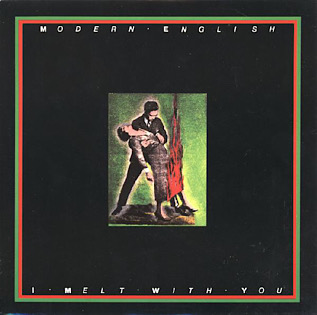
Couples have married to it. People tell the band, to their faces, that they lost their virginity to it. And the whole time, the song they were melting to is about two people making love while the atomic bombs come down. Robbie Grey wrote the words in about three minutes, sitting on the floor of a London flat, and it took years before anyone thought to ask him what they meant. When they finally did, the answer was the end of the world.
"I Melt with You" was written by Robbie Grey and Modern English in 1982 during sessions for their album After the Snow. Grey wrote the lyrics quickly in his London flat, imagining a couple making love as a nuclear bomb falls, with the chorus line "I'll stop the world and melt with you" carrying a deliberate double meaning: bodies melting in the blast, or lovers melting together. Released in August 1982, it never cracked the US top 40, yet became one of the most enduring songs of the decade.
The bleak England that made it
The song came out of a specific mood, and that mood was dread. Grey has described the England he wrote it in as a country running on empty during an economic slump. "There was no money," he said, recalling a place where "you'd be at home with candles" when the power went. Layer his fear of nuclear war over that, and you have the seed of the song. The last thing he wanted was a normal love song. As he put it to the Los Angeles Times in 1997, the track is a "love song," but more about the "good and bad in people," and he was blunt about what he was avoiding: "The last thing we wanted was to write a song where boy meets girl, they go to the cinema and make love, and that's the end of it."
The writing itself was fast and unglamorous. "I'd gone home with some of the music being made for 'I Melt with You,' some of the parts of it, and I wrote the lyrics in about three minutes sitting on the floor stoned in my house in Shepherd's Bush in London," Grey recalled for Jim Beviglia's book Playing Back the '80s. "I just wrote these words down on a scrap of paper really quickly." He even smuggled the band's own history into the first verse: the phrase "mesh and lace" is the title of Modern English's 1981 debut album.
The producer who told him to stop shouting
Modern English were a post-punk band who, by their own admission, could barely play when they started. The thing that turned "I Melt with You" from a noise experiment into a pop record was their producer on After the Snow, Hugh Jones. Grey has been generous about it. "It was only when we did the second album, After the Snow with producer Hugh Jones that we understood: verse/chorus/verse/chorus/middle eight type of thing," he told SPIN in 2024. "He showed us that. He taught us how to craft songs."
Jones also changed how the song is sung, and it happened by accident. Grey was a shouter, standing back from the microphone to force emotion. Jones told him to do the opposite. As Grey described the session to SPIN, "'I Melt With You' was the first vocal I did on the album. I'd been used to shouting," and then, "Hugh said, 'Just talk into the microphone.'" The result is the strange, half-spoken intimacy of the verses. Grey is honest about why it works: "The verses of 'I Melt With You' have almost got a spoken quality. That's because I don't really know what I'm doing. I'm just standing in front of the microphone, talking. That might be a bit of its charm."

Making love as the bomb drops
The meaning is not hidden. It is just so well disguised by the music that nobody looked. The lyric follows a man racing to spend his last minutes on earth with the woman he loves, "the world crashing all around" her face, while he makes "a pilgrimage to save this human's race." The bridge delivers the whole thing in one bitterly ironic line: "The future's open wide." It is not hope. It is a countdown.
Grey has told the concept plainly for years. "I could never write a straightforward love song, I wouldn't be able to do that," he told SPIN. "The idea of it being in a nuclear war, making love as the bomb drops is what the concept was." The chorus is where the trick lives. "I'll stop the world and melt with you" reads two ways at once: a couple physically melting in the heat of a nuclear blast, or melting together the way lovers do. Grey wrote it to hold both meanings and never resolved them.
What amuses him is how completely the darkness slipped past everyone. "It got missed for years until somebody asked me what it was about," he told American Songwriter. "I think everybody just thought it was a straightforward love song. It was almost like a metaphor for that time. Using a relationship and people making love as an example of something good against something so dark in the background."
The hit that was not a hit
Now the part people get wrong, straight from the Billboard tables. "I Melt with You" was never a chart smash. Released as a single on August 9, 1982, it failed to reach the UK singles chart at all. In America it became the band's breakthrough, but a modest one on paper: it peaked at number 7 on Billboard's Mainstream Rock chart in April 1983 and only number 78 on the Hot 100. A 1990 re-recording nudged back onto the Hot 100 at number 76. It never once entered the US top 40, which is why the band is filed under one-hit wonders for a song that technically was not even a hit single.
Grey knows this better than anyone and enjoys correcting the record. "The craziest thing about 'I Melt With You' was, it was never a hit," he told SPIN. "People think it was a hit record, and in the charts, but it never was." What it did instead was refuse to die. It broke in America off imported vinyl. As Grey told the LA Times, "Someone picked up an import from England and started playing it on mainstream radio in America, and it just went like wildfire. We used to play to 200 people in art college; the next thing we knew, we were in Daytona Beach playing to 5,000 people who knew all the words." Its 1983 placement in the teen film Valley Girl, over a falling-in-love montage and again on the end credits, sealed it into the culture. This is exactly the kind of slow-burn import that made 80s radio worth listening to, and an all-80s stream from the Bubble is on the way.
How the telling has grown over the decades
Grey has been telling this story, in pieces, for the better part of thirty years, and the interesting thing is how the emphasis shifts. In the 1997 Los Angeles Times profile, he was still mostly explaining that it was never a simple boy-meets-girl song and marveling at the wildfire success. On the 2003 Valley Girl 20th-anniversary DVD he laid out the bleak, candlelit England behind it. By the 2012 Miami New Times interview he was describing the song's fame as something "literally thrust upon us." The oral history Mad World collected his account in 2014. And in the 2024 SPIN and American Songwriter pieces he gave the fullest version yet: the three-minute writing, the stoned floor in Shepherd's Bush, the nuclear concept stated flatly.
The honest wrinkle is right there in his own words. Grey says the meaning "got missed for years until somebody asked me what it was about," which is a quiet admission that the apocalyptic reading, however real to him when he wrote it, was not something he pushed at the time. The song went out into the world as a love song, got adopted as one, and only later did its author start narrating the mushroom cloud behind it. The details never contradict each other. What changed is that Grey went from letting people melt to telling them exactly what they were melting into.
The honest bottom line
Take the romance away and "I Melt with You" is a doomsday song that got mistaken for a wedding song, written in three minutes by a band that could barely play, sung half-spoken by a man who says he did not really know what he was doing, and it never even reached the top 40. It should not have lasted. It lasted anyway, because a lyric about clinging to one person while everything ends turns out to be exactly as good for a prom as it is for the apocalypse. Grey wrote the darkest possible love song and the world heard only the love. He has made his peace with that, and it pays his bills. Two years later, the Smiths would bury an even bleaker lyric under an even more borrowed sound with How Soon Is Now?, and the two songs together prove that British indie's most lasting trick was hiding something painful inside something the audience could dance to.
FAQ
What is "I Melt with You" really about? A couple making love during a nuclear war. Robbie Grey wrote it imagining two people spending their final moments together as the bombs fall. The chorus line "I'll stop the world and melt with you" means both bodies melting in a blast and lovers melting together.
Who wrote "I Melt with You"? Robbie Grey wrote the lyrics, and the music is credited to all of Modern English: Grey, Gary McDowell, Richard Brown, Michael Conroy, and Stephen Walker. Grey has said he wrote the words in about three minutes in his London flat.
Was "I Melt with You" a number one hit? No. It never reached the US top 40. It peaked at number 7 on Billboard's Mainstream Rock chart in 1983 but only number 78 on the Hot 100, and a 1990 re-recording reached number 76. Grey often points out it "was never a hit."
Why does "I Melt with You" sound like a love song if it is about nuclear war? Because the bright, gliding music hides the meaning. Grey wanted a relationship to stand for "something good against something so dark in the background," so the apocalypse sits underneath a genuinely romantic surface. He says the meaning "got missed for years."
What movie made "I Melt with You" famous? The 1983 teen film Valley Girl, which used the song in a falling-in-love montage and over the end credits. It had already been spreading on American radio via imported vinyl before the film, but Valley Girl cemented it.
Sources
- SPIN, "Modern English's Robbie Grey on 'I Melt With You' and 'Making Love as the Bomb Drops'" (Lily Moayeri), January 19, 2024
- American Songwriter, "The Apocalyptic Meaning Behind 'I Melt with You' by Modern English" (Jim Beviglia), February 2, 2024, quoting his book Playing Back the '80s
- Los Angeles Times, "A One-Hit Legacy" (Sara Scribner), November 13, 1997, as cited by Wikipedia
- Valley Girl 20th anniversary DVD interview with Robbie Grey, MGM Home Entertainment, 2003, as cited by Wikipedia
- Miami New Times, "Modern English's Robbie Grey on 'I Melt With You' Fame" (Arielle Castillo), September 26, 2012, as cited by Wikipedia
- Mad World: An Oral History of New Wave Artists and Songs That Defined the 1980s (Bernstein and Majewski), 2014, as cited by Wikipedia
- Wikipedia, "I Melt with You," for chart history and background
- Billboard Mainstream Rock and Hot 100 weekly charts, 1983 and 1990
The facts never melt around here.
Part of Stories Behind the Songs. See also 99 Luftballons and Don't You Forget About Me.