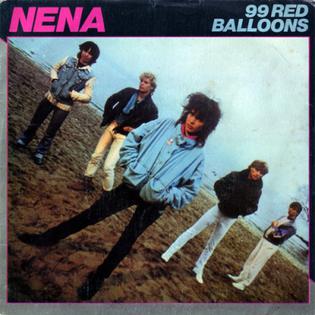
American radio in early 1984 did something it almost never does. It fell in love with a song sung entirely in a language most of its listeners did not speak. You heard that bouncy new-wave beat, that urgent voice counting balloons in German, and you sang along phonetically without knowing you were singing about the end of the world. It climbed all the way to number two, and it did it in German.
"99 Luftballons" was a 1983 song by the West German band Nena, and it reached number two on the US Billboard Hot 100 in March 1984, held off the top only by Van Halen's "Jump." Remarkably, it was the original German-language version that became the American hit. The title translates to "99 air balloons," and the lyric is a Cold War fable in which harmless balloons are mistaken for a threat and trigger 99 years of war.
The song that starts with a Rolling Stones concert
The idea was born at a concert. Nena's guitarist, Carlo Karges, was at a Rolling Stones show in West Berlin in June 1982 and watched a mass of balloons released into the sky. He wondered what would happen if they drifted over the Berlin Wall into East Berlin, and whether the nervous militaries on either side would mistake them for something dangerous. In a divided city at the height of the Cold War, that was not a paranoid thought.
That single image became the whole song. It is a piece of pop built on a real fear that everyone in 1983 carried: that a misunderstanding, not a decision, would start the war nobody wanted.

What the song actually says
The story in the German lyric is grim under the cheerful melody. Ninety-nine balloons float up and get mistaken for UFOs. A general scrambles fighter pilots to investigate. The pilots find nothing but balloons, but they put on a huge show of firepower anyway. That display spooks the countries watching, war ministers see a chance to grab power, and the whole thing spirals into 99 years of war with no winner left to claim it. The last verse ends in a ruined world.
It is an anti-war song disguised as a party record, which is exactly why it worked. You could dance to it and dread it at the same time.
Why the German version won
Here is the twist that trips up almost everyone. Nena recorded an English-language version called "99 Red Balloons" in 1984, but that is not the one America made a hit. It was the original German recording that hit number two on the Hot 100. The English version did not chart in the US at all.
The English rewrite is not a straight translation either. "Luftballons" simply means "air balloons," not "red" ones, and the English lyric leans harder into overt political drama while the German original hinges on a tragic misunderstanding between frightened neighbors. Many listeners assume "99 Red Balloons" is the real song. It is the adaptation. The German one is the original and the bigger American hit.
The honest bottom line
By the American chart, Nena is a one-hit wonder, and the hit is a novelty in the strict sense: a foreign-language single most of its audience could not translate. It should have been a curiosity that faded in a season. Instead it became one of the defining songs of 1984 and one of the sharpest anti-war statements pop ever smuggled onto the radio, precisely because the darkness hides inside something you cannot help bouncing to. A protest song that conquered a country that could not understand the words is not a fluke. It is a small miracle of songwriting. The number one it could not reach was Van Halen's Jump, another 1984 single built on a synth riff its own band resisted, and the fact that a German protest song and a California keyboard hook shared the top two places on the chart that winter says something about how wide the decade's radio lane really was.
FAQ
What is "99 Luftballons" about? It is a Cold War anti-war fable. Ninety-nine balloons are mistaken for a threat, militaries overreact, and the misunderstanding escalates into 99 years of war that leaves the world in ruins. The bright melody hides a very dark story.
What does "99 Luftballons" mean in English? It translates literally to "99 air balloons." The English adaptation was titled "99 Red Balloons," but "red" is not in the German title and was added for the rewrite.
Is "99 Luftballons" the same as "99 Red Balloons"? No. "99 Red Balloons" is a separate English-language version with somewhat different lyrics. It is not a direct translation, and in the US it was the original German version that became the hit.
How high did "99 Luftballons" chart in the US? It reached number two on the Billboard Hot 100 in March 1984, kept out of the top spot only by Van Halen's "Jump."
Who is Nena? Nena is a West German band, also the name of its lead singer. "99 Luftballons" came from their 1983 self-titled album and was their only major US hit.
Where did the idea for the song come from? Guitarist Carlo Karges got the idea at a 1982 Rolling Stones concert in West Berlin, watching released balloons drift toward the Berlin Wall and imagining the militaries mistaking them for a threat.
Part of our guide to 80s One-Hit Wonders. See also Come On Eileen.
Cold-war pop hits different when you lived the decade.