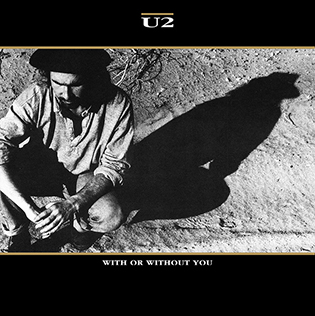
Three quarters of the band wanted it deleted. The producers agreed. Everything they tried to fix it with, playing harder, playing louder, adding electronics, made it worse. The thing that finally saved it was a prototype guitar that had just arrived from Canada, played almost by accident while somebody was testing whether it worked at all.
"With or Without You" started as a chord structure Bono brought to a late 1985 demo, and by the 1986 Joshua Tree sessions the Edge, Adam Clayton and Larry Mullen Jr. had all tired of it. Bono and his friend Gavin Friday rescued the arrangement, and the Edge's part was cut on Michael Brook's prototype Infinite Guitar. Billboard shows it at number one for three weeks from May 16, 1987, U2's first American number one.
The song nobody else wanted
It is the oldest song on The Joshua Tree. The chord structure dates to the tail of The Unforgettable Fire tour, and the band put a demo of it down in late 1985. Then it sat there getting less popular with everyone except the man who wrote it.
By the time the album sessions began in 1986, the Edge, Clayton and Mullen had all decided the song was stuck in a loop, going nowhere. Brian Eno and Daniel Lanois, co-producing, had them attack it: play louder, play harder, add electronic touches. None of it worked, and the band and the producers were close to abandoning the track outright.
Bono was the only holdout, and his reason was not musical. He thought the lyric was the most honest thing he had. His friend Gavin Friday came in on his side, helped rearrange the track in the studio, and argued it could be a hit. Once Friday was convinced, the others started to come around: Eno added keyboards, Clayton found the bass tone, Mullen worked out where the drums should finally arrive.
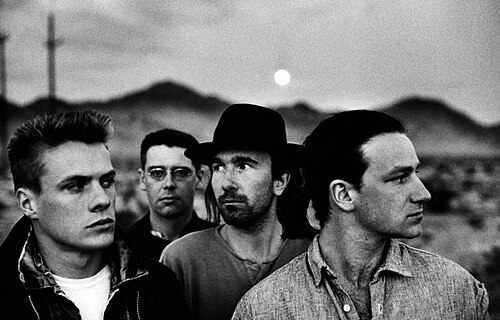
The guitar that had just come out of the box
What turned it from a rescued song into an unmistakable one was a piece of equipment that barely existed yet. The Infinite Guitar was invented by Michael Brook, a Canadian musician the Edge had worked with on the soundtrack to the 1986 film The Captive. Brook built it by replacing a guitar's pickup with a magnetic device that vibrates the strings, so a note can sustain without the player touching it again.
Daniel Lanois gave Songfacts the fullest account of how it got onto the record, and in his telling he is the one holding it first. "We had a little secret weapon. It was called the 'infinite sustain guitar,' invented by my good friend Michael Brook, a Canadian associate," Lanois said. "Michael had invented this instrument where you didn't have to use your right hand on the guitar. You just held a note with your left hand, and he had a little self-looping system built into the instrument. But as you went up higher on the guitar, the infinite sustain just kept going into the stratosphere."
Then the part that matters: nobody was recording a part. They were checking whether the thing worked. "So, that sound that you hear, I was taking the infinite sustain guitar out of the box and plugging it in to see what it did, and it started making that sound. The Edge was really just testing the guitar to see what it could do. He did a take, and I said, 'That sounds pretty good. Can you try another one?' And then we did a second one, and that was it. We did a little 'best of the two performances,' and then it became that signature, high-frequency stratospheric sound on 'With Or Without You.'"
Lanois told Mojo the same story in 2008 in fewer words. "For 'With or Without You' we had the rhythm and the chords then we were testing Michael Brook's Infinite Guitar invention," he said, and then: "I asked Edge just to play a little something with it. He did two takes and those are the ones in the ultimate mix of 'With or Without You.' Beautiful sounds, stratospheric."
Lanois has also described how the track was assembled from the floor up: a rhythm on a Yamaha beatbox first, then the chord sequence, then Clayton's bass, then the Edge with the Infinite Guitar.
What the song is actually about
The popular reading is a doomed romance. Bono's own tellings have consistently pointed somewhere less comfortable: a man divided against himself.
He had been married to Alison Stewart for five years by the time The Joshua Tree came out, and he has described the lyric as "pure torment." The setting was the French Riviera, where he found himself wondering whether domestic life and an artist's life could occupy the same person. "I was at least two people: the person who is so responsible, protective and loyal and the vagrant and idler in me who just wants to run from responsibility," he said in the book U2 by U2. "I thought these tensions were going to destroy me but actually, in truth, it is me. That tension, it turns out, is what makes me as an artist."
To Mojo he was blunter about the state he was in. "I had some difficult emotional stuff going on," he said. "I didn't understand at that point the freedom that I would receive from a committed relationship."
And in 1987, he gave a reading of one line that is not about a marriage at all. Asked about "and you give yourself away," he said everybody in the group knew what it meant: "It's about how I feel in U2 at times - exposed. I'm not going to do many interviews this year. Because there's a cost to my personal life, and a cost to the group as well."
By 2005 he had moved the emphasis again, onto the music rather than the words, calling the wordless refrain the most important part of the song because it releases the tension. That, he said, "is when the 'Aah-aah' comes out. That is what giving yourself away is, musically."
One more piece of context that explains why the lyric feels so unanchored. Bono has said he intended it as part of a trilogy with two other songs that never made the album, and that at the time he did not think it made sense on its own. Listeners filled the gaps in themselves, which is arguably why it works on so many people.
Restraint as the hook
The most striking thing about the record is what it refuses to do. There is no big guitar solo where the arrangement obviously wants one.
Bono told Rolling Stone that this was deliberate, and that he knew early the song was unusual. "It was self-clear early on that this was a little bit special," he said. "The song is all one build to a crescendo. The song breaks open and comes down, and then comes back. Everyone in the room is, 'OK, Edge, let's see if you can let off some fireworks here.'" What the room got instead, in Bono's words, was "psychotic restraint, and that is the thing that rips your heart out, not the chorus."
Bono has also been clear that it did not sound like anything else at the time, including anything else U2 were making. "Looking back on it now, I can see it was so out of step with everything around," he said in the Classic Albums documentary on The Joshua Tree. "It was mad. ... Something like 'With or Without You,' it's a very odd-sounding song ... it kind of whispers its way into the world and this odd guitar part that's played on Edge's Infinite Guitar. It was an unusual sounding record."
Releasing it as the album's first single was therefore a real decision, and the Edge explained the logic to NME: "We really agonized over which single was going to lead, if we were going to release one, and 'With or Without You' became the obvious choice," and the reason was not the obvious one, "not because it's probably the most commercial song on the record but because it's the one that seems to smooth the transition from the last thing to this record, the easiest."
What it did
"With or Without You" entered the Billboard Hot 100 at number 64 on March 21, 1987 and reached number one on May 16, 1987, holding for three weeks through the chart dated May 30 before Kim Wilde's "You Keep Me Hangin' On" took over on June 6. It was U2's first American number one. Billboard credits the song to Bono, The Edge, A. Clayton and L. Mullen Jr., with D. Lanois and B. Eno producing.
Before The Joshua Tree, U2's biggest American hit had been "Pride (In The Name Of Love)," which peaked at 33. The band went from a number 33 ceiling to two consecutive number ones, because "I Still Haven't Found What I'm Looking For" followed this song to the top.
The band played it live for the first time in Tempe, Arizona on April 4, 1987, the second night of The Joshua Tree tour. An all-80s radio stream from the Bubble is coming, and this is one of those records that changed what a hit single was allowed to sound like.
How the telling has grown over the decades
1987, contemporary interviews. Bono explains "you give yourself away" as being about exposure inside U2 rather than inside a marriage, and announces he is withdrawing from interviews because of what fame is costing. The Edge, to NME, explains the strategic reason it was chosen as the lead single.
Rolling Stone and the Classic Albums documentary. The "psychotic restraint" telling, where Bono identifies the absence of a guitar solo as the emotional mechanism of the song, and separately concedes how strange the record sounded at the time.
2005. Bono relocates the meaning into the wordless refrain rather than the lyric.
2006, U2 by U2. The fullest and most personal version: the South of France, the two people he felt himself to be, and the conclusion that the tension is not a problem to solve but the engine of his work.
2008, Mojo (Lanois). The producer's short version of the Infinite Guitar session.
Songfacts interview with Daniel Lanois. The long version of the same session, plus the build order of the track and his own reading of the song: "'With Or Without You' has a lot of 'yearn' in it," and, "What I get from it is you're ready to accept but you're ready to leave something behind, much like life itself."
Where the tellings drift. Two spots. First, who was actually handling the Infinite Guitar when the sound appeared. Lanois puts himself unboxing it and plugging it in to find out what it did, with the Edge testing it rather than performing a part. Ultimate Classic Rock's account has Brook sending the guitar to the Edge, who tried it out. The versions are compatible but the emphasis moves, and it decides whether the most famous guitar texture of 1987 was a guitarist's idea or a producer's curiosity. Second, what ended up in the mix. Lanois told Mojo in 2008 that the Edge did two takes and "those are the ones in the ultimate mix." He told Songfacts that they made a "best of the two performances." One says both takes, one says a composite of both. It is a small thing, and it is exactly the kind of detail that softens twenty years after the session.
What has not drifted. Every account, from every member and both producers, agrees that the band wanted to abandon the song and that Bono would not let them.
The honest bottom line
The most-loved U2 song is one three of the four members were ready to bin, held together by a chord loop they found monotonous, saved by an outsider friend and a piece of prototype gear that happened to be in the room. Its emotional payload is a man who could not decide whether he wanted his marriage or his freedom, dressed vaguely enough that thirty-nine years of listeners have read their own relationships into it, and Bono has admitted it was written as one third of something that never got finished. None of that is a knock. Records that sound inevitable almost never were, and the reason this one still stops a room is the thing the band nearly cut for being too simple. That same year, Crowded House's Neil Finn was writing Don't Dream It's Over in a mood and being told by his own band that it was terrible, another song rescued by stubbornness and a producer who heard what the writers could not.
FAQ
What is the story behind "With or Without You" by U2? Bono wrote the chord structure near the end of The Unforgettable Fire tour and the band demoed it in late 1985. During the 1986 Joshua Tree sessions the Edge, Adam Clayton and Larry Mullen Jr. had grown tired of it and the producers were ready to drop it. Bono and his friend Gavin Friday rearranged it in the studio, and the Edge's part on Michael Brook's prototype Infinite Guitar gave the song its identity.
What is "With or Without You" really about? Bono has described it as being about being two people at once. "I was at least two people: the person who is so responsible, protective and loyal and the vagrant and idler in me who just wants to run from responsibility," he said in U2 by U2, describing the conflict between married life and an artist's life. He has also called the lyric "pure torment."
What is the Infinite Guitar on "With or Without You"? An instrument invented by Michael Brook, made by replacing a guitar's pickup with a magnetic device that vibrates the strings so notes sustain without being replayed. Daniel Lanois described it as a "little secret weapon" and said the sound on the record came from the Edge testing the guitar rather than recording a planned part.
Did U2 almost not release "With or Without You"? The band nearly abandoned the song entirely. Every member except Bono thought it was going nowhere, and the producers agreed, after attempts to fix it by playing louder and harder failed. Bono and Gavin Friday saved it.
When was "With or Without You" number one? It topped the Billboard Hot 100 for three weeks starting May 16, 1987, and held through the chart dated May 30 before Kim Wilde's "You Keep Me Hangin' On" replaced it. It debuted at number 64 on March 21, 1987, and it was U2's first number one in America.
Why is there no guitar solo in "With or Without You"? By choice. Bono told Rolling Stone that when the song breaks open, everyone in the room expected fireworks from the Edge and got the opposite: "psychotic restraint, and that is the thing that rips your heart out, not the chorus."
Sources
- Songfacts interview with Daniel Lanois (Infinite Guitar session, track build order, his reading of the song)
- Songfacts, "With Or Without You by U2" (Bono's 1987 and 2005 comments, the Michael Brook and The Captive background, the intended trilogy, the "pure torment" description, Bono in U2 by U2, Bono to Mojo)
- Ultimate Classic Rock, "How Bono Convinced U2 to Not Throw Away 'With or Without You'," Bryan Wawzenek, updated March 16, 2022 (quoting Lanois to Mojo 2008, Bono to Rolling Stone, Bono in the Classic Albums documentary, the Edge to NME)
- U2 by U2 (Bono on the South of France and the two people he felt himself to be), as quoted by Songfacts
- Billboard Hot 100, weeks of May 16, May 23, May 30 and June 6, 1987 (chart positions, debut date, writer and producer credits)
With or without you, the record decides.
Part of Stories Behind the Songs. See also The Story Behind Sledgehammer and The Story Behind In the Air Tonight.