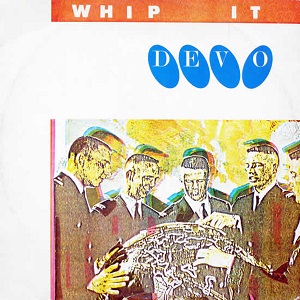
The biggest apparent bondage anthem of MTV's first year is a self-help parody. The lyric was cribbed from the satirical limericks in a Thomas Pynchon novel and written in a single night in a bedroom. And when disc jockeys and fans decided the song was about whips and sadomasochism, the band that wrote it made a video to encourage them, then said nothing for years. Devo has spent four decades explaining that everybody heard "Whip It" exactly wrong, and that they wanted it that way.
"Whip It" was written by Devo's Gerald Casale, who took the lyric from Thomas Pynchon's parodies of all-American self-help writing in Gravity's Rainbow and wrote it in one night. The music was assembled from cassette sketches, with drummer Alan Myers supplying the beat. Released in August 1980 off Freedom of Choice, it peaked at number 14 on the Billboard Hot 100 on November 15, 1980, and it is a parody of motivational cliches, not sadomasochism.
The lyric came out of a Pynchon novel
The words came first, and they came from a book. "'Whip It,' like many Devo songs, had a long gestation, a long process," Casale told Songfacts. "The lyrics were written by me as an imitation of Thomas Pynchon's parodies in his book Gravity's Rainbow. He had parodied limericks and poems of kind of all-American, obsessive, cult of personality ideas like Horatio Alger and 'You're #1, there's nobody else like you' kind of poems that were very funny and very clever." He liked them enough to try one himself. "I'd like to do one like Thomas Pynchon,' so I wrote down 'Whip It' one night."
Casale told the same origin to Consequence in 2020, adding the detail of where he was sitting. "I had been reading Thomas Pynchon's book Gravity's Rainbow, and in it he created all these poems and limericks that were satires of American exceptionalism...I thought, I want to make one of those. I want to make a Tom Pynchon kind of limerick, and I wrote 'Whip It' in one night in my bedroom." The point of the exercise, he told Flavorwire in 2009, was to sound like an inspirational poster and mean the opposite. "For me, 'Whip It' was a parody of the whole Horatio Alger 'You're number one, there's nobody else like you, you can do it' thing." He built it out of dead phrases on purpose. "I was trying to use lyrics that were a bunch of cliches if taken out of context, on purpose."
Casale and Mothersbaugh aim at different targets
Ask the two men who ran Devo what the song is a parody of and you get two answers pointed at slightly different things, which is worth naming rather than smoothing. Casale keeps it general and literary, the Horatio Alger self-made-man myth as filtered through Pynchon. Mark Mothersbaugh puts a specific president in the frame. "We had just done our second world tour when we started writing our third album," Mothersbaugh told Songfacts. "The one thing that we were impressed with that we noticed everywhere around the world was that everybody was totally freaked out by American politics and American foreign policy. At the time, Jimmy Carter was in charge. I thought of 'Whip It' as kind of a Dale Carnegie, 'You Can Do It' song for Jimmy Carter." Same joke, different bullseye: Casale is mocking a national myth, Mothersbaugh is mocking a national mood.
The music was four cassettes and a strange beat
The words were a one-night job. The music was not. "'Whip It' came about from four different cassette tapes at different times over a two-week period, and they were each sketches that embody pieces of the composition that became 'Whip It'," Casale told Consequence. The hook that everyone remembers came from the drummer. "Alan came up with what became the famous 'Whip It' beat, which we thought at the time was so cool and strange." Casale credits the band's flat structure for letting the pieces fit. "When you're a band that is collaborating freely, when there's no real hierarchical politics, and when you're sharing this information, great things can happen." Nobody in the room treated it as the hit. "We didn't like it any better or any less than any of the other songs we were doing, and we had no idea it would become a hit," Casale told Songfacts.
They let the country misread it, then filmed the misreading
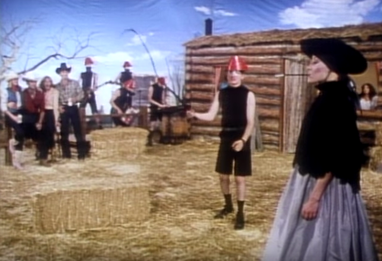
The famous part of this story is not the writing. It is what Devo did once radio decided the song was dirty. "All the DJs and people hearing it assumed it was a song about beating off or sadomasochism, so we let them think that," Casale told Songfacts. "We didn't want to ruin it and tell them the truth." Then they leaned in. The video, shot cheap, made the misreading literal. "We made a video to it for like $15,000 that was shot in our rehearsal studio," Casale said. "We kind of magnified that myth that this was a song about whipping and sadomasochism."
The visual came from an old magazine, not from any interest in bondage. "There was this one magazine that I found in a store in Santa Monica," Casale told Songfacts. "It was a 1962 men's girlie mag called Dude, I think. There was a feature article on a guy who had been an actor and fell on hard times, he wasn't getting parts anymore. He moved with his wife to Arizona, opened a dude ranch and charged people money to come hang out at the ranch." That dude-ranch tableau, cowboy hats and a cheering crowd, became the set. To Flavorwire, Casale framed the whole video as a bait-and-switch: "OK, let's just give 'em what they want, or what they think they want to see..." The rest was Devo making fun of Americana while everyone thought they were watching something naughty. "We like the irony. We knew people would think that."
What it became
The joke worked better than the band expected. Released as a single on August 13, 1980, off the album Freedom of Choice on Warner Bros., "Whip It" climbed to number 14 on the Billboard Hot 100, dated November 15, 1980, and hung around for 25 weeks. It remains Devo's only Top 40 hit in America and the reason a band built on a theory of human de-evolution is remembered, by most people, for a song they think is about whips. Mothersbaugh has argued the record is more Devo than it looks. "I think a lot of Devo is in 'Whip It.' There's Americana mixed with something menacing, there's irony and humor, there's a hook and a big dance beat, there are interesting synth parts, lyrics that aren't the typical lyrics about getting laid or losing your baby," he told Songfacts.
How the telling has grown over the decades
The spine of this story has never moved: Pynchon parody, written in one night, deliberately misread. What each telling adds is texture. The Flavorwire interview in 2009 nailed down the Horatio Alger target and the cliches-on-purpose method. The Songfacts interviews gave both founders room, which is where the Jimmy Carter framing from Mothersbaugh and the Dude magazine dude-ranch detail from Casale live, along with the plainest admission that they let the sadomasochism reading stand. The 2020 Consequence conversation is where Casale separated the two halves of the writing that fans tend to blur: the lyric was one night in his bedroom, but the music was four cassette sketches over two weeks, with Alan Myers handing over the beat. The one-night story and the two-week story are not a contradiction. One is the words, the other is the track. The only thing the tellers nudge is where the satire points, national myth for Casale, national mood for Mothersbaugh, and that difference is the most honest thing about the song.
The honest bottom line
Strip the affection away and "Whip It" is a novelty hit built on a misunderstanding the band chose not to correct. It is a literary in-joke most of its audience never got, sold with a video that faked exactly the content Devo was mocking, from a group that never had another American Top 40 single. None of that has dimmed it. The beat is still strange, the parody still lands the second you know it is there, and the men who wrote it clearly enjoy the fact that the whole country sang along to the opposite of what they meant.
FAQ
What is "Whip It" by Devo actually about? It is a parody of American motivational self-help, the "You're number one, there's nobody else like you, you can do it" school of thinking. Gerald Casale modeled the lyric on the satirical poems in Thomas Pynchon's Gravity's Rainbow. It is not about sex or sadomasochism, though the band let listeners believe it was.
Is "Whip It" a song about S&M? No. Devo has said for decades that disc jockeys and fans assumed it was about whipping and sadomasochism, and the band let the myth stand and even played it up in the video. Casale called the whole thing an irony they knew people would fall for.
Who wrote "Whip It"? Gerald Casale wrote the lyric in a single night. The music was built from four cassette sketches over about two weeks, with drummer Alan Myers creating the signature beat. Mark Mothersbaugh shaped the song's synth and arrangement.
How high did "Whip It" get on the charts? It peaked at number 14 on the Billboard Hot 100 on November 15, 1980, and spent 25 weeks on the chart. It was Devo's only Top 40 hit in the United States.
What inspired the "Whip It" video? Casale said the dude-ranch setting came from a 1962 men's magazine called Dude, which ran a feature on a down-on-his-luck actor who opened a pay-to-visit dude ranch in Arizona. The band used that imagery to magnify the sadomasochism myth on purpose.
Sources
- Songfacts, "Whip It by Devo," interview quotes from Gerald Casale and Mark Mothersbaugh
- Flavorwire, "Exclusive: Devo's Jerry Casale on De-evolution and the Meaning of 'Whip It'," March 18, 2009
- Consequence, "The Story Behind Devo's Surprise Breakout Hit 'Whip It'," November 2020
- Billboard Hot 100 weekly charts, August to November 1980 (peak number 14, dated November 15, 1980), via Wikipedia chart citations
When a claim comes along, we must whip it.
Part of Stories Behind the Songs. See also Blue Monday and Sweet Dreams (Are Made of This).