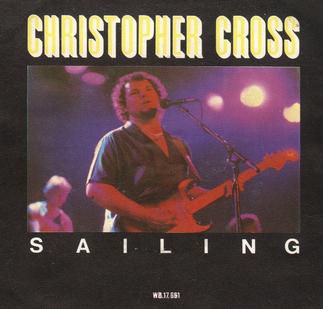
The verse and the chorus arrived in a single sitting at a kitchen table. The bridge took two years. And when the record company wanted it as a single, the man who wrote it thought they had lost their minds.
"Sailing" was written by Christopher Cross alone, at the table of a cheap apartment, with his guitar in an open tuning he had picked up from listening to Joni Mitchell. The verse and chorus came out at once. The bridge took about two years, because the modal tuning kept trapping him in one mood. Warner Bros. released it as the follow-up to "Ride Like the Wind" over his objection that it was too introspective, and it hit No. 1 on the Billboard Hot 100 dated August 30, 1980.
The part that took a minute
Cross has told the writing story with unusual precision, because it happened in one identifiable burst. Speaking to Songfacts in an interview published October 18, 2013, he laid out the moment:
"Well, I was just at home sitting in this cheap apartment, sitting at the table. I remember coming up with the verse and chorus, and the lyrics to the first verse of the chorus all came out. These tunings, like Joni used to say, they get you in this sort of trance, so all that came out at once: 'It's not far down to paradise...' The chorus just sort of came out. So I got up and wandered around the apartment just thinking ... 'That's really cool.' So then I sat down and had to try to come up with other stuff to make the rest of the song, but I thought I had something there."
He has told a matching version elsewhere. In an interview with Rick Beato, quoted by American Songwriter in October 2023, Cross called it "one of these mystical things" and described the same table: "I was just messing around the kitchen table and believe it or not, I played basically the structure of the song."
The part that took two years
Then the song stopped. The problem was the thing that had made it come so easily.
"Then it took about two years before I had a bridge to that song, because the modality of the modal tuning thing, it gets pretty linear, and you've got to be careful," Cross told Songfacts. "There are writers ... whose songs can get kind of boring because everything's this modality. So I knew I needed to lift the song out of that modality in the bridge and make key changes. It took about two years before I came up with the bridge that changes all the keys to where it lifts, but it was a pretty special moment."
Told to Rick Beato, the same problem got a better image. Cross explained that he was in an open D tuning, borrowed from his Joni Mitchell obsession, and that an open tuning has a gravity to it: "You can get trapped where it's almost like a mantra."
That is the whole craft lesson of "Sailing" in one sentence. The tuning that hands you a hypnotic verse will not hand you an escape from it. Every key change in the bridge is a man climbing out of his own trance on purpose.
The single he argued against
"Ride Like the Wind" went out first and reached the American Top 5. When the label came back for the follow-up, Cross thought they were wrong.
"When Mo Ostin with Warner Brothers wanted to release it as a single, I thought he was out of his mind because I thought the song was way too introspective to be a hit," he told Songfacts.
He said the same thing on the biggest stage he ever had. Accepting his Grammy, Cross called "Sailing" his favorite song on the album and noted that it had not originally been meant as a single.
The vindication arrived slowly and from a specific direction, and he tracks it carefully: "Subsequently, over the years, writers have been very gracious to say to me that the cool thing about 'Sailing' is that it's an artistic song that was a hit. And writers that I've talked to say that's hard to do: write a song that has credibility that's also popular."
Cross is equally blunt about the album around it. Asked what did not hold up, he named his own songs: "Say You'll Be Mine" is "pretty disposable," in his words, and "Minstrel Gigolo" he wishes had more words. "Sailing," by contrast, is the one he claims outright: "That's the song that I feel I wrote by myself that's really good."
Where the song came from
The subject is not the ocean. It is escape, and a particular person who provided it.
Cross has said, including on the Howard Stern Show, that as a teenager an older friend used to take him out on a boat, and that those trips got him away from the trials and tribulations of being a teenager. Songfacts records the punchline he uses when he tells it: if the friend had taken him bowling and he had loved it, the song might have been "Bowling."
That is the honest limit of what the sources here support. The friend's name is attached to this song all over the internet, and it traces back to Wikipedia's background section rather than to any interview text located for this piece. We are not printing a name we could not hear Cross say himself.
The recording has its own footnote: "Sailing" was cut in 1979 using the 3M digital recording system, making it one of the first digitally recorded songs to reach the charts.

What it did
"Sailing" reached No. 1 on the Billboard Hot 100 on the chart dated August 30, 1980, in its twelfth week on the chart, climbing from No. 2. It held the top for exactly one week and was back at No. 2 on September 6.
Then came the trophies. "Sailing" won the Grammy for Record of the Year, Song of the Year, and Arrangement of the Year, and Cross took Best New Artist the same night. He is the only artist in Grammy history to sweep all four of the general categories in a single ceremony.
The song's second life is stranger than its first. It became the archetype of yacht rock, a genre label invented decades after the fact for music Cross and his peers had simply called the West Coast sound. VH1 named it the most "softsational soft rock" song of all time in 2007. And it became a set-closer for other people's bands. Nicholas Niespodziani of the Yacht Rock Revue explained the effect to Songfacts: "That song is exceptionally smooth," he said. "Everything we do is pretty smooth, but then there's like, a next level of smooth, that's just so vibed out. A lot of times, you can create excitement by being not excited, and that song is the perfect example of that: It's so chilled out that it gets people pretty amped up."
How the telling has grown over the decades
The Howard Stern Show, date not established here. The origin story goes public in its most personal form: the older friend, the boat, the teenage escape. Songfacts and American Songwriter both point to this telling, and Cross has repeated the bowling line for years, but no dated transcript of the appearance was located for this piece.
October 18, 2013, Songfacts. Greg Prato gets the fullest craft account: the cheap apartment, the trance of the open tuning, the two-year hunt for the bridge, and Mo Ostin overruling him on the single.
October 9, 2023, American Songwriter. Julia Mahncke reports Cross's telling to Rick Beato. Same kitchen table, same Joni Mitchell tuning, and the sharpest phrasing of the trap: "You can get trapped where it's almost like a mantra."
The drift is small and worth naming: to Songfacts, Cross twice says the bridge took "about two years." In the Beato telling as reported by American Songwriter, the gap is described as over a year. He has never wavered on why it took that long.
A second, larger gap. Two widely repeated claims about this song, the name of the friend who took him sailing and a story that the orchestral opening was the result of a wrong button pressed in the studio, both appear on the song's Wikipedia page. Neither could be traced to an interview in Cross's own words for this piece. They are left out here rather than dressed up.
The honest bottom line
"Sailing" is the softest record ever to win Record of the Year, and it earned every joke it has taken since. It is slow, it is pretty, it has no drums to speak of for long stretches, and it launched a genre name that started as a punchline. It is also a technically stubborn piece of writing by a man who refused to ship it until the bridge stopped repeating itself, and who then told his label they were wrong to release it. The song that sounds like nothing is happening took two years to finish. That is the part the yacht jokes miss. That same year, Dolly Parton turned a similar piece of craft patience into 9 to 5, another record whose signature sound came from what was in the room rather than what was planned, and together the two songs own opposite ends of what the early 1980s thought a hit should sound like.
FAQ
What is the story behind "Sailing" by Christopher Cross? Cross wrote it alone at his kitchen table with his guitar in an open tuning. The verse and chorus came out in one sitting, but the bridge took about two years because the tuning kept pulling the song back into one mood. It was released as a single over his own objection and went to No. 1.
What is "Sailing" about? Escape. Cross has said that as a teenager an older friend would take him out on a boat to get away from the difficulties of being a teenager, and that the song came out of those trips. He has joked that if the friend had taken him bowling instead, the song might have been about bowling.
Who wrote "Sailing"? Christopher Cross, by himself. He has called it the song he wrote alone that he considers genuinely good.
Did "Sailing" go to number one? Yes. It reached No. 1 on the Billboard Hot 100 dated August 30, 1980, and held the top spot for one week.
How many Grammys did "Sailing" win? The song won Record of the Year, Song of the Year and Arrangement of the Year, and Cross won Best New Artist at the same ceremony. He remains the only artist to take all four general-field Grammys in one night.
Why did Christopher Cross not want "Sailing" released as a single? He thought it was too introspective for radio. He has said he believed Warner Bros. chief Mo Ostin was out of his mind for wanting it, and he repeated in his Grammy speech that the song had never been intended as a single.
Sources
- Songfacts, Christopher Cross Songwriter Interview (Greg Prato), October 18, 2013
- Songfacts, "Sailing by Christopher Cross," including the Songfacts interview quotes and Nicholas Niespodziani of the Yacht Rock Revue
- American Songwriter, "The Peaceful Meaning Behind 'Sailing' by Christopher Cross" (Julia Mahncke), October 9, 2023, reporting Cross's interview with Rick Beato
- Billboard Hot 100 weekly charts, August 30 and September 6, 1980
- Wikipedia, "Sailing (Christopher Cross song)," for the May 1980 single release, the 3M digital recording detail, the Grammy categories and the Grammy speech
Sailing takes us away to well-documented waters.
Part of Stories Behind the Songs. See also Africa and Broken Wings.