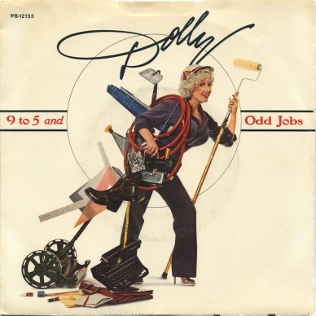
The instrument that gives "9 to 5" its clatter was not a typewriter. It was a set of long acrylic fingernails, clicked together between camera setups by a first-time actress who did not have her guitar with her. Dolly Parton was on a film set, stuck without her instrument, so she used the only thing she had, and the rhythm she tapped out sounded exactly like the office machine the movie was about. She liked it so much she put her nails on the actual record, and they got credited as an instrument. Parton has told this story for over forty years, and it stays funny every time.
"9 to 5" was written by Dolly Parton in 1980 for the film of the same name, her acting debut alongside Jane Fonda and Lily Tomlin. Stuck on set without her guitar, Parton clacked her acrylic fingernails together, decided the sound was like a typewriter, and built the song around that rhythm. She played her nails on the finished recording, and they are credited as an instrument on the album. It topped the Billboard Hot 100 in February 1981.
No guitar on the set
The problem was practical. Parton was making her first movie, the days were long, and she could not exactly haul out a guitar and start singing between takes. So she improvised with her hands. "I did it on my fingernails," she told Howard Stern. Her acrylics, long enough that most guitarists would find them an obstruction, turned out to be a percussion kit she carried everywhere. "It sounded like a typewriter, and I didn't have my guitar because I didn't want to get too scattered, because we were trying to stay in the mood, and they were doing lights, and all that," she said.
The connection was immediate, because the movie was about office workers and the typewriter was the tool of the trade. Parton heard the clack of her nails and heard secretaries. "I thought it sounded like a typewriter," she told Stern. "Can you hear that?" The whole hook of the song, the busy, ticking rhythm under "tumble outta bed and stumble to the kitchen," came from that accidental discovery on a soundstage.
Writing at night, clacking by day
The nails were the sketchpad. The real writing happened after hours. "I would just kind of play my little fingers, go back to the hotel at night, write down the words, and or get my guitar and start singing it," Parton told Stern. She described the same routine to Songfacts: "I would watch things going on, on the set. At night, I would go back to the hotel Bel-Air. I would get my guitar, and I would start putting pieces together." The clacking on set generated the groove and the mood; the guitar at the hotel turned it into a song.
Parton knew when she had struck gold in the lyric. Asked which line she was proudest of, she pointed to one from this song. "One that I remember the very moment I wrote when I was working on '9 to 5,' was 'Pour myself a cup of ambition,'" she told Songfacts. "I went, 'Yeah that's so good.' That has really followed me oh through the years." It is the kind of line that does the whole job of the song in five words: the grind, the hope, and the joke, all at once.
The nails made the record
Most artists would have left the fingernail trick on the set. Parton brought it into the studio. "I actually played my nails on the thing," she told Stern, meaning the finished master. Her producer, Greg Perry, had first wanted to use an actual typewriter to make the clacking sound. Then they decided the source should be the source: Parton put her acrylics to work on the recording itself. The nails were not a novelty afterthought either. On the album they are formally listed as an instrument, a credit Parton has laughed about in interviews for years, as Vanity Fair documented in 2020.
There is a small, honest dispute buried in the tellings about what you are actually hearing. In some accounts the fingernail sound was cleaned up or replaced with a genuine typewriter for the single, so what reaches your ear is the machine. In others, backed by the album's own instrument credit, the clatter is Parton's real nails. Both versions circulate, sometimes from Parton herself, and the truth is probably that both a typewriter and her nails are in there. What is not in dispute is where the rhythm came from: her hands, on a film set, with no guitar in reach.
What it became
"9 to 5" was released as a single in November 1980 and became one of the biggest crossovers of Parton's career. It reached number one on the Billboard Country chart in January 1981, then went to number one on the Billboard Hot 100 on February 21, 1981. It was knocked off the top a week later by Eddie Rabbitt's "I Love a Rainy Night," then climbed back to number one on March 14, 1981, one of the rare cases of a song reclaiming the summit after being displaced. It also topped the Adult Contemporary chart, and it remains Parton's first and only solo number one on the Hot 100. The song was nominated for the Academy Award for Best Original Song at the 1981 ceremony and won Parton two Grammy Awards, for Best Country Song and Best Female Country Vocal Performance.
How the telling has grown over the decades
The core of this story has barely changed in forty years, which is unusual, and it is because the story is simple and true: Parton had no guitar, used her nails, heard a typewriter, and kept the idea all the way to the record. She has told it on late-night television, on Howard Stern, in print interviews, and on talk shows, always with the same delight. The details that drift are minor. The exact writing spot moves a little between tellings, with the Bel-Air hotel and generic hotel nights standing in for the same nighttime routine. And the one genuine open question is whether the clatter on the record is a real typewriter, her real nails, or both. The album credits her nails as an instrument, which is the detail Parton clearly enjoys most, so that is the version worth remembering.
The honest bottom line
"9 to 5" is a movie theme, written to order for a comedy, by an artist who had never acted and needed a song fast. It could have been a throwaway. Instead Parton turned a logistical annoyance, no guitar on set, into the most memorable production choice in her catalog, and wrote a working-class anthem sharp enough to outlive the film it came from. The fact that its signature sound is a pair of fake fingernails, credited on the sleeve as a real instrument, is not a gimmick. It is Parton's whole method in miniature: make something out of what you have, and never lose the joke while you do it. Four years later, Kenny Loggins would pull off the same trick with Footloose, another movie theme that outgrew its film, written to a brief by a songwriter who found a way to make assignment work sound like it meant something.
FAQ
How did Dolly Parton write "9 to 5"? She wrote it in 1980 while filming the movie 9 to 5. Without her guitar on set, she clacked her long acrylic fingernails together, decided the sound was like a typewriter, and built the song's rhythm around it, then finished the lyrics and melody at night with her guitar at the hotel.
Are Dolly Parton's fingernails really on the "9 to 5" record? Yes. Parton has said she played her nails on the actual recording, and on the album they are credited as an instrument. Some accounts say a real typewriter sound was also used, so the clatter you hear may be a mix of both, but the idea and the credit come from her acrylics.
What is the "cup of ambition" line in "9 to 5"? It is the lyric "pour myself a cup of ambition," which Parton has named as one of the lines she is proudest of ever writing. She has said she knew the moment she wrote it that it was special.
Did "9 to 5" reach number one? Yes. It topped the Billboard Country chart in January 1981 and the Billboard Hot 100 on February 21, 1981. Eddie Rabbitt's "I Love a Rainy Night" displaced it a week later, and "9 to 5" then returned to number one on March 14, 1981. It is Dolly Parton's only solo number one on the Hot 100.
Did "9 to 5" win any awards? It won Dolly Parton two Grammy Awards, for Best Country Song and Best Female Country Vocal Performance, and was nominated for the Academy Award for Best Original Song at the 1981 Oscars.
Was "9 to 5" written for the movie? Yes. Parton wrote it specifically for the 1980 film 9 to 5, which was her acting debut alongside Jane Fonda and Lily Tomlin. She wrote it during production, using her time on set to develop the rhythm.
Sources
- American Songwriter, "How Dolly Parton Wrote '9 To 5' Using Those Big Acrylic Nails of Hers," and "If You Listen Closely, You Might Hear Dolly Parton's Acrylic Nails on '9 To 5,'" both quoting Parton's Howard Stern interview
- Songfacts, "9 to 5 by Dolly Parton," with Parton quotes on the writing and the "cup of ambition" lyric
- Vanity Fair, "Dolly Parton Explains Why Her Acrylic Nails Are Credited as a Musical Instrument on Her Album," October 13, 2020
- Wikipedia, "9 to 5 (Dolly Parton song)," for chart, awards, and personnel credits; Billboard Hot 100 weekly tables, February and March 1981
Working nine to five on accuracy, the whole story.
Part of Stories Behind the Songs. See also The Story Behind Girls Just Want to Have Fun and The Story Behind Eye of the Tiger.