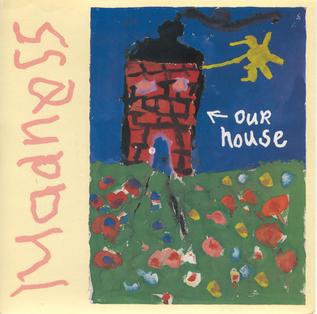
The guitarist brought it to rehearsal as a slow, dirgy thing he had knocked out on a borrowed record player. The trumpet on the finished record was played by a man who had only recently learned the instrument, and it took him a long time to get it. And the band that made it were, at that exact moment, quietly shopping for a new producer. Then "Our House" fell out of the rehearsal room and none of that mattered.
"Our House" was written by Madness guitarist Chris Foreman and second vocalist Cathal "Chas Smash" Smyth, after Smyth suggested the band each write songs about their own childhoods. Foreman's original version was slow and dirgy. The band rebuilt it around a Motown rhythm, producers Clive Langer and Alan Winstanley recorded it at AIR Studios in London, and it reached No. 5 in the UK and No. 7 on the Billboard Hot 100 dated July 23, 1983.
It started as a dirge, and Chas started the theme
The clearest account of how the song came to exist is Foreman's own, given to author Jim Beviglia for the book "Playing Back the '80s: A Decade of Unstoppable Hits" and quoted by American Songwriter in March 2024:
"Anyway, I had this dirgy song which I took to rehearsals. Chas (Smash, real name Cathal Smyth) had suggested we all write songs about our childhood and he wrote some lyrics along those lines to go with my music. We all started playing the song and eventually settled on a Motown-type rhythm. I wrote the middle 8 real quick; it was part of another song idea I had been working on. I came up with the (guitar) solo in the studio when we were recording it."
That single paragraph carries the whole architecture. The music existed first and it was not fast. The lyric came from a band-wide assignment, not from the singer who ended up performing it. The Motown feel that defines the record was arrived at collectively, in a room, by playing it. The middle eight was recycled from something else entirely. And the guitar solo, the part most people can hum, did not exist until the tape was rolling.
Foreman has also told the tooling side of it himself. Asked in a 2021 interview with kultur.media how technology changed his writing, he answered: "When I wrote 'Our House' Dave Robinson (Stiff Records) lent me some record player which came with a drum machine on it." In the same conversation he described the song with the flatness of a man who has answered the question a thousand times: "You know, it's a straight chord ... I wrote that, then we did a couple changes. Try to put in some motown infusion there."
The song that saved a partnership
Langer and Winstanley had produced Madness since 1979. By the fourth album they were not a lock. Langer told Sound On Sound in June 2006 that the band had already gone to take a meeting elsewhere: "In fact, at one point they went to see Trevor Horn when Stiff thought it was maybe time for a change, but that's when 'Our House' popped out and so we maintained our relationship."
He knew what he had the first time he heard it in a rehearsal room. "It had a great beat, almost like The Kinks' 'You Really Got Me' or 'All Day And All Of The Night', where the snare drum lands in a space," Langer told Sound On Sound. "All of the parts were there and Mike worked hard on it, as did the rest of the band, and I just thought we had the chance of making the perfect pop record. I actually thought that a few times with Madness."
The album around it did not inspire the same confidence. "Many of the songs on The Rise And Fall essentially weren't up to it," Langer said in the same interview, pointing at road exhaustion and keyboard player Mike Barson's mood, before adding that he enjoyed making it anyway.
Two key changes, on purpose
The trick that makes the end of "Our House" feel like it is climbing a staircase was Langer's, and he has explained the mechanics of it plainly. "I remember putting in two key changes instead of one at the end of the song, so as the outro went on you never knew where the beginning was; you'd probably lost sense of the key that the song was in," he told Sound On Sound. "It was really exciting working on that, and if I say so myself, I was quite proud of it because the whole thing was quite clever and it worked."
His rule of thumb is the part producers steal: "I normally go a tone and a half down ... because it's a bit cabaret when you just go a tone up." He suggested the first drop during rehearsals, heard it come back "a little bit boring," and pushed for a second change on top. Barson, he says, got very excited about that.
Then came the strings. "Even though we had a solid song, we could really push it to its limits and get David Bedford to write an exciting string arrangement," Langer said. "I think that really lifted it, the Western film-type strings in the background." Sound On Sound documents the session down to the microphones: four first violins and four second violins in miked pairs, four violas, two cellos.
Suggs remembered the same hire from the singer's chair, telling the Daily Mirror on September 18, 2009, in a quote preserved by Songfacts: "This was the first time we worked with the string arranger David Bedford. It was clear to him what our records needed and he did great things for us. It's strange now to think we were so philosophical about such everyday things."
The trumpet part that took forever
Cathal Smyth wrote the lyric, and he also played the trumpet on the record, which was not a foregone conclusion. Winstanley laid out his arc for Sound On Sound: "Carl had come a long way in a short time," he said. "On the first album he wasn't even in the band. Only the other six guys appeared on the sleeve, even though he was the one shouting 'Hey, you!' on 'One Step Beyond'. That's all he was at that point; the kid who got up on stage and did the introduction as well as the nutty dancing."
Then the sentence that tells you what kind of band this was: "He learned to play the trumpet, and even though he wasn't the greatest trumpet player in the world, he played it on 'Our House'. It took him a long time to actually nail it, but he wanted to do it and we didn't say 'Nah, bollocks, let's just get a session guy in.'"
Smyth's other contribution is the part of the record people forget is unusual. "Then there was Carl's really fast vocal in the last verse, almost pre-empting rap," Langer told Sound On Sound. "It was just so much fun and absorbing to work on that song, because you knew you were creating this very clever thing, without trying to be too clever."
The key changes bit back in the vocal booth
Clever cost them. Winstanley's memory of the sessions is not of a breeze: "What I do remember is that the vocals were a bit of a problem on that song because of all the key changes that Clive had come up with, and when the guys did the backing vocals it was always a problem trying to pitch to come back in for the key change. That was really hard, and so it took a long time to do all of the vocals and backing vocals on that song. They just couldn't get the pitch right for each upcoming key change."
The fix was a crutch track. "Since the difficult thing was pitching into the next chorus, we had to play a piano part and have it on a spare track and we then sang along to that piano in order to enter the change in the right key," Langer said. He got something out of it too: "I was quite excited because we all did backing vocals, and so I finally got my voice onto one of their tracks." Writing in 2006, he noted that after nearly 25 years of playing it live, the band had finally got good at it.
The record was cut at AIR Studios in central London on a custom 56-channel Neve desk. Winstanley kept the rhythm section on 16-track and built a 24-track slave for everything else, then brought the 16-track back out at mix time for bass, drums and piano. His reason, in Sound On Sound: "Because of the extra width, 16-track sounded a bit better than 24-track."
What it did, and where
"Our House" was released on 12 November 1982 and peaked at No. 5 in the UK. In America, where Madness had spent three years being filed under ska and ignored, it entered the Billboard Hot 100 at No. 76 and climbed for months. On the chart dated July 23, 1983, in its twelfth week, it hit No. 7. That was the peak. It slipped to No. 10 the following week and No. 12 the week after, and it remains the band's biggest American hit by a distance. It won Best Pop Song at the Ivor Novello Awards in May 1983.
The video did a lot of the American work, arriving exactly when MTV was hungry for British bands with a visual idea. It was shot partly at a terraced house at 47 Stephenson Street in north-west London, and drummer Dan Woodgate later told Q Magazine in August 2008, in a quote preserved by Songfacts, where the gags came from: "The knocking-on-the-door bit where somebody comes out, goes, 'Where are they?' and the others sneak in and close the door... That's The Flintstones. We stole lots of ideas from the Keystone Kops and Benny Hill."
Foreman, decades on, tracks the song's afterlife the way a songwriter does. "And you know, it was used in lots of adverts, so yeah, there's money from it," he told kultur.media in 2021. "Which we share it, share together."

How the telling has grown over the decades
The story arrived backwards, production first and origin last.
June 2006, Sound On Sound. Richard Buskin's Classic Tracks piece with Clive Langer and Alan Winstanley is still the deepest single source on the record: the Trevor Horn near-miss, the two key changes, the string session, the backing-vocal pitching problem, Smyth's trumpet.
August 2008, Q Magazine. Dan Woodgate explains the video's slapstick lineage, The Flintstones and the Keystone Kops and Benny Hill.
September 18, 2009, Daily Mirror. Suggs adds the David Bedford hire from the band's side and, in one line, the odd retrospective feeling of having been that earnest about ordinary domestic life.
August 23, 2021, kultur.media. Foreman gives the tooling: the record player with the built-in drum machine, lent to him by Stiff boss Dave Robinson. Also the shrug about the chords and the adverts money.
March 17, 2024, American Songwriter. Jim Beviglia publishes Foreman's fullest origin account, from his book "Playing Back the '80s". This is the telling that names Smyth's childhood-songs suggestion, the dirge tempo, the Motown decision, the recycled middle eight, and the solo written in the studio.
Two honest notes on the drift. First, the equipment. American Songwriter's framing around Foreman's quote describes the source as a boom-box type recording device that Foreman owned, while Foreman himself, three years earlier, said Dave Robinson lent it to him and called it a record player with a drum machine on it. The writer's summary and the writer of the song do not match on who owned the box.
Second, a piece of lore that follows this song around: that the demo was originally called "Confidence." It was not. The song called "Confidence," demoed with Suggs on vocals, became "Walking with Mr. Wheeze," the instrumental B-side written by Mike Barson.
And one gap worth naming rather than papering over. Almost everything known about how the lyric came to be runs through Foreman. Smyth's own extended first-person account of writing the words about his childhood home is not part of the widely available record in the way the production story is. The song about somebody's family is told mostly by the guy who wrote the chords.
The honest bottom line
Strip the affection away and "Our House" is a compromise record. The music was too slow until the band fixed it, the lyric came out of a group assignment, the trumpet was played by someone still learning it, the outro effect was a producer's trick he admits he reuses, and the lead vocal is sung by a man remembering a childhood that belongs to his bandmate. In Britain it was one more Top 10 in a long run. In America it was the entire career, the only song most listeners can name. None of that reads as a knock once the strings come in. A band that had been dismissed as novelty in the States made one perfectly built pop record about doing the washing up, and it outlived the genre labels anybody stuck on them. Three years later, Pet Shop Boys would face the same problem from the opposite direction with West End Girls, a British synth record about class anxiety that America heard as a dance hit, and together the two songs bracket how much got lost in translation when the Second British Invasion crossed the Atlantic.
FAQ
What is the story behind "Our House" by Madness? Guitarist Chris Foreman wrote the music and brought it to rehearsal as a slow, dirgy demo made on a record player with a built-in drum machine. Cathal "Chas Smash" Smyth had suggested the band write songs about their childhoods and wrote the lyric to fit. The band reworked the rhythm into a Motown feel, and Foreman wrote the guitar solo in the studio.
Who wrote "Our House"? Chris Foreman and Cathal Smyth, credited as Chas Smash. Foreman wrote the music and the middle eight, which he had lifted from an unfinished song idea. Smyth wrote the lyric about his childhood home.
Is "Our House" about a real house? The lyric came out of Smyth's own childhood, per Foreman's account of the writing session. The terraced house seen in the music video is 47 Stephenson Street in north-west London, a location, not the family home in the song.
How high did "Our House" chart in America? It peaked at No. 7 on the Billboard Hot 100 dated July 23, 1983, after entering the chart at No. 76. It was Madness's biggest American hit. In the UK it peaked at No. 5.
Why does the end of "Our House" keep changing key? Producer Clive Langer put two key changes into the outro instead of one, deliberately, so listeners would lose track of the song's original key. He has said his default is to drop a tone and a half, because going up a tone sounds cabaret.
Did Madness nearly use a different producer? Yes. Langer has said the band went to see Trevor Horn when Stiff Records thought it might be time for a change. "Our House" surfaced at that moment and the existing partnership held.
Sources
- American Songwriter, "The Meaning Behind 'Our House' by Madness and How They Finally Got Their Shot in America" (Jim Beviglia), March 17, 2024, quoting Chris Foreman from the book "Playing Back the '80s: A Decade of Unstoppable Hits"
- Sound On Sound, "Classic Tracks: Madness 'Our House'" (Richard Buskin), June 2006, interviews with Clive Langer and Alan Winstanley
- kultur.media, interview with Chris Foreman, August 23, 2021
- Songfacts, "Our House by Madness," preserving Suggs to the Daily Mirror, September 18, 2009, and Dan Woodgate to Q Magazine, August 2008
- Billboard Hot 100 weekly charts, July 23, July 30 and August 6, 1983
- Wikipedia, "Our House (Madness song)," for release date, UK peak, Ivor Novello category, B-side history and video location
Our house, in the middle of our method.
Part of Stories Behind the Songs. See also Come On Eileen and Don't You Want Me.