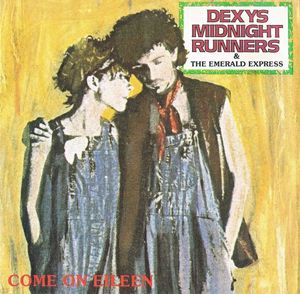
The band was broke, the manager was threatening to walk, and the day they finally brought the song into rehearsal the writer lost his temper and two members walked out of the room. The chorus everyone shouts at weddings was, at that moment, a placeholder nobody had words for. And the man who wrote it has since admitted, on the record, that he lied about the girl for years and that he took the sound from a friend he had fallen out with. This is the making of it, not the meaning of it.
"Come On Eileen" was written by Kevin Rowland with Big Jim Paterson and Billy Adams in late 1981 and early 1982, under heavy financial pressure on Dexys Midnight Runners. Rowland built it on a deliberately borrowed rhythm, salvaged a lyric from an abandoned song called "Yes Let's," and finished it with Adams after Paterson walked out of the rehearsal that introduced it. Rowland has since said the Too-Rye-Ay sound came from Kevin Archer, who receives songwriting royalties.
If you want the meaning of the lyric, the chart upset over "Billie Jean" and the one-hit-wonder question, that is all in our companion piece on Come On Eileen. This one is only about how the record got made.
Written broke
The circumstances were not romantic. Dexys had lost half their lineup in 1980, rebuilt as an eight-piece, and could not reliably cover wages.
"We definitely got the impression if that album didn't do well, it would've been bye-bye," Rowland told SPIN in August 2023. "There was a lot of pressure internally and externally around the band. The manager was losing interest. He was having to put his own money in to pay wages, and he was getting fed up. He was clear about that."
The song did not arrive whole. Part of it was scavenged. "We'd written a song, Jim and I called, 'Yes Let's,' and it had some of the lyrics that later ended up in 'Eileen,' like Poor Johnny Ray sounded sad upon the radio, but a different melody, a different rhythm," Rowland said. So the most famous opening line in the catalog is a transplant from a song that did not work.
Paterson, his writing partner, was running out of appetite for it. "Jim was under a lot of pressure. He was getting fed up," Rowland said. "I just didn't understand why anybody would want a life outside of the band. Jim wanted to go home and see his girlfriend. Invariably I'd say, 'Jim, come on. Let's go and write this evening,' after rehearsing all day."
The rhythm they went looking for
Rowland has been unusually specific about the fact that the groove was chosen rather than discovered. Speaking to Songfacts, he named the records they were chasing.
"We wanted a good rhythm and we found one. Lots of records we liked had that rhythm: 'Concrete and Clay,' 'It's Not Unusual' by Tom Jones," Rowland said. "Lots of records we liked had that 'Bomp ba bomp, bomp ba bomp.' We felt it was a good rhythm. We came up with the chord sequence ourselves and just started singing melodies over it. I remember thinking, 'We're really onto something here.'"
The hook that defines the song came to him on top of that. "I came up with that, 'Too ra loo ra,' and I remember thinking, 'Wow, this is sounding really good,'" he told Songfacts. "You get a feeling when you're writing a song. Something happens. And in the end it kind of finished itself."
The rehearsal that cleared the room
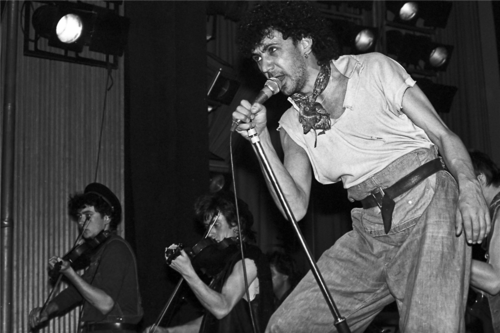
The day the song was first shown to the band is the centerpiece of Rowland's 2023 telling, and it is not a triumphant scene.
"I always felt nervous bringing a song to rehearsal to show the band because you never know," he told SPIN. "You feel it's good, but you think it could be rubbish and they're going to laugh at you, or they're going to say, 'That's crap. I'm not playing that,' or whatever. This day was a particularly tense day, the day we brought 'Eileen' in."
The famous chorus did not have words yet. Rowland was teaching the band nonsense syllables to hold the shape of it, and the room had turned on him. "I could just feel the tension in the room," he said. "Whereas when they had joined a year, 18 months earlier, they're all listening to me, 'Oh, yes, Kevin, what do you want to do?' Now they weren't listening to me. They were just pissed off, no money, working hard."
He was coaching the alto sax player through the chant when the man said he understood the part but did not like it. Rowland, by his own account, snapped and swore at him in front of everybody. "I was under pressure and I snapped," he said.
The fallout was immediate and expensive. Paterson objected, told Rowland he could not talk to a bandmate that way, and left. "Jim says to me, 'You can't talk to him like that. If he's going, I'm going,' but Jim walked out," Rowland said. "He didn't come back and neither did Brian. They came back and played on the album as session players which we'll pay them as session players, but that's what happened."
The song was completed by the man who was left. "Billy Adams, who was a guitar player in the band, he helped me finish it," Rowland said. "We finished it off and as we were writing it, I did feel this could be a really good one."
The sound he admits he took
The fiddles that make the record are not originally a Dexys idea, and Rowland says so plainly.
Kevin Archer, known in the first Dexys lineup as Al Archer, had left at the start of 1981 to form the Blue Ox Babes. He introduced Rowland to violinist Helen Bevington, who became Helen O'Hara, and he played Rowland his demos.
"Now I was already experimenting with strings, I was trying cello and a small string quartet and stuff like that. It was sounding okay, but it wasn't sounding amazing," Rowland told SPIN. "He played me his demos and I liked it better what he was doing with strings."
What Rowland says he took was the style, and he is careful about the boundary. "Also, we were definitely influenced by Kevin Archer's sound. Not the music, not any notes, not any chord sequences, not any rhythms, not any lyrics, but the style of music," he said. "I thought, 'Oh, it does sound a bit close to Kevin Archer's,' but we were quite competitive at the time. We'd slightly fallen out and I was just like, 'Oh well, screw him.'"
He is less careful about the structural device. Archer's band had a song called "What Does Anybody Ever Think About" with a breakdown and a violin speed-up in it. "I mean, it wasn't a unique idea, but it was an unusual idea. So I nicked that basically," Rowland said. "Just full disclosure, Kevin gets a decent percentage of the songwriting royalties to this day and he will continue to do so."
Archer's own version of the fallout, given to Mojo in July 2009, is bleaker. He described a group run "with a rod of iron," a leader who "wouldn't speak to us personally," post-show sessions that turned into "hate Kevin Rowland time," and his own exit in a Bearwood cafe: "I said I was leaving. He never showed any emotion." He was then asked to teach the new guitarist the chords. "I formed The Blue Ox Babes, and I lent Kevin a tape with three of our songs on including 'What Does Anybody Ever Think About.'"
The mix he never accepted
Even after it became the biggest-selling British single of 1982, Rowland did not think the record sounded right, and in 2022 he did something about it, remixing the whole album for the As It Should Have Sounded edition.
"Before 'Come On Eileen,' we'd had a couple of singles that didn't do so well, so their opinion held sway. If I said I really didn't like the sound of something, I'd be told not to worry, it was fine," he told uDiscover Music. "I could never pinpoint exactly what the problem was with the way [the album] sounded, but I was never happy with it. Then, when it was finished, I was told the budget was spent, so I've had to live with it..."
His summary of the 2022 project leaves no ambiguity about what he blames. "It was the mix that let it down. That was what always needed addressing," he said, adding that the performances were never the problem.
The same interview supplies a piece of context that has nothing to do with music and everything to do with 1982 Britain. "For example, Birmingham's biggest radio station, BRMB apologized after they played 'Come On Eileen' for the first time," Rowland said. "They said they hoped it didn't cause offense to anybody, because there had only just been an IRA bomb gone off in London the day before. We had all that to contend with, so I felt I almost had to sneak a bit of Irish culture in. I certainly didn't want to go all out on playing Irish folk, but it was good to bring a little into our sound."
The video argument
Julien Temple was assigned to direct, and his pitch was not the video that exists. "He came down at lunchtime and we talked and he said, 'I've got this idea. You're all in a club. You're all dressed in suits. You're playing businessmen and the waitress is called Eileen,'" Rowland told SPIN. "I said, 'I don't really fancy that.'"
Rowland pushed for the street instead, in the kind of terraced neighborhood he grew up in until he was about 11. Temple's response was a shrug with a note of resignation: "Okay. If you wanted to be literal, fair enough."
The shoot was one day. "It was one day. We started at 6 in the morning, we finished very late at night. It just kind of worked," Rowland told Songfacts.
Where it ended up
The Billboard Hot 100 shows "Come On Eileen" entering at number 79 on the chart dated January 22, 1983 and reaching number one on the chart dated April 23, 1983, for a single week. It was already the biggest-selling single of 1982 in Britain. Our companion piece covers what it displaced and what displaced it.
One footnote on its influence: Songfacts records that Cyndi Lauper and her producers, struggling to find the right rhythm for "Girls Just Want To Have Fun" while "Come On Eileen" was all over American radio, landed on it after hearing the Dexys record.
How the telling has grown over the decades
- 1982, Smash Hits. Rowland is defensive and in character, insisting the ragged look is not a pose. Asked about it by Dave Rimmer, he snapped: "I take deadly serious what I do. It's very important to me to be an individual. I don't care if people laugh."
- July 2009, Mojo. Kevin Archer gives his side: the rod of iron, the cafe resignation, the tape he lent Rowland containing "What Does Anybody Ever Think About."
- 2014, The Guardian. Rowland retracts his own long-running account of who Eileen was. "For years, I told everyone that Eileen was my childhood girlfriend," he said. "In fact, she was composite, to make a point about Catholic repression."
- 2022, uDiscover Music. Promoting the remixed Too-Rye-Ay, Rowland reveals he never accepted the original mix and had been overruled on it because his recent singles had flopped.
- August 2023, SPIN. The fullest version yet: the money, the salvaged "Yes Let's" lyric, the rehearsal blow-up, Paterson's walkout, Adams finishing the song, and the unprompted admission about Archer's sound and royalties.
The drift here is unusually blunt, because the writer created most of it himself.
The first split is over Eileen. Rowland spent years telling interviewers she was his childhood girlfriend, then told The Guardian in 2014 that he had made that up. The older version is still in circulation: Songfacts, to this day, presents Eileen as a real girl Rowland grew up with, with a relationship that turned romantic at 13. That is not sloppy reporting so much as the residue of the story Rowland used to tell.
The second split is over credit. Songfacts names the co-writers as Rowland, Jim Paterson and "guitarist Al Archer." Rowland's own account names Billy Adams as the man who helped him finish it, with Archer compensated separately as the source of the album's sound. Those are two different credit stories on the same song, and only one of them comes from someone who was in the room.
The honest bottom line
Strip the goodwill off and this is a song written under threat of the band folding, using a rhythm openly lifted from two older hits, a lyric line rescued from a failure, an arrangement style the writer concedes he took from a former bandmate, and a chorus first taught to the band as nonsense syllables during a row that emptied the rehearsal room. The frontman then spent a decade telling a made-up story about the girl in the title, and thirty years disliking the mix. What redeems all of it is that Rowland has said every one of those things out loud, in his own name, including the ones that cost him money. Very few writers of a song this beloved have volunteered this much evidence against themselves.
FAQ
How did Kevin Rowland write "Come On Eileen"? He and Jim Paterson built it in late 1981 and early 1982 around a rhythm they deliberately borrowed from records like "Concrete and Clay" and Tom Jones's "It's Not Unusual," recycling the "Poor Johnny Ray" line from an abandoned song called "Yes Let's." Billy Adams helped him finish it after Paterson walked out.
Who actually wrote "Come On Eileen"? Rowland's own account credits himself, Jim Paterson and Billy Adams, with Kevin Archer receiving a share of songwriting royalties for the sound and the speed-up device. Songfacts lists the co-writers differently, naming Al Archer rather than Adams.
Did Kevin Rowland copy Kevin Archer? He says he took the style, not the notes. "We were definitely influenced by Kevin Archer's sound. Not the music, not any notes, not any chord sequences, not any rhythms, not any lyrics, but the style of music," he told SPIN, and said Archer still receives a percentage of the royalties.
Why did Kevin Rowland remix Too-Rye-Ay? He was never satisfied with the original mix and was overruled at the time because his previous singles had underperformed. "It was the mix that let it down. That was what always needed addressing," he told uDiscover Music in 2022.
Was Eileen a real person? Rowland told interviewers for years that she was his childhood girlfriend, then told The Guardian in 2014 that this was not true and that she was a composite made to make a point about Catholic repression. The meaning of the lyric is covered in our companion piece.
Who directed the "Come On Eileen" video? Julien Temple, whose original pitch had the band as businessmen in a club with Eileen as a waitress. Rowland rejected it and asked for the street setting instead. The shoot took one day, starting at 6 in the morning.
Sources
- SPIN, "Dexys' Kevin Rowland on Come on Eileen," August 2023
- Songfacts, "Come On Eileen by Dexys Midnight Runners," including its interview with Kevin Rowland and its citation of Kevin Archer in Mojo, July 2009
- uDiscover Music, "Kevin Rowland On Remixing Dexys Midnight Runners' Too-Rye-Ay," 2022
- American Songwriter, "Come on Eileen One-Hit Wonders Reveal Who (Or What) Eileen Is," December 26, 2025, quoting Rowland's 2014 Guardian interview
- Billboard Hot 100 weekly charts dated January 22, April 23 and April 30, 1983
This telling comes verified, too-ra-loo-ra honest.
Part of Stories Behind the Songs. See also our companion piece on Come On Eileen and Girls Just Want To Have Fun.