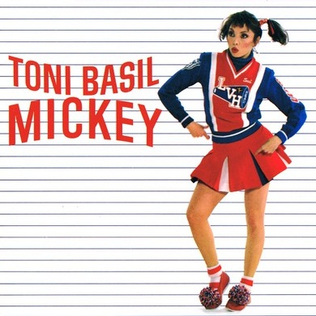
The most famous cheerleader chant in pop history was welded onto a song that did not have it, sung about a boy who used to be a girl, from a record the label thought was a terrible idea. Toni Basil found a forgotten British single, flipped its gender, wrote a cheer squad into the intro, and directed the video herself before most of America had cable. Then she spent the next forty years correcting the myths that grew up around it, including a fake one somebody planted on her Wikipedia page.
"Mickey" began as "Kitty," a 1979 song about a girl written by Nicky Chinn and Mike Chapman and recorded by the British band Racey. Toni Basil covered it for her 1981 debut album Word of Mouth, changed the subject from female to male, renamed it "Mickey," and added the "Oh Mickey, you're so fine" cheerleader chant that Racey never had. It reached number one on the Billboard Hot 100 for the week of December 11, 1982, her only American chart-topper.
It started as a British flop called Kitty
The song Basil built her career on was not hers and was not a hit. Chinn and Chapman, the hit factory behind "Ballroom Blitz" and later "Love Is a Battlefield," wrote "Kitty" for Racey, who put it on their 1979 debut album. It went nowhere. Basil, a working choreographer and dancer who had cut a few records of her own, heard something in it that its own writers had not cashed in. The one problem was the song itself. "It was too cute for me," she told SiriusXM's Volume in 2022. So she took it apart.
The gender flip and the name nobody believes
Basil's first move was to turn the song around. "Kitty" is a woman being sung to. Basil made the target a man and needed a male name to carry the new hook, and she landed on Mickey. That single choice spawned a rumor she has been swatting down ever since: that "Mickey" was named for Micky Dolenz of the Monkees, whose film Head she had choreographed. She says it is nonsense, and she says she knows exactly how it spread. "Some guy decided that it would be funny to put that in my Wikipedia entry," Basil told interviewer Adrienne Day. "He was adamant that Mickey was about Micky Dolenz. I choreographed the Head movie but I didn't really know Micky at all. I knew Davy Jones much better. We finally got it off Wikipedia." The name was a rhyme solution, not a crush.
The cheer chant came from a basketball court in 1959
The part everyone actually remembers, the stomping "Oh Mickey" chant, is the part Racey never recorded. Basil added it, and she traced the idea straight back to her own teenage years as a cheerleader. "I remembered on the basketball courts [in high school], how extraordinary it was when we used to cheer and stomp and clap; I loved it," she told Volume in 2022. She had carried the memory for decades without a use for it. "I couldn't figure out how to use it, but then when I got this opportunity years later, I thought, 'I'm going to write a cheerleader song!'" To an earlier interviewer she put the same memory more plainly: "I remember the echoing in the basketball court of the cheerleaders, of us, stomping and chanting," she told Cuepoint in 2014.
When she went back to watch modern squads for the video, the distance between eras startled her. "And wow, the cheerleaders were really different in 1979, '80 than they were when I was cheerleading in 1959 and '60! I thought, 'Man, this is funky!'" she told Volume. The uniform she wears in the clip was her own from her high school days, and the squad behind her was a real championship team.
Nobody at the label wanted it
The idea that made the song immortal is the idea her record company tried to kill. "The record company thought it was a terrible idea," Basil told Volume in 2022. "Nobody thought it was a good idea." She got the chant onto the recording by tying it to the one thing she controlled, the video, and she has told the standoff as a joke on herself. Her pitch to the label, as she recalled to Volume, ran straight into a punchline: "I'm going to put [the chant] on it. I'm doing a video. And if it ever becomes a single, take the chant off..." Then she cut herself off. "Don't take the chant off!" To Cuepoint she compressed the whole fight into one line: "I said, all right, I'm just going to do it for the video."
That video is why "Mickey" survived. There was barely an outlet for it when she made it. "There was no MTV yet, so they didn't really see the point of a video," Basil told Cuepoint in 2014. "They thought, 'What in the hell is she doing now?' That's been the story of my life: 'What in the hell is she doing now?'" When MTV needed clips to fill its new schedule, Basil already had one ready, and a cheerleader in a Carson High uniform chanting a name became one of the images that sold the channel.
What it became, and what it did not pay
"Mickey" went to number one on the Billboard Hot 100 for the week of December 11, 1982, the only time Toni Basil topped the American chart. She has always framed the timing as luck. "I was lucky that it wasn't released before that. It would have been before its time," she told Cuepoint. The fame did not convert to a fortune, which is the thread that runs through every telling. "It changed my life, but it hasn't changed my bank account," she told Cuepoint in 2014. Four decades later she was still fighting for the ownership of the recording, and she was blunt about why. "I really thought I should put my foot down and receive money for it," she told Volume in 2022.
How the telling has grown over the decades
The spine has held for forty years: a British flop called "Kitty," a gender flip, a cheer chant bolted on from a 1950s memory, a label that hated it, and a video that outran the song. What each interview adds is a different grievance corrected. The 2014 Cuepoint piece is where the pre-MTV skepticism and the "It changed my life, but it hasn't changed my bank account" line live. The 2022 Volume conversation is where the cheerleader memory gets dated precisely to 1959 and 1960, and where the royalties fight becomes the headline. The Adrienne Day interview is where she names the Dolenz rumor as sabotage and says she scrubbed it off Wikipedia. The only real drift is not in Basil's telling at all, it is in the retellings of the chart run: some accounts have "Mickey" dethroned by Lionel Richie's "Truly," when the Billboard table shows the opposite order, "Truly" first and "Mickey" reaching the top for the week of December 11, 1982. When the tellings and the chart disagree, the chart wins.
The honest bottom line
Stripped of nostalgia, "Mickey" is a cover of a failed single, rewritten by someone who was not primarily a singer, over the objections of the people paying for it. Basil did not write the song and has spent decades chasing money from it. None of that undercuts what she actually did. She heard a hit inside a flop, added the one hook that made it unforgettable, and directed the video that turned it into a permanent piece of the culture. The writers made "Kitty." Toni Basil made "Mickey."
FAQ
Was "Mickey" originally called "Kitty"? Yes. The song was written by Nicky Chinn and Mike Chapman and first recorded by the British band Racey as "Kitty" in 1979, sung about a girl. Toni Basil flipped the gender, renamed it "Mickey," and added the cheer chant.
Did Toni Basil write "Mickey"? No. Chinn and Chapman wrote the underlying song. Basil transformed it: she changed the subject from female to male, retitled it, and added the "Oh Mickey, you're so fine" cheerleader chant that the original did not have.
Is "Mickey" about Micky Dolenz of the Monkees? No. Basil has denied this for years and says the claim was deliberately planted on her Wikipedia page. She chose Mickey as a male name to replace "Kitty," and says she barely knew Dolenz despite choreographing the Monkees film Head.
Did "Mickey" reach number one? Yes. It hit number one on the Billboard Hot 100 for the week of December 11, 1982, for one week. It was Toni Basil's only United States number one.
Where did the cheerleader chant come from? From Basil's own memory of cheerleading in the late 1950s. She has said the stomping and chanting on the basketball court stuck with her for decades until she finally used it, adding the chant to the record over the record company's objections.
Sources
- SiriusXM Volume interview with Toni Basil, via Yahoo Entertainment, May 25, 2022
- Cuepoint (Medium), "Toni Basil's Tenacious Tumble to 'Mickey'" by Tom Nawrocki, 2014
- Toni Basil interview with Adrienne Day, as collected at JonKutner.com
- Songfacts, "Mickey by Toni Basil" (songwriter and Racey background)
- Billboard Hot 100 weekly charts, December 1982, and List of Billboard Hot 100 number ones of 1982 (number one, week of December 11, 1982)
Oh Mickey, you are so fine, and so is our sourcing.
Part of Stories Behind the Songs. See also Girls Just Want to Have Fun and I Love Rock 'n' Roll.