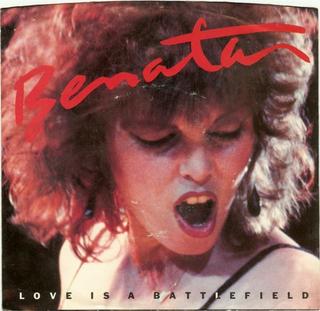
The phone rang in the middle of a writing session and it was Pat Benatar, asking for a hit. The title that ended up defining her career was thrown out as a throwaway example of the kind of weird phrase they should aim for. And when the man who blurted it heard what Benatar's husband had done to the song, he asked for it back.
"Love Is a Battlefield" was written by Holly Knight and Mike Chapman at Chapman's house, minutes after Benatar called to ask Chapman for a song. Knight played the chords, Chapman blurted the title as an example of something strange enough to sit on top of them, and they wrote it as a slow song. Neil Giraldo turned it into an uptempo record over Chapman's objections. It peaked at number 5 on the Billboard Hot 100 on December 10, 1983.
The phone call
Knight has told the origin the same way for more than fifteen years. Her fullest account is in a 2008 Songfacts interview.
"I was at his house, I was just starting to write with him, and Pat Benatar called up and said, 'Mike, I would love for you to write me a song. I'm doing an album, will you write me a hit, please?'" Knight said. "And he goes, 'Well, I'm here with one of my writers, Holly Knight, and we were just going to sit down and write. So we'll write something for you.'"
Chapman hung up and Knight started playing. "So he hung up, and I started playing the chords to 'Love Is A Battlefield.' He said, 'That's so great, I love that, keep doing that.'"
Then came the piece of craft advice that produced the title, which Knight has always credited to Chapman rather than herself. "He says, 'Now, what we really need,' and this is something I learned from him, 'This song is very catchy, very commercial, let's write something really, really weird on top of it. That'll make it special. And it'll be that much better.'"
Knight agreed, and Chapman reached for an example. "He says, 'We're going to write something really sick, like...' and he just spit out 'Love is a battlefield,' as an example. I said, 'Well, that works for me.' And we wrote that song. It was just like free association."
The title was never meant to survive. It was a demonstration of a category, and it stuck because Knight liked it more than the man who said it did.
Writing a song you do not understand
Knight has been open about the fact that neither writer knew what the phrase meant when they committed to it. Speaking to Songfacts again in 2021, she used it as an example of how she works.
"When we wrote 'Love Is A Battlefield,' I remember saying to him, 'I don't know what it means,' and he said, 'We'll figure it out as we're writing it,'" Knight said. "I write a lot of songs that start from just titles."
She has also said the song is one of the rare ones that starts on the chorus. "'Love Is A Battlefield' is one of them," she told Songfacts in 2021. "It's dangerous though, because record people hate it because they think you're already giving the chorus away and that's going to ruin it from being a hit, but that's not true at all. It's just whatever is right for the song."
Knight's fighting titles are a pattern she only noticed when an interviewer pointed it out. "I talked to an interviewer who said, 'All your songs have titles about fighting and that sort of stuff, what's up with that?'" she told Songfacts in 2021. "I didn't know how to answer that, so I went home and I looked at the titles of some of the songs: 'The Warrior,' 'Invincible,' 'Better Be Good To Me,' 'Love Is A Battlefield'... I thought, he's right, and I realized that as a songwriter, I was sort of venting and things were coming out of me. I mean, you write what you know!"
Talking to Can't Get Much Higher around the release of her 2022 memoir I Am the Warrior, she refined that answer. "The songs weren't about fighting with people, though. They were about fighting something external."

The version Chapman tried to take back
Knight and Chapman wrote it slow. What Benatar's guitarist, producer and husband Neil Giraldo did with it is the reason anybody remembers it.
Giraldo told Songfacts he hears finished records on first listen. "And the best example of that probably is 'Love Is a Battlefield,'" he said. "That was a song written very slow, very methodical, boring, like 'We... are... young... heartache... to... heartache...' I mean, it was really slow. As soon as I heard it, I went, 'I don't understand why this song would be so slow.' I just heard it done in the uptempo thing."
Chapman's reaction was not gratitude. "When I did it, and Mike [Chapman] heard it, and I love Mike, he's done so much for me in my life. He's one of the people that I owe everything to, because he's the guy that put all this stuff together for me, but when he heard it, he just went crazy," Giraldo said. "He goes, 'I don't want you to have the song anymore. I hate it. I hate what you've done. It's horrible. I can't listen to it. It's horrible.'"
Then the record charted. "And then it went to #5, and he goes, 'I think it's great!'"
Knight's own first reaction was no warmer, and she has said so plainly. "When Mike and I first heard it we were horrified, we hated it, because it was so different," she told Songfacts. "But then it became such a huge hit, and we had to step out and say, You know, they did a very good rendering of it, and that's how it was meant to be. There's lots of ways you can hear that song, and they're all good."
The record company said no too
The arrangement that everybody now recognizes, built on a programmed loop, nearly did not get released.
"It was difficult for the record company to hear it, too," Giraldo told Songfacts. "Because when they heard it, they went, 'What are you doing? What is this drum machine thing you did? Why did you create this weird loop? Why did you do this? It's horrible. What are you doing? I'm not going to release it. It's wrong.' I go, 'No, it ain't wrong. Song's a hit, I'm telling you. Leave it the way it is.' I battled with them and battled with them, and eventually they said yes."
Giraldo has also said out loud that he understands why the writers reacted the way they did. "But think of it if it was me, where I wrote the song and I gave it to somebody, and I had a vision of what it was and they totally destroyed that thing. I would have said the same thing Mike did. I would have went, 'What the hell are you doing? You ruined my song. What would you do that for?'"
The video that made it a story
The song reached the charts at the moment MTV could still turn a record into an event. Bob Giraldi directed a clip in which Benatar plays a runaway, and it did two things that were unusual for 1983: it put spoken dialogue inside the song to move a plot along, and it built to a full group dance sequence, months before "Thriller" arrived later that year. Dancing was not Benatar's discipline, and she learned the routine anyway.
Bassist Roger Capps, who co-wrote "Hell Is For Children" and played on the album, has named the bass line on this track as his favorite thing he did with the band.
What it did
"Love Is a Battlefield" debuted on the Billboard Hot 100 at number 78 on September 24, 1983, and peaked at number 5 on December 10, 1983, in its twelfth week on the chart. Giraldo's memory of the number is exact, which is rare in this lane, where artists usually get chart facts wrong.
How the telling has grown over the decades
2008, Songfacts. Knight gives the full origin: Benatar's phone call, the chords, Chapman's rule about putting something weird on top of something commercial, and the title blurted as an example. She credits the title to Chapman without hesitation.
Songfacts, Neil Giraldo interview. The other half of the story arrives from the producer's side: the slow original, the uptempo rebuild, Chapman demanding the song back, the label refusing the drum loop, and the eventual number 5.
Songfacts, Knight on the aftermath. Knight confirms Giraldo's account from the writers' side and does not soften her own first reaction: horrified, hated it.
2021, Songfacts. Knight uses the song as a teaching example rather than a memory. She reveals she told Chapman she did not know what the title meant and he told her they would work it out, and she explains why the song opens on its chorus.
2022, Can't Get Much Higher, around her memoir I Am the Warrior. Knight reframes the fighting-titles pattern across her whole catalog: the fight is external, not personal.
Where the tellings drift: Knight in 2008 describes the title as free association and does not mention any confusion about its meaning, while in 2021 the "I don't know what it means" exchange is central. Both can be true, and neither version claims the phrase was profound at the time. Nobody involved has ever claimed authorship of the title except by pointing at Chapman.
The honest bottom line
Nothing about this song was intended. The title was an example, not an idea. The writers wrote it slow and hated the version that made it famous. The label tried to block the arrangement. The video that turned it into a cultural artifact was built around a plot and a dance routine, neither of which the singer specialized in. What holds it together is that everyone involved was good enough that their disagreements produced something better than any one of their intentions, and honest enough afterward to admit they had been wrong. That is rarer than the song. Three years earlier Benatar had become a rock star on Eddie Schwartz's Hit Me with Your Best Shot, another record whose writer hated what it became; this time it was the writers and the label on the same wrong side.
FAQ
What is the story behind "Love Is a Battlefield"? Pat Benatar called Mike Chapman asking for a hit while he was starting a writing session with Holly Knight. Knight played the chords, Chapman blurted "love is a battlefield" as an example of a strange title, and they wrote the song that day as a slow number. Neil Giraldo later rebuilt it as an uptempo record.
Who wrote "Love Is a Battlefield"? Holly Knight and Mike Chapman. Knight wrote the music and Chapman supplied the title. Knight went on to write or co-write "The Warrior," "Obsession," "Invincible," "Better Be Good To Me" and "The Best."
Did the songwriters like Pat Benatar's version? No, not at first. "When Mike and I first heard it we were horrified, we hated it, because it was so different," Knight told Songfacts. Chapman told Neil Giraldo, "I don't want you to have the song anymore. I hate it." Both came around after it became a hit.
Who changed "Love Is a Battlefield" into a fast song? Neil Giraldo, Benatar's guitarist, producer and husband. He said the original was "very slow, very methodical, boring" and that he heard the uptempo arrangement immediately. The record company also objected to his drum loop before agreeing to release it.
How high did "Love Is a Battlefield" chart? It peaked at number 5 on the Billboard Hot 100 dated December 10, 1983, after debuting at number 78 on September 24, 1983.
Was the "Love Is a Battlefield" video really before "Thriller"? Yes. Bob Giraldi's video, with its spoken dialogue and group dance sequence, came out ahead of the "Thriller" video later in 1983.
Sources
- Songfacts, Holly Knight songwriter interview, 2008
- Songfacts, Holly Knight songwriter interview by Carl Wiser, June 17, 2021
- Songfacts, Neil Giraldo interview, as quoted on the "Love Is A Battlefield" song page
- Songfacts, "Love Is A Battlefield by Pat Benatar"
- Can't Get Much Higher, "The Making of a Hitmaking Warrior: A Conversation with Holly Knight," on her memoir I Am the Warrior
- SongwriterUniverse, Holly Knight interview, 2016
- Billboard Hot 100 weekly charts, November 19, November 26, December 3 and December 10, 1983
Love is a battlefield, sourcing is a discipline.
Part of Stories Behind the Songs. See also Eye of the Tiger and What's Love Got to Do with It.