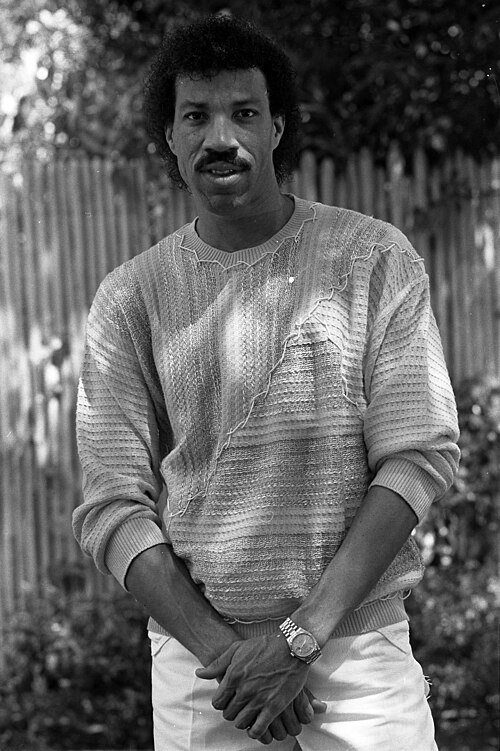
There was a voice on the radio in the early 80s that felt like it was smiling directly at you. Warm, unhurried, impossible to dislike. Whether he was throwing a party in "All Night Long" or aching through "Hello," Lionel Richie had a way of sounding like the most reasonable, welcoming man in America. For a few years he was less a pop star than the friendly host of the entire decade's soundtrack.
Lionel Richie scored five number one solo hits on the US Billboard Hot 100 in the 1980s, including "Endless Love," "All Night Long," and "Hello." Even more remarkably, as a songwriter he had a number one record on the Hot 100 every single year for seven straight years, from 1978 through 1984, first with the Commodores and then on his own. His 1983 album Can't Slow Down was certified Diamond for over ten million copies sold.
The seven-year streak
The stat that captures Richie best is the streak. Starting in 1978, he had a hand in a number one hit every year through 1984, an unbroken run almost no writer has matched. It began with the Commodores, the band he fronted, on "Three Times a Lady" in 1978 and "Still" in 1979. Then he wrote "Lady" for Kenny Rogers, a number one in 1980. Then came his own run: "Endless Love" with Diana Ross in 1981, "Truly" in 1982, "All Night Long" in 1983, and "Hello" in 1984.
Seven years, seven number ones, three different vehicles. That is not a hot streak, it is a decade-defining reign, and it made him one of the most valuable songwriters and performers in the world.
From the Commodores to the top of the world
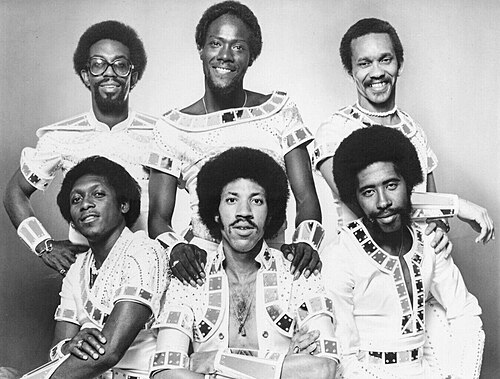
Richie did not arrive as a solo act. He spent the 70s as the Commodores' frontman, and his gift there was already clear: he wrote the tender ballads that crossed the funk band over to the widest possible audience. When he went solo at the start of the 80s, he simply expanded that gift.
The peak was Can't Slow Down, released in 1983. It became a monster, throwing off hit after hit and eventually earning Diamond certification for more than ten million copies sold in the US. His fifth solo number one, "Say You Say Me," arrived in 1985 from the film White Nights. For a stretch there, a new Lionel Richie single was close to a guaranteed smash.
Why radio could not resist him
Richie's superpower was range without edges. He could do the slow-dance ballad, the mid-tempo groove, and the full-on party anthem, and all of it sounded smooth, clean, and welcoming. That made him a programmer's dream. Pop stations, adult contemporary stations, and R&B-leaning stations could all play him without a second thought, so one artist blanketed the dial across formats.
He never alienated anyone. There was no danger, no controversy, no rough edge to skip past. Just song after song built to make a room feel good, which is exactly the fuel radio runs on.
The honest bottom line
The very smoothness that made Lionel Richie unstoppable is also the easiest thing to hold against him. His music rarely takes a risk, and at its softest it can slide toward the bland, the sound of a hotel lobby more than a rebellion. Critics who wanted grit never found it. But that misreads what he was doing. Writing a number one every year for seven years, across a band and a solo career, demands a rare and real command of melody and mood. He made comfort into an art form, and comfort that lasts forty years is not nothing. He remains the smoothest, most universally welcome voice the decade's radio carried. The same chart that rewarded his comfort rewarded Tina Turner's restraint on What's Love Got to Do with It, and the distance between the two says something about how wide the 1984 pop lane really was.
FAQ
How many number one hits did Lionel Richie have? He had five solo number one singles on the US Billboard Hot 100 in the 1980s, including "Endless Love," "All Night Long," "Hello," "Truly," and "Say You Say Me."
What is Lionel Richie's seven-year streak? Richie had a number one record on the Billboard Hot 100 every year from 1978 through 1984, as a Commodores member, as a songwriter for Kenny Rogers, and as a solo artist, an almost unmatched run of consistency.
Was Lionel Richie in a band? Yes. Before his solo career he was the frontman of the Commodores, for whom he wrote ballads like "Three Times a Lady" and "Still" in the late 1970s.
What was Lionel Richie's biggest album? Can't Slow Down, released in 1983. It was certified Diamond in the US for over ten million copies sold and produced several of his biggest hits.
What are Lionel Richie's most famous 80s songs? His signature 80s tracks include "All Night Long (All Night)," "Hello," "Endless Love" with Diana Ross, "Truly," and "Say You Say Me."
Why was Lionel Richie so popular on radio? His range across ballads, grooves, and party anthems all shared a smooth, welcoming sound that fit pop, adult contemporary, and R&B stations at once, letting a single artist dominate many formats.
More from the 80s Radio guide. See also Hall and Oates.
All night long is a fact-checked claim around this place.