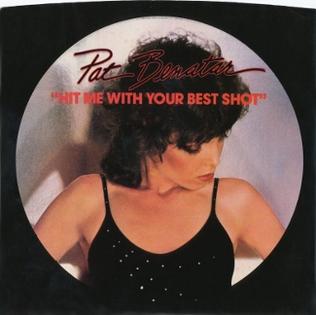
A struggling songwriter punches pillows in an experimental therapy session, walks outside, and a title lands in his head. His publisher, the same company that owns the Beatles catalog, calls it one of the worst songs they have ever heard and orders the master erased. The engineer erases it, then secretly slips him a single cassette copy at dinner. That cassette is why "Hit Me with Your Best Shot" exists, and Eddie Schwartz has told the story, in almost the same disbelief, for close to twenty years.
"Hit Me with Your Best Shot" was written by Canadian songwriter Eddie Schwartz in 1978. The title came to him after a pillow-punching session in a form of therapy called bioenergetics, and he later cut a rough demo overnight, improvising the lyrics. His publisher ATV hated it and erased the master, but the studio engineer kept a secret cassette. Pat Benatar recorded it for her 1980 album Crimes of Passion, and it peaked at number nine on the Billboard Hot 100.
The therapy session that named the song
Schwartz was in his mid-20s, going nowhere, and someone pointed him at an unusual kind of therapy. "It was called bioenergetics, I believe," he told Songfacts. "And one of the things that we did was punch pillows." The title arrived on the way out the door. "So after a session where I punched a lot of pillows... to get out hostility, anxiety, whatever... I walked out on the porch of the place," he told Nashville Scene. "The phrase 'Hit me with your best shot' just came to me, and I thought, 'There's something there.'"
The phrase sat for a long time before it became a song. In the Nashville Scene telling, Schwartz jots the line in a notebook and only writes the song a couple of years later, pulling the notebook out while taking college courses. He has been open about how bad his prospects were at the time. "'Hit Me with Your Best Shot' was written at a time when I couldn't get in the music business," Schwartz told American Songwriter. "I couldn't get my foot in the door anywhere, and I was just about to give up and go back to school. My mother wanted me to go to law school, and I just said, 'No, I'm going to pursue a musical career.'"
The overnight session where he improvised the words
The song's finished form came out of a panic. Schwartz had a publisher interested but no finished songs, so he booked a studio session for the small hours after a gig. On the drive to that gig, the music arrived. As he told Songfacts, "the sky opened up and the entire song just came to me, musically and the chorus. I didn't have the verse lyrics yet." He grabbed a guitar, worked out the chords, and played the gig with the song half-formed in his head.
The lyrics were built live at the microphone as the sun came up. "I stepped up to the microphone and I realized I had no verse lyrics," Schwartz told Songfacts. His fix was to gamble. "Look, just run the tape three times. Whatever I sing the third time, those are the lyrics. And we'll just go with that." That is how the words were written. "I really just improvised the lyrics," he said. He wrote it from a man's standpoint originally, a detail he has kept in every telling.
"That may be the worst song we've ever heard"
Schwartz signed with ATV Music, the publisher that held the Beatles catalog, and brought them a five-song demo. They loved four of the songs. They loathed the fifth. "We think it's beneath you as a writer," Schwartz remembered them saying to Nashville Scene. "That may be the worst song we've ever heard." He told Songfacts the same beat in blunter language, the ATV people saying his "'Best Shot' thing was so bad we don't even want to demo it. It's absolutely pathetic." His verdict on the exchange: "And that was my introduction to the music business."
He spent months in Los Angeles begging ATV to let him cut a proper demo of the song. When they finally relented, they hated the result even more. Recalling the ATV supervisor in the room, Schwartz told Nashville Scene: "We listened back to the demo, and he turned to John and said, 'Erase it.'" The supervisor was unmoved: "Yeah, I hate it. I still think it's one of the worst songs I've ever heard." As Schwartz put it to Songfacts, they "hated it so much they actually erased the master recordings of it."
The cassette the engineer smuggled out
The song survived because of the studio engineer, John Rhys. Dejected and about to fly home to Toronto, Schwartz got a dinner invitation. There, he told Nashville Scene, Rhys "reaches into his breast pocket, takes out a cassette and puts it in my pocket." Rhys had defied his own client. "I had to erase the tape because ATV's one of my biggest clients," Schwartz quoted him saying. "But before I did, I made one copy of it. You can't play it for anybody now, because they'd fire me, but there will come a time and a place."
That surviving copy found its way to a new ATV hire, Marv Goodman, who was still finishing up at Chrysalis Records and played it obsessively. What happened next, Schwartz has always flagged as secondhand. As he told Songfacts, "the story I heard... I wasn't there... was Pat Benatar took a meeting in the office next door and heard it through the wall, got excited about it, and that's how she heard it." Benatar cut it for Crimes of Passion, and the song the publisher tried to erase became her signature hit.
What the song is actually about
For a track that sounds like a taunt, Schwartz's account of the meaning is not about a fight between lovers. "Writing the song was an act of defiance against ... the music business that seemed to have no place for me," he told Nashville Scene. "The 'tough cookie,' you could argue, is the music business, because that's who I was wrangling with, and so far, not winning any battles." He told Songfacts the core is confidence, not sex, that "it's a song about self-confidence. It's a song saying, 'no matter what you throw at me, I can handle it. I can play in your league.'"
He was stung when the song was read the opposite way. "There was some commentary in journals, in newspapers at the time, about it being sexist, about it being encouraging violence against women," he told Songfacts. "Which shocked me. Because A: it was written from a man's standpoint originally, and B: it was always meant metaphorically."
How the telling has grown over the decades
The spine of this story has held since Schwartz sat down with Songfacts in 2007: the pillow-punching therapy, the improvised session, the erased master, the smuggled cassette. The drift is in the timeline and the exact insults. On how long the title sat before he wrote the song, the tellings do not agree: in the 2007 Songfacts version he describes bits of the song circling in his head for a few months before the overnight session, while in the July 2026 Nashville Scene version he jots the line in a notebook and only writes it a couple of years later. On what ATV actually said, the wording shifts between "it's absolutely pathetic" in 2007 and "that may be the worst song we've ever heard" in 2026, two rememberings of the same rejection.
The vivid run-the-tape-three-times detail is strongest in the Songfacts telling; the later interviews lean on the ATV rejection and the cassette rescue instead. And the moment Benatar first heard the song, through an office wall, is a story Schwartz is careful to label as one he was told, not one he witnessed. The bones never move. The small numbers do.
The honest bottom line
Strip the legend and "Hit Me with Your Best Shot" is a demo, improvised at dawn by a broke rhythm guitarist, that the professionals in the room judged to be one of the worst things they had ever heard and physically destroyed. It reached the world only because one engineer broke the rules for a stranger. It has been misread as a song about violence when its writer says it was aimed at the music business that kept slamming doors on him. None of that stopped it. It became Pat Benatar's calling card, the first shot in a run that would peak three years later when Love Is a Battlefield turned her into a video-era icon, and the man who wrote it clearly enjoys telling the story of the people who were sure it was garbage.
FAQ
What is the story behind "Hit Me with Your Best Shot"? Eddie Schwartz came up with the title after a pillow-punching therapy session in the late 1970s, then wrote and demoed the song overnight, improvising the lyrics. His publisher hated it and erased the master, but the studio engineer secretly kept a cassette copy. That copy reached Pat Benatar, who made it a hit.
Who wrote "Hit Me with Your Best Shot"? Canadian songwriter Eddie Schwartz wrote it, words and music, in 1978. He originally wrote it from a man's point of view before Pat Benatar recorded it.
What is "Hit Me with Your Best Shot" really about? Schwartz has said it is about self-confidence and defiance, not violence, and that the "tough cookie" he was wrangling with was really the music business that kept rejecting him.
Did Eddie Schwartz record "Hit Me with Your Best Shot" first? He cut the original demos, but the hit version is Pat Benatar's, released on her 1980 album Crimes of Passion. Schwartz's own recording came later.
How high did "Hit Me with Your Best Shot" go on the charts? It peaked at number nine on the Billboard Hot 100, reaching that spot the week of December 20, 1980, and it became Pat Benatar's first Top 10 hit in the US.
Sources
- Songfacts, "Eddie Schwartz (Hit Me With Your Best Shot)" songwriter interview (Carl Wiser), page dated 2007
- Nashville Scene, "Eddie Schwartz on the Story of 'Hit Me With Your Best Shot,'" July 2026
- American Songwriter, "The Writer's Block: Eddie Schwartz on Writing Pat Benatar's 'Hit Me With Your Best Shot'" (Tina Benitez-Eves), November 2025
- Billboard Hot 100 weekly charts, weeks of December 6, 13, 20 and 27, 1980
Hit us with your best claim, it gets verified.
Part of Stories Behind the Songs. See also I Love Rock 'n' Roll and Jessie's Girl.