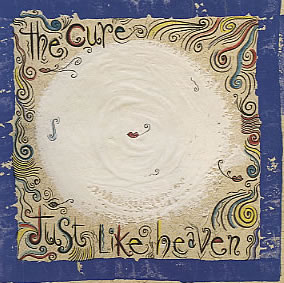
A goth band famous for songs about rain and dread wrote one of the sunniest pop singles of the decade, and the man who wrote it did it by forcing himself to work fifteen days a month so he would not spend the afternoons drinking. The music existed as a French television theme before it had a single word of lyric. And the cliffside where the video was supposedly filmed, the place the whole song is built around, turns out to be a set. Robert Smith has told the story of "Just Like Heaven" in pieces over the years, and the honest version is better than the myth.
"Just Like Heaven" was written by Robert Smith and the Cure during 1987 recording sessions in the south of France, built from a chord sequence Smith developed under a self-imposed regimen of writing music fifteen days a month. The lyric drew on a seaside trip to Beachy Head with his future wife, Mary Poole, who dances with him in the video. Released in October 1987, it became the Cure's first American top 40 hit.
The regimen that produced the chords
The most romantic Cure song came out of an anti-romantic discipline. Smith was living with Mary in a small flat in London, drinking too much, and he set himself a rule. "I set myself a regimen of writing 15 days a month," he told Blender in 2003, "otherwise I'd have just got up in mid-afternoon and watched TV until the pubs opened, then gone out drinking." During that regimen he found the strummed chord sequence that became the song, and he knew immediately what he had. "I knew as soon as I'd written it that it was a good pop song," he said.
He also spotted, later, where the shape had come from. "Although I didn't realize it at the time, the structure is very similar to 'Another Girl, Another Planet,' by The Only Ones, which I can still vividly remember hearing on the radio late at night in the mid-'70s," Smith told Blender. What he added to that borrowed skeleton was the melancholy. "The main difference is that as the song progressed, I introduced some different chord changes, which give it that slightly melancholic feeling."
The song that existed before the words did
Here is a detail almost nobody knows. The music was finished and being broadcast across Europe while the lyric was still a blank page. When the French television show Les Enfants du Rock asked the Cure for a theme, Smith handed over the wordless track. "It meant the music would be familiar to millions of Europeans even before it was released," he explained in the same Blender feature. So the tune reached its first audience as anonymous background music on French TV, and only afterward became "Just Like Heaven."
The arrangement that everyone recognizes, instruments entering one at a time before the vocal, was not Smith's idea. It came from drummer Boris Williams at Studio Miraval in Provence. "He introduced a drum fill that gave me the idea of introducing the instruments one by one before the vocal comes in," Smith told Blender. After years of running the Cure as what he freely called a songwriting despot, Smith had decided Kiss Me, Kiss Me, Kiss Me would be a band record, and the intro is the proof: the most famous fifteen seconds in the Cure catalog belong to the drummer.
Beachy Head, the trick, and Mary
Then Smith wrote the words, and scattered them with pieces of his own life. The opening line, "Show me, show me, show me how you do that trick," reaches back to childhood. It refers to Smith's love of magic tricks as a kid, the small thrill of bamboozling his friends. But he has said the line works on two levels. "On one level, that's what 'Show me how you do that trick' is about," he told Blender, "but on another, it's about a seduction trick, from much later in my life. It was something that happened on Beachy Head, on the South Coast of England."
Beachy Head is a chalk cliff on the English coast, and the song's central memory is a night there with Mary Poole, the girl he met at fourteen and married in 1988, the year after the song came out. Smith has never dressed up what the song is physically describing. "The song is about hyperventilating," he told Blender, "kissing and fainting to the floor." His summary of the whole thing is the line fans hold onto: "The idea is that one night like that is worth 1,000 hours of drudgery."
The video, and the cliff that was really a set
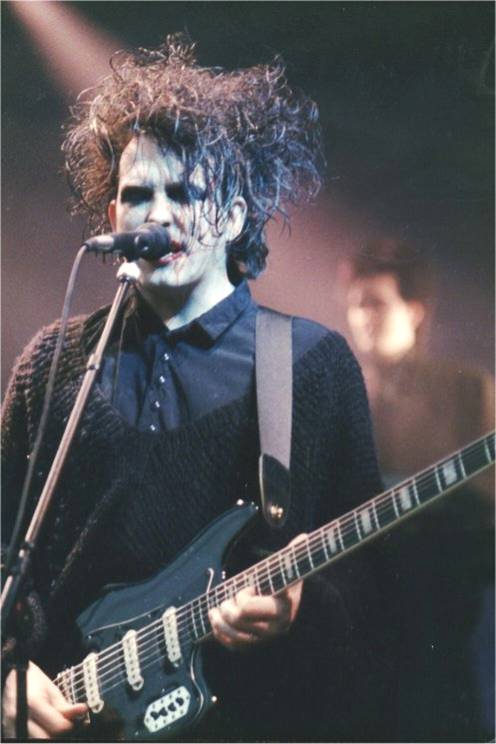
For years Smith let people believe the video was shot at Beachy Head itself, at the very cliff the song describes. Tim Pope, who directed every Cure video from 1982 on, shot it, and it looks like a windswept clifftop over the sea. It was mostly a studio. The bulk of the video was filmed at Pinewood Studios in October 1987, and the real cliff and water footage was not even new: it was lifted from the band's 1985 video for "Close to Me." Smith eventually admitted this, and it is the cleanest example of a habit he has cheerfully confessed to over the years, of improving a true story until parts of it are not true anymore.
One thing about the video is not embellished. The woman in white who dances with Smith during the piano section is Mary. "Mary dances with me in the video because she was the girl, so it had to be her," Smith told Blender. Pope later pointed out what that makes her: "[Poole] can honestly lay claim to being the only featured female in any Cure video, ever."
What it did on the charts
Chart facts here come from the Billboard tables, not from the interviews. "Just Like Heaven" was the third single from Kiss Me, Kiss Me, Kiss Me, which had come out on May 26, 1987. In Britain it reached number 29 and spent five weeks on the chart across October and November 1987, the Cure's eleventh UK top 40 hit. In America it did something the band had never done before: it crossed over. "Just Like Heaven" became the Cure's first US top 40 single, peaking at number 40 on the Billboard Hot 100 in December 1987. It stayed the band's highest Hot 100 placing until "Lovesong" went to number 2 in 1989. It is, as one critic put it, in American terms the one Cure song everyone seems to know. An all-80s radio stream from the Bubble is on the way, and this is exactly the kind of record that made 80s radio worth taping.
How the telling has grown over the decades
The interesting thing about this story is how little Smith gave away at first, and how much later. In September 1987, when the band's own fanzine Cure News asked what the song was about, Smith deflected. He said only that it came from "something that happened to me a long time ago," and told fans to go watch the video. That was the whole answer. The full account, the regimen and the Only Ones and Beachy Head and the seduction trick and Mary, arrives in one place: the November 2003 Blender feature, which is where almost every later retelling of this story is drawing from, whether it says so or not.
The honest drift is not in the words of the song's meaning, which Smith has kept remarkably consistent. It is in the video. Smith spent years letting the clifftop look like a real location and the memory look like documentary, then admitted the cliffs were old footage and the rest was a soundstage. He has been open that he enjoys sanding a story into a better shape, which is worth remembering with any Smith interview: the emotional facts are steady, the production facts sometimes got prettier in the retelling. The spine, a night at Beachy Head with Mary turned into three and a half minutes of pop, never moved.
The honest bottom line
Strip the glow off and "Just Like Heaven" is a calculated pop move by a band that spent the early 80s making some of the bleakest records in Britain, written to a quota by a man trying to outrun his own drinking, over a structure borrowed from someone else's single, with a signature intro handed to him by his drummer. Even the video's romantic location is a fake. None of that dims it. Smith aimed at a perfect pop song on purpose and hit it, and the one thing in the whole enterprise he never faked is the woman it is about. She married him in 1988 and she is still there. Two years earlier, Johnny Marr had built How Soon Is Now? from a similarly borrowed guitar trick and a similarly personal place, and the two records between them hold down opposite poles of what British indie meant in the 1980s.
FAQ
What is the story behind "Just Like Heaven" by The Cure? Robert Smith wrote the music during a self-imposed regimen of composing fifteen days a month, then added a lyric based on a night at Beachy Head on the English coast with his future wife, Mary Poole. The band finished it in France in 1987, and it became the Cure's first American top 40 hit.
What is "Just Like Heaven" actually about? A seaside memory with Mary Poole. Smith has described it plainly as being about "hyperventilating, kissing and fainting to the floor," with the opening "trick" line referring both to childhood magic tricks and to a seduction "much later in my life" at Beachy Head.
Who is the woman in the "Just Like Heaven" video? Mary Poole, Smith's then-girlfriend and, from 1988, his wife. She is the woman in white who dances with him during the piano section. Director Tim Pope noted she is the only featured female in any Cure video.
Was the "Just Like Heaven" video really filmed at Beachy Head? No. Smith claimed for years that it was, but the video was mostly shot at Pinewood Studios in October 1987, and the cliff and sea footage was reused from the Cure's 1985 "Close to Me" video.
Did "Just Like Heaven" go to number one? No. It peaked at number 40 on the Billboard Hot 100 in December 1987, which was still the Cure's first US top 40 hit, and at number 29 in the UK. The band did not reach the US top ten with it.
Sources
- Blender, "The Greatest Songs Ever! Just Like Heaven" (Johnny Black), November 2003, as quoted by Songfacts, Far Out Magazine, and Louder
- Cure News #3, the band's official fanzine, September 1987, as cited by Wikipedia
- Songfacts, "Just Like Heaven by The Cure"
- Far Out Magazine, "The Story Behind The Song: The Cure's Just Like Heaven is Robert Smith's love letter to his wife" (Jack Whatley), October 2020
- Louder / Classic Rock, "The meaning behind The Cure's classic 1987 hit Just Like Heaven"
- Wikipedia, "Just like Heaven (The Cure song)," including the Tim Pope commentary and video production details
- Billboard Hot 100 weekly charts, December 1987, and UK Official Singles Chart, October 1987
A telling just like the others, carefully checked.
Part of Stories Behind the Songs. See also Time After Time and In the Air Tonight.