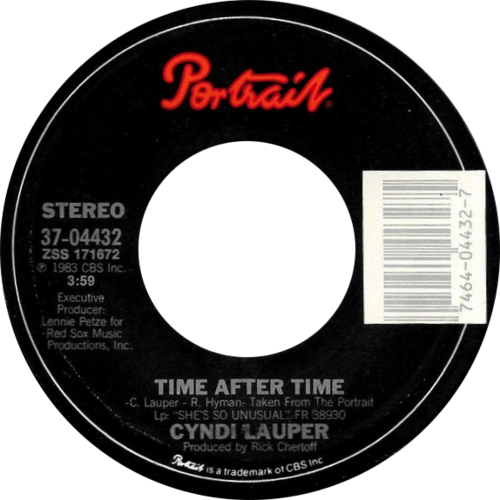
The title was a placeholder pulled from a TV listings magazine, and it was never supposed to stick. The clock ticking in the lyric was a real windup clock grabbed from somebody's mother's house. The whole song was written after everyone else had gone home, by two people who barely knew each other, trading the details of their falling-apart love lives across a piano. And the version you have heard ten thousand times is not a polished recording. It is the first take. Cyndi Lauper and Rob Hyman have told this story for four decades, and the more they tell it, the more it sounds like an accident that refused to stay small.
"Time After Time" was written in 1983 by Cyndi Lauper and Rob Hyman of the Hooters, at the end of the sessions for her debut album She's So Unusual, after producer Rick Chertoff asked for "one more song." Lauper took the title from a TV Guide listing for the 1979 film Time After Time and meant it only as a placeholder. The pair poured their real breakups into the lyric, and the song became Lauper's first number one, topping the Billboard Hot 100 on June 9, 1984.
The last song on the album
The album was nearly finished when the song that made it did not yet exist. Lauper had a Portrait Records deal, a producer in Rick Chertoff, and a band assembled largely from the Philadelphia group the Hooters, chiefly Eric Bazilian and Rob Hyman. They had already cut the songs that would carry the record. Then Chertoff asked for more.
"With 'Time After Time,' we wrote that very quickly," Hyman told Songfacts. "We had all the songs chosen, and quite simply the producer, Rick Chertoff, suggested to all of us that the album could use 'One more song.' We had 'Girls Just Want To Have Fun,' we had 'She Bop,' we had 'All Through The Night,' we had what would end up being really strong songs." Chertoff, Hyman noted, said that about every album. This time he was right. "We had most of the album recorded and we were close to mixing the record when he suggested this fateful 'one more song.' Cyndi and I sat at the piano one night and after the sessions we would just stay in the studio. It was over several days." They worked at the Record Plant in New York, throwing ideas "into a cassette machine."
Lauper was glad of the partner. "I was so happy when Rob wanted to write together," she told the Wall Street Journal in 2015.
A title from a TV Guide
The song started, unusually, from its name. "We started by putting together a list of song titles," Lauper told the Wall Street Journal. "I thumbed through a TV Guide magazine. One movie title seemed good ... a sci-fi film called 'Time After Time' from 1979. I never meant for it to be the song's real title. It was just supposed to get me thinking." The film was a science fiction picture in which H.G. Wells chases Jack the Ripper through time. Lauper only wanted a phrase to write toward.
Hyman remembers the moment as more decisive than a placeholder. "When she saw Time After Time, something clicked," he told Songfacts. "She said, 'I think I have a title.'" That small gap between their memories, a throwaway to her, a lightning strike to him, is the first sign of how a shared song splits into two tellings. Either way, the phrase held. Lauper later said she tried to change it and could not, because by then the title had become so fundamental that the song would fall apart without it.
Then the music came, fast and simple. "I was sitting at the piano and just started banging out what would eventually be the chorus, hook, and the way we sing it," Hyman told Songfacts. "It almost had like a reggae feel, it was a little bouncier and a little more upbeat." What survived was stark. The verses, he said, were "just a little repeating three-note motif," something "almost like a nursery rhyme." They built the chorus around the two words Lauper had found. "We had 'Time After Time,'" Hyman said, "we just had to get the words that would surround it."
Two strangers and their breakups
The reason the song aches is that both writers were hurting when they wrote it, and they barely knew each other well enough to be embarrassed about it. Hyman was coming out of a relationship. Lauper was struggling with her boyfriend and manager, David Wolff. That combination, raw feeling plus near-strangers, is what Hyman credits for the honesty.
"At this point, we were both going through some personal relationships and some personal things that were both meaningful and deep for us, and somehow the lyrics just started to come out," Hyman told Songfacts. "It's almost one of those things where you can open up to a stranger or a more casual acquaintance than a deep friend or family member." He was blunt about the source: "for me it was a relationship that was just breaking up and for Cyndi with her manager, which was also a personal relationship." The result, he said, was that "the song reflected that mood."
Some of the most specific images came from real objects and real lines. Hyman brought in the phrase "suitcase of memories," which, according to Lauper's memoir, struck her as a wonderful line. And the clock that opens the song was not a metaphor reached for at the piano. Hyman grabbed a windup clock from his mother's house, and it fed the lyric "Lying in my bed I hear the clock tick and think of you." 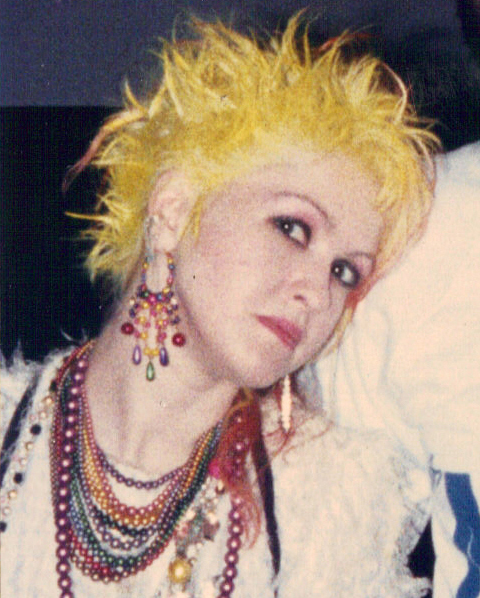
The song was written in pieces across two cities, Lauper in New York and Hyman in Philadelphia. "With the chorus and two verses in place, we still needed a third," Hyman told the Wall Street Journal. "We came up with the last verse over the phone when I was back home in Philadelphia."
First take
There is no demo of "Time After Time." What sounds like a demo is the record. Every other song on the album had been worked to death in rehearsal first. This one had no time for that.
"We never did a demo of the song," Hyman told Songfacts. "We just kind of bashed it out on the piano over a couple of days, maybe a week or two period. It really did happen pretty quickly, and we needed to because the album was being finished." They skipped straight past the usual process. "The demo was what you hear. That was literally the first real recording besides some little cassette ideas." Because the album was closing, they went directly to the master tape. "We went right to the tape, and what you hear is our first take on it, which I think added so much to the overall feel of that song." The vocal was captured in the same rush. "Her vocal was incredible. I think she was singing it and we were playing it for the first time. That's such a rare thing to happen, and I know that communicates to people."
Lauper put the same idea more simply years later. The song, she said, had "real moments of humanity in it."
Her first number one
"Time After Time" was the follow-up to "Girls Just Want to Have Fun," and it was the one that proved Lauper could write. It entered the Billboard Hot 100 at number 53 on April 14, 1984, and rose for eight weeks. On June 9, 1984, it reached number one, knocking Deniece Williams' "Let's Hear It For The Boy" off the top. It stayed at number one the following week as well, June 16, holding off Duran Duran's "The Reflex," which gave it two weeks at the summit. It was the first number one single of Lauper's career, released on the Portrait label.
The reach went far past pop radio. Miles Davis fell for the melody and played an instrumental version in nearly every concert from 1984 until shortly before his death in 1991. Lauper has called his the favorite of the countless covers: "I mean it's Miles. Wow. Mindblowing!"
How the telling has grown over the decades
The story has been told the same way at its spine and refined at its edges. In her 2012 memoir, Lauper laid down the emotional core: the placeholder title she could not shake, the breakups behind the words, the "suitcase of memories" line that struck her. In the 2015 Wall Street Journal account, both writers filled in the mechanics: the TV Guide, the demos cut at the Hooters' Philadelphia warehouse they called "the Ranch," the windup clock, the last verse finished over the phone. Rob Hyman's Songfacts interview is where the studio detail lives: the piano origin, the nursery-rhyme verses, the single first take that became the master. By the time of the 2021 Rolling Stone video piece, both were reflecting less on how and more on why it lasted.
The one honest seam is the title. Hyman remembers Lauper announcing "I think I have a title" the moment she saw the movie name. Lauper remembers it as a placeholder she "never meant" to keep, one she later tried and failed to replace. Both can be true. That is what happens when two people write one song and then answer the same question for forty years.
The honest bottom line
Nothing about "Time After Time" was planned as a landmark. It was the extra song at the end of a finished album, built on a title yanked from a TV listings magazine, written by two people who had known each other only months. The recording is a first take they never intended as the final version. And the reason it works is almost unfair: the writers happened to be nursing real heartbreaks at the same moment and happened to be strangers enough to admit it. The craft is real, the melody is deceptively plain, and the feeling is not manufactured. It became Lauper's first number one, a jazz standard in Miles Davis' hands, and one of the few 80s ballads that has never once sounded dated. The accident held.
FAQ
Who wrote "Time After Time" for Cyndi Lauper? Cyndi Lauper co-wrote it with Rob Hyman, a founding member of the Philadelphia band the Hooters, who also sang backing vocals on the record. It was the first song the two ever wrote together, created near the end of the sessions for her 1983 debut album She's So Unusual and produced by Rick Chertoff.
Where did the title "Time After Time" come from? Lauper found it in a TV Guide, in a listing for the 1979 science fiction film Time After Time. She has said she meant it only as a placeholder to get her writing, not as the final title, but it stuck. She later felt the song would fall apart under any other name.
What is "Time After Time" about? It is a love song about devotion and reassurance, and both writers drew it from their own relationships. Hyman was coming out of a breakup and Lauper was struggling with her boyfriend and manager, David Wolff. Hyman has said they opened up to each other precisely because they were near-strangers.
When did "Time After Time" hit number one? It reached number one on the Billboard Hot 100 on June 9, 1984, and held the top spot for two weeks. It was Cyndi Lauper's first number one single, the follow-up to "Girls Just Want to Have Fun."
Is the recording of "Time After Time" a first take? Essentially, yes. Hyman has said the song was never demoed in the usual way. Because the album was being finished, they went straight to the master tape, and the version people know is close to the first full take of the performance.
Did Miles Davis really cover "Time After Time"? Yes. Miles Davis recorded an instrumental version in 1985 and played the melody in nearly all of his concerts from 1984 until shortly before his death in 1991. Lauper has named his version her favorite of all the covers.
Sources
- Songfacts, "Time After Time" song page and Songfacts interview with Rob Hyman
- The Wall Street Journal, "How Cyndi Lauper Wrote Her First No. 1 Hit, 'Time After Time'" (Marc Myers), December 1, 2015, as reported by Philadelphia Magazine (Josh Middleton), December 2, 2015
- Cyndi Lauper: A Memoir (Simon and Schuster, 2012), as cited by Wikipedia
- Rolling Stone, "'The Breakdown': Cyndi Lauper, Rob Hyman Recall Making of 'Time After Time'" (Brittany Spanos), June 21, 2021
- Wikipedia, "Time After Time (Cyndi Lauper song)"
- Billboard Hot 100, weeks of June 9 and June 16, 1984
If you fall, the record catches you, time after time.
Part of Stories Behind the Songs. See also Girls Just Want to Have Fun and Total Eclipse of the Heart.