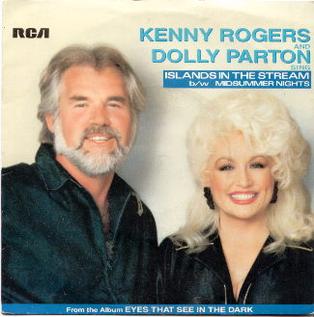
Kenny Rogers spent four days singing a song he had come to hate. The three brothers who wrote it could not agree, then or later, which soul singer they had written it for. And the fix arrived because the woman who saved the record happened to be working in the same building that afternoon.
"Islands in the Stream" was written by Barry, Robin and Maurice Gibb, named after the Ernest Hemingway novel, and originally intended as an R&B song. Barry Gibb has always said it was written for Diana Ross. Kenny Rogers cut it for his 1983 album Eyes That See in the Dark, struggled with it for four days, and Gibb called for Dolly Parton, who was in the same studio building. It reached number one on the Billboard Hot 100 dated 29 October 1983.
Who the song was actually written for
This is where the story splits, and it has never been put back together.
Barry Gibb's version has not moved in forty years. Talking to Billboard in January 2021 about his Greenfields album, he laid it out in one line: "'Islands in the Stream,' for instance, was written for Diana Ross, but when I agreed to work with Kenny [Rogers], he wanted to do a duet with Dolly." He went further on what the Gibbs did and did not know they had: "we knew it was good, we knew it was potentially very strong, but we didn't know it was a duet. So we just went to work on that, and the R&B song became a country song."
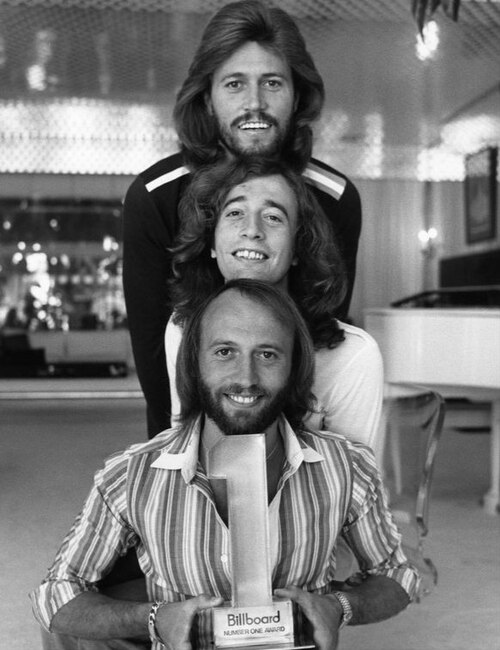
Robin Gibb told it differently, and told it on national television. In a 2001 Good Morning America interview with the Bee Gees, Barry said the song was written for Ross and Robin cut across him: "No, we wrote it for Marvin Gaye ... We sent it to him but he was dead so it was a bit difficult for him to sing it."
The chronology check
That claim has a problem, and it is not a small one.
Marvin Gaye died on 1 April 1984. "Islands in the Stream" was released as a single on 15 August 1983, and Dolly Parton's own website dates her vocal session to 3 July 1983. Wikipedia's infobox puts the recording in May 1983. Every one of those dates sits before Gaye's death by between eight and eleven months. Whatever happened when the Gibbs shopped the song, Gaye was alive for all of it. Robin Gibb's memory of a dead recipient cannot be describing 1983.
Robin also gave a softer version elsewhere, and the softer version survives the calendar without a scratch: he described the song as being written "... as a Tamla kind of soul song in a Marvin Gaye type feel," which is a statement about style, not about a recipient. That reading fits Barry's account exactly. An R&B song, aimed at the Motown end of the dial, written with Diana Ross in mind.
The Gaye version has spread anyway, because it is the better anecdote. It sits on Dolly Parton's own official site, which states plainly that the brothers "wrote the song originally for Marvin Gaye." Songfacts carries a third variant, crediting a BBC Breakfast appearance on 10 March 2009 where Maurice Gibb said Gaye was sent the song and turned it down. Maurice Gibb died on 12 January 2003, six years before that date, so the attribution cannot stand as written.
Three brothers, one song, and no agreed answer. Robin died on 20 May 2012 and Maurice in 2003, so the only writer left to ask is Barry, and Barry has never budged off Diana Ross.
Four days of Kenny Rogers hating it
The recording story, by contrast, is told the same way by everybody who was there.
Rogers had signed to RCA and picked Barry Gibb as his producer, an odd pairing that produced Eyes That See in the Dark. "Islands in the Stream" was handed to him as a solo. It did not work. Rogers told the story to People magazine, quoted by Smooth Radio in 2020: "The story is the producer and the writer on the song was one of the Bee Gees, Barry Gibb." Then the part every singer dreads admitting: "And we had been singing this song in my studio in L.A. for four days. And I finally said, 'Barry, I don't even like this song anymore.'"
Gibb's answer was a name. "And he said, 'We need Dolly Parton.' I said, 'Well, why not, you know?'. And Ken Kragen, my manager said, 'I saw her downstairs.' I said, 'Well, go get her.'"
What happened next is the line Rogers repeated for the rest of his life: "And Dolly, in her inimitable fashion, marched into the room and the song was never the same." A shorter version of the same sentence sits on Parton's official site: "Once she came in [the studio], that song was never the same. She lit it up and we became good friends from that point on."
Dolly's side of the same afternoon
Parton has told her half of it for four decades, and she was still telling it in 2023. Speaking to Smooth Radio that July, forty years after the fact, she gave the version she got from Barry Gibb himself: "It's like Barry said, they said they tried to find the right people, they didn't know what they were going to do with the song, almost dumped it. And then Barry asked Kenny if he knew a girl named Dolly Parton and Kenny said, 'yeah, I think I do, I think I could reach her'."
Then the geography that made the record: "And I happened to be right up the street so that was just meant to be. And so I went down and within two or three hours we had that whole record done."
Two or three hours, against Rogers's four days. She has never claimed credit for the save beyond that arithmetic. What she does claim is the choice: "That's another thing I'm as proud of as anything I ever did in my musical career to make the choice to do that."
Rogers died on 20 March 2020. Parton's line about him in that 2023 interview was flat and unadorned: "I can't believe it's been 40 years and I miss Kenny every day because we had a great, great relationship."
All three surviving Gibbs sang on the record. Barry and Maurice Gibb are on it as backing singers and musicians, which is why the chorus sounds like a Bee Gees record wearing a cowboy hat.
What it did on the charts
The song entered the Billboard Hot 100 at number 58 on 27 August 1983. Nine weeks later, on the chart dated 29 October 1983, it went to number one and knocked Bonnie Tyler's "Total Eclipse of the Heart" down to number two. It held the top spot again on 5 November 1983, with Lionel Richie's "All Night Long (All Night)" at number two, and Richie took it from them on 12 November 1983.
Two weeks at number one on the pop chart, plus number one country and number one adult contemporary. It was the second pop number one for each of them: Rogers had "Lady" in 1980, Parton had "9 to 5" in 1981.
How the telling has grown over the decades
The recording story stabilized early and has barely changed. Rogers told the four-days-and-fetch-Dolly version to People and to interviewers for the rest of his life, and Parton's 2023 Smooth Radio telling matches it beat for beat, adding only the detail that the song was nearly abandoned and that her part took two or three hours.
The origin story went the other way. It got less settled over time, not more. Barry Gibb said Diana Ross in the early tellings and said Diana Ross again to Billboard in January 2021. Robin's 2001 Good Morning America interruption introduced Marvin Gaye as the intended recipient, in a form that the calendar contradicts, and Robin himself elsewhere described only a Marvin Gaye type feel. Songfacts adds a Maurice telling with a date that postdates Maurice's death by six years. Parton's own official website has adopted the Gaye version outright.
None of that gets smoothed here. Barry Gibb is the last writer standing and his account is the one that survives a date check. The Gaye story is documented, repeated, and loved, and it is told by people who were in the room. Both facts are true at once, and the sensible reading is Robin's second one: the song was written to sound like Marvin Gaye, not written for him.
The honest bottom line
Strip the affection away and this is a leftover. It was an R&B song aimed at somebody else, handed to a country singer who could not make it work and openly said so, rescued by a guest vocalist who was recruited because she was down the hall. The writers cannot agree on who it was for. Nobody involved planned any part of the thing that made it immortal. And it still knocked "Total Eclipse of the Heart" off number one, still topped three formats at once, and still empties every wedding bar in America the second the first line lands, because Rogers and Parton sound on tape like two people who genuinely like each other, which they were.
FAQ
What is the story behind "Islands in the Stream"? The Bee Gees wrote it as an R&B song named after the Hemingway novel. Kenny Rogers spent four days failing to make it work as a solo, and producer Barry Gibb suggested Dolly Parton, who was recording in the same building. Her vocal turned it into a duet and a number one.
Who wrote "Islands in the Stream"? Barry, Robin and Maurice Gibb. Barry Gibb also produced Kenny Rogers's album Eyes That See in the Dark, and he and Maurice sang backing vocals on the record.
Was "Islands in the Stream" written for Marvin Gaye? Barry Gibb has always said it was written for Diana Ross. Robin Gibb said on Good Morning America in 2001 that it was written for Marvin Gaye and that Gaye was dead when they sent it. Gaye died on 1 April 1984, months after the record was made and released, so that account does not fit the dates. Robin elsewhere described only a Marvin Gaye type feel.
How did Dolly Parton end up on the record? Rogers was ready to abandon the song. Gibb said they needed Dolly Parton, and Rogers's manager Ken Kragen had seen her downstairs in the same building. Parton has said the whole record was finished within two or three hours of her walking in.
Why is it called "Islands in the Stream"? It is named after Ernest Hemingway's novel Islands in the Stream, published in 1970, the first of his books released after his death.
When was "Islands in the Stream" number one? It topped the Billboard Hot 100 on the charts dated 29 October 1983 and 5 November 1983, replacing Bonnie Tyler's "Total Eclipse of the Heart" and being replaced by Lionel Richie's "All Night Long (All Night)."
Sources
- Billboard, Barry Gibb interview on the Greenfields album, 5 January 2021
- Smooth Radio, "Dolly Parton recalls 'Islands in the Stream' 40 years on" (Tom Eames), 7 July 2023
- Smooth Radio, "The Story of... 'Islands in the Stream'" (Tom Eames), 21 March 2020, quoting Kenny Rogers's account given to People magazine
- Dolly Parton official site, "'Islands in the Stream' Duet With Kenny Rogers," carrying Kenny Rogers's studio quote
- Songfacts, "Islands In The Stream" song page
- Wikipedia, "Islands in the Stream (song)," for the 2001 Good Morning America exchange, release date, credits and recording details, plus Wikipedia entries for Marvin Gaye, the Bee Gees and Kenny Rogers for death dates
- Billboard Hot 100 weekly charts, 29 October 1983, 5 November 1983 and 12 November 1983
Two voices, one verified telling, that is how it works.
Part of Stories Behind the Songs. See also 9 to 5 and Total Eclipse of the Heart.