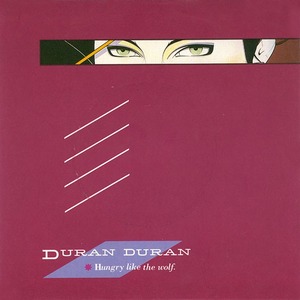
The song that broke Duran Duran in America, won the first video Grammy, and turned five men in makeup into international heartthrobs was written in a single afternoon, by a hungover band messing around with brand-new machines, and finished, as the bass player likes to say, by cocktail hour. The menacing lyric about a predator on the hunt was inspired by Little Red Riding Hood, a detail the guitarist did not even clock at the time. The famous laugh at the start belongs to the keyboard player's girlfriend. "Hungry Like the Wolf" sounds like a carefully engineered assault. It was closer to a lucky Saturday.
"Hungry Like the Wolf" was written and recorded by Duran Duran in a single day in spring 1982 at EMI's demo studio in London, built up as each band member arrived. Andy Taylor created the guitar riff, Nick Rhodes the synth sequence on a Roland Jupiter 8, and Simon Le Bon a lyric loosely inspired by Little Red Riding Hood. Released on the album Rio, it reached number 3 on the Billboard Hot 100 in 1983 and became the band's American breakthrough.
Built in a day, one member at a time
Every version of this story agrees on one thing: it was fast. Bassist John Taylor has described it as being "written very quickly," and his account of the day is the clearest anyone has given. "It was a Saturday afternoon, we were in EMI's demo studio, a studio they had up in Manchester Square HQ, and I think Nick and Andy were kind of messing around," he told The A.V. Club in 2012. "Andy had the riff, Nick developed this sequence, Simon had a thing, Roger came in and played 'cause he'd just bought some Simmons drums, so that was where he got those big fills from. I came in, and they'd been working for maybe two hours, and I just knew exactly what to play. The song was probably written by cocktail hour."
That is the whole method. No agonizing, no rewrites. Each member walked in, added his piece to what was already taking shape, and by evening the song existed. It is the opposite of a labored masterpiece. It is a band catching lightning because everyone happened to know exactly what to do.
The hangover and the new machines
There is a reason they were all in the studio on a Saturday, and it is not discipline. According to Nick Rhodes, he and Le Bon had been out drinking the night before, and the session was partly an attempt to work off a "terrible hangover." Rhodes had an idea brewing before he even arrived. "We got in quite early and we'd been listening to something in the car and we got a sort of idea," he recalled. From there it moved fast. "Simon had an idea for a lyric and by lunchtime when everyone else turned up, we pretty much had the song."
The sound came from gear that was brand new in 1982. This was the moment synthesizers, sequencers, and drum machines were reshaping pop, and Duran Duran leaned straight into it. Andy Taylor linked a Roland 808 drum machine to a sequencer and a Roland Jupiter 8 keyboard to get the song's distinctive pulsing track. "That track came from fiddling with the new technology that was starting to come in," Taylor told Blender in 2002. He remembered the exact moment it clicked: "As soon as we heard that, we knew we had something." On top of the machines he laid a guitar riff he has described as a Marc Bolan-flavored, Marshall-sounding lick, the human snarl over the electronic click.
The wolf came from a fairy tale
For a song that sounds like pure predatory menace, the lyric has an almost silly origin. Andy Taylor built the rest of the track around Le Bon's words without knowing where they came from. "Then we added the bass and drums, and the whole track was finished that day, including Simon's vocal melody and lyric," Taylor told Blender. Then the punchline: "He has a great ear for putting a melody to a bunch of chords. I didn't realize it at the time, but his inspiration for that lyric was Little Red Riding Hood!"
There were other odd threads feeding the wolf. Le Bon had jotted the title phrase in his notebook, drawn partly to the kind of predatory rock-god image Jim Morrison had cultivated. And the repeated "do do do" that ends each verse is not original either. Its melody is lifted from the instrumental line in Gordon Lightfoot's "If You Could Read My Mind." So the most famous hook of the New Romantic era is a folk melody borrowed from a 1970 soft-rock ballad. The predatory growl and the panting at the edges of the record, the laugh that opens it and the moan that closes it, were performed by Nick Rhodes's girlfriend Cheryl, who also supplied the laugh on "Rio."
MTV, Sri Lanka, and orange hair
The song was a good record. The video made it a phenomenon. Directed by Russell Mulcahy, the man who had directed the very first clip MTV ever aired, it was shot in Galle, Sri Lanka, loosely modeled on Apocalypse Now, with the band hunting through an exotic landscape and Le Bon running sweat-soaked through a market. It landed on MTV exactly when the young channel needed exactly this, and it made the band famous in places that had never heard them. Drummer Roger Taylor remembered the culture clash. "We'd go to Alabama or Texas and the girls would be screaming and the guys in cowboy hats would be looking at us with clenched fists," he told Q magazine in 2008. "I don't suppose they'd seen so many guys in make-up pouting before." Le Bon saw the mechanism clearly: "Video made it possible to create a cult of personality across the globe. You arrive on a tour bus and they'd already seen us on a yacht in a video."
Even the look was partly an accident. The night before the shoot, Le Bon went to get blond highlights and the job was botched, turning his hair orange, which is why he spends the video in a hat.
 In 1984 the "Hungry Like the Wolf" video helped Duran Duran win the very first Grammy awarded for Best Short Form Music Video. This is exactly the sort of song and image that made MTV-era radio impossible to ignore, and an all-80s stream from the Bubble is on the way.
What it did on the charts
The chart facts come from the Billboard tables. "Hungry Like the Wolf" was a single from Rio in 1982, but its big American moment came on a US re-release. It climbed to number 3 on the Billboard Hot 100 in March 1983, the band's breakthrough hit in the United States, and reached number 5 on the UK Singles Chart. It never went all the way to number one on the Hot 100, which is worth stating plainly, but for a British synth band that Americans could previously hear and not see, cracking the top three was the moment everything changed.
How the telling has grown over the decades
Because all five members were in the room, the story of "Hungry Like the Wolf" comes in five slightly different shades, and the drift is worth noticing. Andy Taylor, in his 2002 Blender telling, centers the technology and his own riff. Nick Rhodes centers his car idea and the hangover and Le Bon's lyric arriving by lunchtime. John Taylor, in his 2012 A.V. Club account, centers the group chemistry and his own instant instinct for the bassline. Each man naturally remembers his own contribution most vividly, which is exactly what happens when a song is genuinely collaborative and nobody is really the sole author.
What every telling agrees on is the shape of the day: one Saturday, a fast build, each member adding a layer as he walked in, the whole thing essentially done by evening. The differences are in emphasis, not in facts, and none of them contradict the core. If anything, the small variations are the proof that it really was a group effort. There is no single genius to credit, so everyone remembers being the one who knew what to do.
The honest bottom line
Strip the leather and the yacht and the Sri Lankan jungle away, and "Hungry Like the Wolf" is a hungover jam session with expensive new toys, a borrowed folk melody, and a lyric quietly based on a children's fairy tale, knocked out in an afternoon by a band that was not trying to make anything profound. That is not a knock. It is the whole appeal. The song does not survive because it is deep. It survives because five people in a room caught a groove on a Saturday, moved fast, and did not overthink a single second of it. Sometimes the throwaway is the masterpiece. Two years later Nile Rodgers would rescue the band's American ambitions by remixing The Reflex into their first American number one, but this is the song that got them through the door.
FAQ
How was "Hungry Like the Wolf" written? In a single day in spring 1982 at EMI's demo studio in London. The band built it up piece by piece as each member arrived: Andy Taylor's guitar riff, Nick Rhodes's synth sequence, Roger Taylor's drums, John Taylor's bass, and Simon Le Bon's lyric and melody. Bassist John Taylor says it was "probably written by cocktail hour."
What is "Hungry Like the Wolf" about? On the surface it is a predatory chase, a hunter pursuing his target. Simon Le Bon's lyric was loosely inspired by the fairy tale Little Red Riding Hood, a detail guitarist Andy Taylor says he did not even realize while they were recording it.
Who does the laugh at the beginning of "Hungry Like the Wolf"? Cheryl, the girlfriend of keyboardist Nick Rhodes. She provided the laugh at the start and the moaning at the end, and also did the laugh heard on the band's song "Rio."
Did "Hungry Like the Wolf" reach number one? No. It peaked at number 3 on the Billboard Hot 100 in March 1983 and number 5 in the UK. It was still the band's American breakthrough and helped their video win the first Grammy for Best Short Form Music Video in 1984.
Where was the "Hungry Like the Wolf" video filmed? In Galle, Sri Lanka, directed by Russell Mulcahy and loosely based on the film Apocalypse Now. Simon Le Bon wears a hat throughout because a hair-dyeing job the night before had accidentally turned his hair orange.
Sources
- Songfacts, "Hungry Like The Wolf by Duran Duran," including John Taylor's 2012 A.V. Club interview and the band's 2008 Q magazine comments
- American Songwriter, "The Meaning Behind Duran Duran's Futuristic Hit 'Hungry Like the Wolf'" (Cillea Houghton), August 11, 2023, quoting Andy Taylor and Nick Rhodes
- Blender magazine interview with Andy Taylor, 2002, as quoted by Songfacts and American Songwriter
- Q magazine, February 2008, Roger Taylor and Simon Le Bon, as quoted by Songfacts
- Wikipedia, "Hungry Like the Wolf," for the Gordon Lightfoot melody detail and chart history
- Billboard Hot 100 weekly charts, 1983
Hungry for the real story, fed by the record.
Part of Stories Behind the Songs. See also True and The Safety Dance.