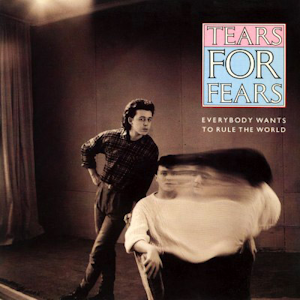
The biggest American hit of Tears for Fears' career is the song its main writer did not want to make. It started as two chords played almost as an afterthought at the very end of the album sessions. It rode a beat the band itself called "alien." It was sung by the member who was not even in the room when it was written. And it was expected to disappear as forgotten album filler. Instead a producer chasing the American charts pushed it through against the songwriter's shrug, and it went to number one. Roland Orzabal has spent forty years admitting he was wrong.
"Everybody Wants to Rule the World" was written by Roland Orzabal, Ian Stanley, and producer Chris Hughes as a last-minute addition to Tears for Fears' 1985 album Songs from the Big Chair. Orzabal did not like it and nearly left it off. Hughes pushed to record it, chasing American success. Recorded in about two weeks and sung by Curt Smith, it topped the US Billboard Hot 100 on June 8, 1985, and stayed there for two weeks.
The album that almost was not
Tears for Fears were not relaxed when they made this record. Their debut, The Hurting, had gone to number one in the UK, and the label wanted a fast follow-up. The band refused to play along. "There was record-company pressure after the first album," Curt Smith told the Los Angeles Times in 1985. "It was successful worldwide and they wanted us to do another album, no matter what the quality ... just as long as we did it quickly. But we weren't willing."
They took their time, and even threw work away. "We started an album at the end of 1983, but we didn't like it," Smith told the Times. "It was too much like the first one, and we were determined to do something different." What emerged more than a year later was Songs from the Big Chair, anchored by the towering "Shout." As far as the band was concerned, the singles were already chosen. The song that would become their signature had not been written yet.
Two chords at the end of the sessions
The song arrived almost as an accident. Producer Chris Hughes heard Orzabal fooling with a couple of chords near the end of the long "Shout" sessions, and that was the seed. "I just had a rhythm on a rhythm machine, and had an acoustic guitar with the bottom string tuned down," Orzabal told the Orlando Sentinel in 1985. "I really didn't think it would be a hit."
Hughes, who would take a co-writing credit alongside Orzabal and Ian Stanley, has always been blunt about how little labor it took. "'Everybody Wants to Rule the World' was so simple and went down so quickly, it was effortless, really," he told Mix magazine. "In fact, as a piece of recording history, it's bland as hell." The track was cut in roughly two weeks and dropped in as the final song on the album, the last thing anyone expected to matter.
The song Orzabal did not want
The strangest fact about a career-defining hit is that the man who wrote most of it kept trying to wave it off. He has been consistent about this for decades. "If it wasn't for Chris, I don't think 'Everybody Wants to Rule the World' would even be a song," Orzabal told Super Deluxe Edition in 2020. "He pushed that, 100 percent. I didn't like it, even though I came up with the main body of the song."
Part of his resistance was the groove itself, which did not sound like Tears for Fears. Orzabal called the shuffle beat "alien to our normal way of doing things. It was jolly rather than square and rigid in the manner of 'Shout,' but it continued the process of becoming more extrovert." Part of it was the words. The chorus line was originally "Everybody wants to go to war," and Orzabal has said that version left him cold. Only when the title changed did the song turn. "Once we got those lyrics, it was a joyful song," he told Songfacts.
Curt Smith, who sings the lead everyone knows, was handed the finished thing. "I came in one day, and they'd actually written this song around this beat and it was very commercial," he told Consequence of Sound in 2014. "So, they said, 'Here it is; you're singing it. Go and do it.' So, I did."
Number one in America
The band was still arguing with its own label at the finish line, this time about which song to release first. "'Shout,' everywhere else in the world, was actually the first single, and to everyone in Europe and to us at the time, we thought that was the obvious single," Smith told Consequence of Sound. "We actually disagreed with the American company who made 'Everybody' the first single." The Americans won that fight.
They were right. "Everybody Wants to Rule the World" entered the Billboard Hot 100 at number 70 in the issue dated March 16, 1985, and climbed all spring. On June 8, 1985, it reached number one, knocking Wham!'s "Everything She Wants" off the top. It held the number one spot for two weeks, through June 15, before Bryan Adams' "Heaven" replaced it. Billboard credits the song to Orzabal, Stanley, and Hughes, with Hughes producing. Smith, who had fought the choice, came around completely. "It was one of those times when the record company was right and we were wrong," he told Consequence of Sound. "For America, yes, it was a better first single."
What it is actually about
For all its brightness, the song is not a happy one underneath, and Smith has been careful to say so. It is "quite serious," he told MTV. "It's about everybody wanting power, about warfare and the misery it causes." The lyric touches the Cold War, environmental damage, financial anxiety, and leaders without vision, all wrapped in a melody so buoyant that most listeners hear only the hook. That gap between a cheerful sound and a bleak subject is a large part of why the record has aged so well. Orzabal has come to see the whole album as a mirror of its moment, an era-defining record, even though the song that made it never impressed him while he was making it.
How the telling has grown over the decades
The core of this story has never wavered: Orzabal did not want the song, and Hughes pushed it through. Orzabal said it in 1985, he said it again to Super Deluxe Edition in 2020, and he has said it in between. What has filled in over the years are the specifics of how the track came together. In 1985 he described the tuned-down acoustic guitar and admitted he did not think it would be a hit. Later he explained the "go to war" title that soured him on it early. In an interview with Guitar World he revealed the vocals were pitched up because the melody felt too slow. And only in a 2025 podcast did he name where the "alien" shuffle came from, crediting it in part to Simple Minds' "Waterfront" and in part to Linx's 1981 song "Throw Away the Key."
The honest tension in the story is not a contradiction between band members but one inside Orzabal himself. He wrote most of a song he disliked, credited the producer for saving it, and then watched it become the thing his career is measured by. His discomfort and his pride have coexisted for forty years, and he has never tried to hide either one.
The honest bottom line
Strip away the status and "Everybody Wants to Rule the World" is a last-minute album track built from two chords, on a beat its own band found foreign, that its principal writer actively did not like and expected to be forgotten. It was rescued not by inspiration but by a producer's cold calculation about the American market, and it was sung by the member who had the least to do with writing it. Every instinct the band had about it was wrong. They wanted "Shout" as the single and lost. They expected the song to vanish and it went to number one. They found the groove alien and it became the most familiar thing they ever recorded. The most honest thing about the song is that the people who made it will tell you, plainly, that they did not see it coming. The song the band actually believed in was Shout, the six-minute primal scream they fought to release first everywhere else in the world, and the fact that both went to number one in America only deepens the joke.
FAQ
How was "Everybody Wants to Rule the World" written? It was a last-minute addition to Songs from the Big Chair. Near the end of the long sessions for "Shout," Roland Orzabal played a couple of chords on an acoustic guitar with the bottom string tuned down, and producer Chris Hughes seized on it. It was written by Orzabal, Ian Stanley, and Hughes and recorded in about two weeks as the final track on the album.
Did Tears for Fears like "Everybody Wants to Rule the World"? Roland Orzabal did not. He has said repeatedly that he disliked the song and that it would not exist without Chris Hughes, who pushed to record it in a bid for American chart success. Orzabal found the shuffle beat "alien" to the band's usual style.
Who wrote "Everybody Wants to Rule the World"? Roland Orzabal, Ian Stanley, and Chris Hughes share the writing credit, with Hughes also producing. Curt Smith, who sings lead on the record, has said the song was already written when the others handed it to him to sing.
What was the original title of the song? The chorus line was first written as "Everybody wants to go to war." Orzabal has said that version left him cold, and that once the lyric changed to "everybody wants to rule the world," the song came together and felt joyful.
When did "Everybody Wants to Rule the World" hit number one? It reached number one on the US Billboard Hot 100 on June 8, 1985, replacing Wham!'s "Everything She Wants," and held the top spot for two weeks. In the UK it peaked at number two.
What is "Everybody Wants to Rule the World" about? Despite its upbeat sound, it is a serious song. Curt Smith has described it as being about everybody wanting power, and about warfare and the misery it causes. The lyrics touch on the Cold War, the environment, financial pressure, and leaders without vision.
Sources
- Ultimate Classic Rock, "40 Years Ago: Tears for Fears Are Forced Into a No. 1 Smash" (Nick DeRiso), collecting interviews from the Los Angeles Times (1985), Orlando Sentinel (1985), Morning Call (1985), Super Deluxe Edition (2020), Consequence of Sound (2014), and MTV
- Songfacts, "Everybody Wants to Rule the World" song page, including producer Chris Hughes in Mix magazine
- Wikipedia, "Everybody Wants to Rule the World," for the writing account, the shuffle inspiration, and chart history
- Billboard Hot 100, weeks of June 8 and June 15, 1985
Everybody wants the story right, here is how we do it.
Part of Stories Behind the Songs. See also Tears for Fears and Africa.