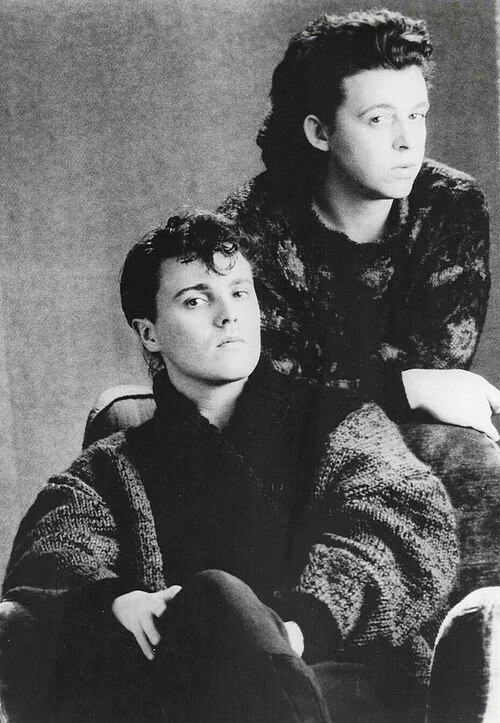
Before they owned the radio, they were the moody synth band with the strange name, singing about childhood pain over cold electronics. Then 1985 arrived, and the same two men who had written a concept album about trauma were suddenly everywhere, with a chorus about ruling the world that felt as light as a summer drive. The distance between those two versions of Tears for Fears is one of the great glow-ups of the decade.
Tears for Fears were a British duo of Roland Orzabal and Curt Smith, and their name comes from a phrase in psychologist Arthur Janov's 1980 book Prisoners of Pain about primal therapy. Their 1985 album Songs from the Big Chair hit number one in the US, and two of its singles, "Shout" and "Everybody Wants to Rule the World," both topped the US Billboard Hot 100. It was a full crossover from cult synth act to global radio staple.
The dark beginning nobody remembers
Their story does not start with sunshine. The band name itself is a clue: it comes from Arthur Janov's writing on primal therapy, the practice of descending into and re-feeling repressed childhood pain. That was the well Roland Orzabal was drawing from.
Their 1983 debut, The Hurting, was a loose concept album about child abuse, psychological trauma, and depression, built on brooding synths and Orzabal's own difficult childhood. It was a real success in Britain, with its first three singles, "Mad World," "Change," and "Pale Shelter," all reaching the UK top five. But it was heavy, introspective music, the sound of a synth cult, not a stadium band. "Mad World," sung by Curt Smith and released in 1982, was their first hit, and it is about as far from a feel-good radio smash as pop gets.
The album that changed everything
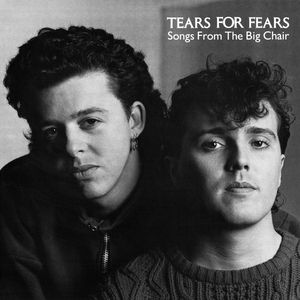
Songs from the Big Chair, released in February 1985, was the pivot. The band traded the claustrophobic gloom of their debut for a bigger, glossier, guitar-forward sound built to fill arenas and airwaves. The lyrics still carried socially and politically conscious themes, but now they rode melodies engineered for maximum reach.
It worked completely. The album went to number one in the US. "Everybody Wants to Rule the World" became one of the defining songs of 1985 and topped the Billboard Hot 100, and "Shout," with its huge insistent hook, did the same. A third single, "Head Over Heels," was a hit too. In a single year, a band known for a dark synth concept record became one of the most-played acts on American radio.
Why the crossover stuck
The trick was that they never dumbed the songs down. "Everybody Wants to Rule the World" sounds breezy but is a wry lyric about power and its temptations. "Shout" sounds like a simple anthem but grew out of the same primal-therapy ideas as their earliest work, a call to let something out. They made records smart enough to reward attention and catchy enough that you did not have to pay any. That double life is exactly what keeps them in rotation forty years later, on radio and in film soundtracks alike.
The honest bottom line
The leap from The Hurting to the Big Chair meant sanding off some of the strangeness that made the early work so distinct, and purists can fairly say the duo traded depth for polish to win the mainstream. There is truth in that. But the crossover did not hollow the songs out. Underneath the gloss, "Everybody Wants to Rule the World" and "Shout" carry real ideas, which is why they never wore out the way lesser 1985 hits did. Getting huge without getting stupid is one of the hardest things in pop, and for one incredible year, Tears for Fears did exactly that.
FAQ
What does the name Tears for Fears mean? It comes from a phrase in psychologist Arthur Janov's 1980 book Prisoners of Pain, about his primal therapy, which centers on re-experiencing repressed childhood pain. The band's early music drew directly on those ideas.
Who are the members of Tears for Fears? The core duo is Roland Orzabal, the lead singer with the signature baritone, and Curt Smith. They played many instruments themselves and brought in studio musicians for the rest.
What are Tears for Fears' biggest hits? Their biggest are "Everybody Wants to Rule the World" and "Shout," both of which topped the US Billboard Hot 100 in 1985, along with "Head Over Heels" and their early UK hit "Mad World."
What album made Tears for Fears famous? Songs from the Big Chair, released in 1985. It reached number one in the US and produced their two American number one singles, turning them from a cult act into a mainstream radio powerhouse.
Was "Mad World" a Tears for Fears song? Yes. "Mad World," sung by Curt Smith, was their first hit, reaching number three in the UK in 1982. It appeared on their darker 1983 debut album The Hurting.
How did Tears for Fears change between their first and second albums? Their 1983 debut The Hurting was a dark, introspective synth album about trauma, while 1985's Songs from the Big Chair adopted a glossier, guitar-driven, radio-friendly sound that made them global stars.
More from the 80s Radio guide. See also Eurythmics.
Everybody wants to rule the facts, we just verify them.