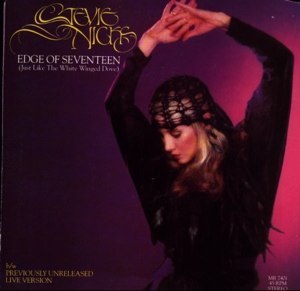
The title is a mistake. Stevie Nicks asked Tom Petty's wife a simple question, misheard the answer through her accent, and liked the misunderstanding better than the sentence. The song she meant to write was a happy one about how that couple met. Then, in a single week in December 1980, John Lennon was murdered and her uncle died of cancer, and it became a song about watching a spirit leave a body.
"Edge of Seventeen" got its title when Stevie Nicks misheard Jane Petty saying "at the age of seventeen" as "the edge of seventeen." It was meant to be about Tom and Jane Petty, but John Lennon was shot on December 8, 1980 and Nicks' uncle died of cancer the same period, and the song became about both. The white-winged dove came from a menu. Billboard shows it peaking at number 11 on April 17, 1982.
The sentence she got wrong
Nicks asked Jane Petty when she and Tom had first met. Jane, who had a strong southern accent, said they met at the age of seventeen. Nicks heard something else and knew immediately what she had.
She told the story to Los Angeles disc jockey Robert W. Morgan in a 1981 interview, quoting what she said to Jane on the spot: "It's got to be 'edge.' 'The Edge of Seventeen' is perfect. I'm going to write a song."
The plan at that point was a song about Tom and Jane, high school sweethearts, and the phrase was simply a beautiful accident that belonged to them. Nicks has always been open that she took the title from Jane and intended to credit her for it. What she could not have known was that the song attached to it would end up somewhere else entirely.
December 1980
Nicks was in Australia on December 8, 1980, when John Lennon was shot in New York. She had never met him, but she was close to the person who had.
"I was in Australia when John Lennon was shot. Everybody was devastated. I didn't know John Lennon, but I knew Jimmy Iovine, who worked with John quite a bit in the '70s, and heard all the loving stories that Jimmy told about him," she said in the commentary for her Live In Concert video, recorded on the Bella Donna tour. "When I came back to Phoenix I started to write this song."
Iovine was producing Bella Donna and was Nicks' boyfriend at the time. She had a grieving partner in one place and a dying relative in another, and she went to Phoenix.
"Right when I got to Phoenix, my uncle Bill got cancer, got very sick very fast, and died in a couple of weeks," she said. "My cousin John Nicks and I were in the room when he died. There was just John and I there. That was part of the song when I went running down the hallways looking for somebody - I thought where's my mom? Where's his wife and the rest of the family? At that point I went back to the piano and finished the song."
She was still describing that room sixteen years later. "We were both there and for some reason, nobody else was there and my uncle died," she said in 1997. "And we were just there by ourselves with him and we didn't even know what to do. It was like, I can't believe this is happening."

Line by line, in her own words
In a 1981 interview Nicks walked through what the lyrics were actually recording, and the answer is that almost all of them are literal.
"'And the days go by like a strand in the wind,' that's how fast those days were going by during my uncle's illness, and it was so upsetting to me," she said. "The part that says 'I went today... maybe I will go again... tomorrow' refers to seeing him the day before he died. He was home and my aunt had some music softly playing, and it was a perfect place for the spirit to go away. The white-winged dove in the song is a spirit that is leaving a body, and I felt a great loss at how both Johns were taken. 'I hear the call of the nightbird singing, come away, come away.'"
The line about "words from a poet and a voice from a choir" is the Lennon half of the song.
Nicks has been direct about how frightening the subject was to a woman who had not yet lost anyone. "It became a song about violent death, which was very scary to me because at that point no one in my family had died," she said. "To me, the white-winged dove was for John Lennon the dove of peace, and for my uncle, it was the white-winged dove who lives in the saguaro cactus ... that's how I found out about the white-winged dove, and it does make a sound like 'whooo, whooo, whooo.' I read that somewhere in Phoenix and thought I would use that in this song."
The dove came off a menu
The image that carries the entire chorus was not a metaphor she reached for. It was a piece of copywriting on a menu, and she remembered the wording well enough to quote it four decades later.
Posting on Twitter on April 7, 2020, Nicks wrote: "In 1980 I was flying home from Phoenix Arizona and I was handed a menu that said, 'The white wing dove sings a song that sounds like she's singing ooh, ooh, ooh. She makes her home here in the great Saguaro cactus that provides shelter and protection for her...'"
Then she added the detail that makes the whole thing land. "As you well know, I was very taken with that whole picture and went on to write 'Edge of Seventeen.' But over the last 40 years, I can honestly say, I have never heard a dove sing ... until now."
She had posted a video of a dove that had come to the window of her Arizona home and started singing. "I started to cry. This dove had come here to watch over me."
Forty years of singing about the sound a bird makes, taken on faith from a menu, before she heard it.
The record itself
The guitar figure that opens the song, the one everybody can hum, is played by Waddy Wachtel, a session guitarist who had worked with Nicks before Fleetwood Mac, back when she and Lindsey Buckingham were a duo. The backing vocals are Lori Perry and Sharon Celani, who sang with her for years afterward. The band on the track includes Roy Bittan of the E Street Band on piano and Benmont Tench of the Heartbreakers on organ, with Bob Glaub on bass and Russ Kunkel on drums. Billboard lists J. Iovine as producer.
It was the third single from Bella Donna, after two duets: "Stop Draggin' My Heart Around" with Tom Petty and "Leather and Lace" with Don Henley. According to Nicks, Iovine did not think the album had a hit, which is why he put her together with Petty on the lead single. That single's success is what got "Edge of Seventeen" its airplay months later.
"Edge Of Seventeen (Just Like The White Winged Dove)" entered the Billboard Hot 100 at number 73 on February 20, 1982 and peaked at number 11 on April 17, 1982.
Nicks has closed her concerts with it ever since, in the same arrangement. "I've never changed it, and I can't imagine ending my show with any other song," she has said. "It's such a strong, private moment that I share in this song." An all-80s radio stream from the Bubble is coming, and this is one of the records that never fell off the 80s dial.
How the telling has grown over the decades
1981, Robert W. Morgan interview. The title story, told within a year of writing it, including her own words to Jane Petty in the moment.
1981, lyric interview. The line-by-line reading: the strand in the wind, the visit the day before he died, the aunt's music playing softly, the dove as a departing spirit, and the phrase "both Johns."
Bella Donna tour, Live In Concert commentary. The fullest single account: Australia, Iovine, the flight to Phoenix, uncle Bill's rapid decline, the room where he died and the run down the hallway looking for the rest of the family.
1997. A shorter return to the same room, and this time the emphasis is on how unprepared they were. "We didn't even know what to do."
April 2020, Twitter. The newest layer and the one nobody could have predicted: the exact wording of the menu, and the admission that in forty years of singing about it she had never actually heard a dove until one turned up at her window.
Where the tellings drift. Three places, and one of them is only an apparent contradiction. First, her uncle's name moves. Nicks says "my uncle Bill" in her concert commentary, while accounts of the song, including American Songwriter in the same piece, call him John and Jonathan. They are the same man: William "Bill" Jonathan Nicks. Nothing is being covered up, but a reader comparing two articles will hit three names for one person. Second, where she read the menu. Her earlier account says only "I read that somewhere in Phoenix." In 2020 she is precise and different: she was flying home from Phoenix and was handed the menu on the plane. Third, and most interesting, what Jane Petty actually said. Songfacts describes Nicks asking Jane when she and Tom met, with "at the age of seventeen" as the answer she misheard. American Songwriter describes Jane suggesting "At the Age of Seventeen" as a title. Those are different scenes: one is a mishearing of a fact, the other is a mishearing of a proposal. The mishearing is constant in every telling. What was being misheard is not.
The honest bottom line
The most famous song Stevie Nicks wrote on her own is built on a misunderstanding, a menu, and two deaths she did not plan for, and it was the third single off an album its own producer did not think had a hit. It should not hold together. It does, because unlike most songs about grief it is not written in metaphor: the hallway, the aunt's quiet music, the visit the day before, the cousin standing in a room with her not knowing what to do, all of it is reportage. The dove is the only invention in the song, and even that she copied off a piece of restaurant furniture. That is the trick worth taking away. She did not reach for imagery about death, she wrote down exactly what the two weeks looked like and let one borrowed bird carry the weight. That same year, Kim Carnes resurrected a seven-year-old reject as Bette Davis Eyes, another song whose most famous feature was someone else's idea, and together they became two of the defining hits by women in 1981.
FAQ
What is the story behind "Edge of Seventeen"? Stevie Nicks got the title by mishearing Tom Petty's wife Jane, whose southern accent turned "at the age of seventeen" into "the edge of seventeen." She intended to write about the Pettys, but John Lennon was murdered on December 8, 1980 and her uncle died of cancer within the same period, and the song became about both deaths.
What does "just like the white winged dove" mean? It is a spirit leaving a body. "The white-winged dove in the song is a spirit that is leaving a body, and I felt a great loss at how both Johns were taken," Nicks said in 1981. She took the bird itself from a menu she was handed while flying home from Phoenix in 1980.
Who are the "two Johns" in "Edge of Seventeen"? John Lennon, who was shot in New York in December 1980, and her uncle, William "Bill" Jonathan Nicks, who died of cancer around the same time. Nicks was in Australia when Lennon was killed and flew to Phoenix, where she was in the room when her uncle died alongside her cousin John Nicks.
Did Stevie Nicks really mishear the title? Yes, and she said so within a year. Telling the story to disc jockey Robert W. Morgan in 1981, she recalled telling Jane Petty on the spot: "It's got to be 'edge.' 'The Edge of Seventeen' is perfect. I'm going to write a song."
Who plays the guitar riff on "Edge of Seventeen"? Waddy Wachtel, a session guitarist who had worked with Nicks before Fleetwood Mac, when she and Lindsey Buckingham performed as a duo. Roy Bittan of the E Street Band plays piano and Benmont Tench of the Heartbreakers plays organ on the track.
How high did "Edge of Seventeen" chart? It peaked at number 11 on the Billboard Hot 100 on April 17, 1982, after debuting at number 73 on February 20, 1982. It was the third single from Bella Donna, following "Stop Draggin' My Heart Around" and "Leather and Lace."
Sources
- Songfacts, "Edge Of Seventeen by Stevie Nicks" (Nicks' Live In Concert video commentary, the 1981 Robert W. Morgan radio interview, and the session personnel)
- American Songwriter, "Meaning Of 'Edge of Seventeen' By Stevie Nicks & The Men Behind It" (Nicks' 1981 lyric-by-lyric interview, her 1997 recollection, and her April 2020 Twitter post)
- Stevie Nicks, post on Twitter, April 7, 2020 (the menu wording and never having heard a dove sing), as quoted by American Songwriter
- Billboard Hot 100, weeks of April 3 and April 17, 1982 (chart positions, debut position and date, peak date, producer credit)
Just like the white winged dove, the record sings the truth.
Part of Stories Behind the Songs. See also The Story Behind Purple Rain and The Story Behind Total Eclipse of the Heart.