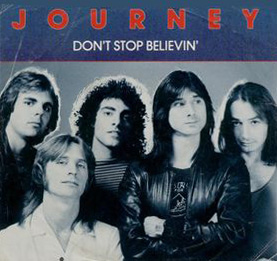
A broke musician calls his father to ask for a loan and permission to quit. The answer his dad gives him gets doodled onto the back page of a spiral notebook and sits there, untouched, for five years. Then a band runs out of songs with two days left to make a record, and someone remembers the notebook. The chorus that comes out of it breaks every rule pop songwriting has, name-checks a town that does not exist, and becomes one of the most played songs on Earth.
"Don't Stop Believin'" was written by Journey's Jonathan Cain, Steve Perry, and Neal Schon for the 1981 album Escape. The title came from advice Cain's father gave him during a broke stretch selling stereos in the 1970s: don't stop believing. Cain found the phrase doodled in an old lyric notebook when the band needed one last song, wrote the chorus in minutes, and the band built the track around it. It peaked at number nine on the Billboard Hot 100.
The phone call that became a chorus
Before Journey, Jonathan Cain was a singer-songwriter who had just been dropped. "I was out of sorts, so I got a job selling stereos," he told Songwriting Magazine in 2024. "I was barely making ends meet, and I needed a loan from my father. So I called my dad and said, 'I need a little money to get me by. Should I come home to Chicago and forget this whole thing?'"
His father talked him out of quitting. Cain has quoted the answer many times, and the fullest version he gave Songwriting Magazine is this: "I know it seems tough right now but I believe the greatest blessing is just around the corner, so don't stop believing Jon."
Cain wrote it down. "I was doodling and I had written his advice on the back page of this spiral notebook that I used to write my lyrics in," he said. "It was just something that I would look at from time to time and say, 'My father really thinks something good is gonna happen here.'" Telling the same story to NSAI's Bart Herbison, quoted by American Songwriter, Cain put it in bigger terms: "He was my prophet. My vision keeper. He said, 'Son, don't stop believing.'"
"There must be something else in that book of yours"
Five years later Cain was in Journey, in San Francisco, making Escape. The album was nearly finished and short one song. The push came from the singer. "We're almost done and Steve Perry says to me, 'There must be something else in that book of yours? We need one more song,'" Cain told Songwriting Magazine. "We only had a couple of days left."
So Cain went home to the notebook. "I see this thing my father had said to me back in the day when I was struggling selling stereos, 'Don't stop believing,'" he said. "It's a doodle on the back page and I said, 'You know, he'll sing this. That sounds like Journey.'" He sat down at a keyboard and the song arrived almost instantly. "I just closed my eyes, and boom, I heard his voice and out comes this chorus and these chords," Cain said. He put the time at ten minutes.
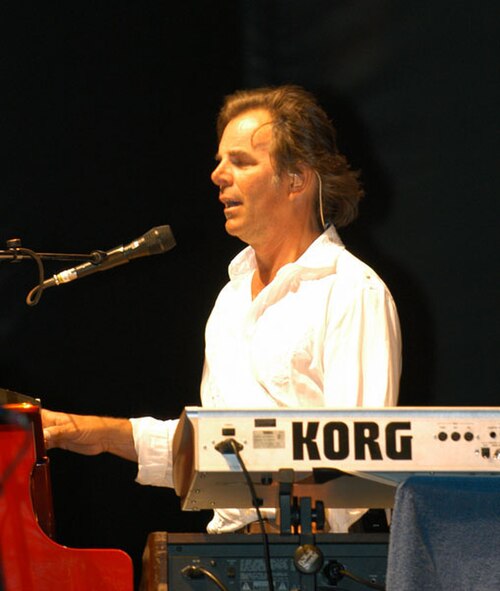
The next day he brought it into the room and the band took it apart and rebuilt it. Perry heard the chorus chords and wanted them everywhere. "Steve said, 'You know those chords that you have in the chorus, we could use those for the verse,'" Cain recalled. "He said, 'Just add that little eighth note thing that you did in The Babys.'" Neal Schon added the guitar line and the angular bridge, and drummer Steve Smith found the beat. Cain called it "a kind of a supernatural afternoon."
The song that saves its chorus for the end
The strangest decision in "Don't Stop Believin'" is that you wait almost the whole song to hear the hook. That was deliberate, and Cain says it started as a small argument. "The most interesting part of the afternoon was that Steve didn't want to put the chorus until the very end," he told Songwriting Magazine. Perry's logic, as Cain quoted it: "Play that melody and then we'll sing it. They'll lose their minds, because they only hear it these few times and then the song's over. They'll want to play the song over and over and over."
Cain knew it was backwards, and that was the point. "It breaks all the rules," he said. "Most songs have many choruses, you'll hear it two or three times. Sometimes they'll even put the chorus at the beginning ... not this one. This one unfolds like a story." Between the verses, Schon started playing an unplanned figure that Cain heard as a rhythm. "That ticker-ticker thing that [Neal] does, I said, 'Steve, it sounds like a train,'" Cain remembered, and that rhythm became the song's midnight train.
South Detroit, the midnight train, and the streetlight people
The lyrics were assembled line by line, mostly out of the two singers' own club years and one night in Michigan. The song's most argued-over word came from Perry trying options out loud. Cain says Perry tested "East Detroit, West Detroit, North Detroit," and when "he got, 'South Detroit,' that was it." There is no South Detroit. Cain owns it happily. "We didn't have Google then; we didn't know there was no such thing as South Detroit. It just sounded good," he said. When critics pointed it out, his answer was ready: "No, that's an imaginary city that doesn't exist. It's a city of possibility."
The "streetlight people" came from Perry, and he traced the image to a specific night in his Library of Congress interview, recorded when the song entered the National Recording Registry in 2022. The band had just played Cobo Arena in Detroit. "I was up on the top floor that night and wasn't tired," Perry said. "The street lights of Detroit at that time were kind of this orange color. They weren't white streetlights like I had grown up with, they had this very cool sort of Amber color to them." People were still out at three in the morning. "So I thought, wow, 'Street-light people.'" He brought the image back to Cain: "When it came time to write the lyrics I told John Cain about this moment, and I wanted 'Streetlight People, Living just to find emotion.'" That image, Perry said, "came from downtown Detroit. It really did."
Then there is the ending nobody thought would matter. Perry has said the outro high notes cost him. "I remember singing the harmonies in the outro and the big high notes. I had to keep punching those until I was satisfied with them," he told the Library of Congress. "Those are what I call payoff notes."
How the telling has grown over the decades
The father's phrase has always been the spine, but the writers fill in different pieces depending on who is talking and when. Steve Perry's 2022 Library of Congress interview is the songwriting partner's angle: it is the source for the Cobo Arena night, the amber streetlights, and the "payoff notes." Cain's interview with NSAI's Bart Herbison added the "prophet, my vision keeper" framing of his father and the detail that Perry told him to go home and dig through the notebook. His 2024 Songwriting Magazine telling is the most complete: the ten-minute chorus, the chorus-at-the-end argument, the South Detroit defense, and the Sunset Boulevard imagery behind the pre-chorus.
The tellings do not agree on everything, and the drift is worth naming. Cain remembers the song starting from his notebook, the title and chorus he carried in. Perry remembers it starting from him: "I have always liked quarters on the piano," he told the Library of Congress. "So I asked John Cain and said, 'We got to write something that has quarters on the piano.'" In Perry's account the germ was his piano idea that Cain built on; in Cain's account the germ was the father's phrase that the band built on. Both men were in the room, both are on the writing credit, and where the song "began" honestly depends on which of them is telling it. Even the instrument moves: Cain told American Songwriter he sat down at his Wurlitzer, and told Songwriting Magazine "I had a piano." The spine holds. The edges soften, the way any true story does after forty years of retelling.
The honest bottom line
Strip the anthem status away and this is a song built fast against a deadline, with a chorus written in minutes, lyrics naming a place that isn't real, and two writers who cannot fully agree on who started it. The same album produced Faithfully, Cain's road-song ballad about the life the band was living while it made Escape; Perry would chase the same emotional exposure on his own two years later with Oh Sherrie. None of that has hurt it. "Don't Stop Believin'" became the number one paid digital download of any song first released in the twentieth century, got a second life on The Sopranos and Glee, and was preserved by the Library of Congress. It survived because the most disposable-sounding part, a worried father's line to his broke son, turned out to be the most universal thing anyone in that band ever wrote down.
FAQ
What is the story behind "Don't Stop Believin'"? The title came from advice Jonathan Cain's father gave him in the 1970s, when Cain was a dropped musician selling stereos and thinking about quitting. His dad told him not to stop believing. Cain doodled the phrase in a lyric notebook, and five years later, when Journey needed one last song for Escape with two days to spare, he built the chorus around it.
Who wrote "Don't Stop Believin'"? Jonathan Cain, Steve Perry, and Neal Schon share the writing credit. Cain brought the title and chorus, Perry shaped the lyrics and melody and supplied the "streetlight people" image, and Schon wrote the guitar figure and the bridge.
What is "Don't Stop Believin'" about? It is about not giving up on a dream, framed as a small-town girl and a city boy who could be anywhere, riding a midnight train. Cain has said the phrase came straight from his father's encouragement during his worst broke stretch.
Is there really a South Detroit? No. Steve Perry tried North, East, and West Detroit out loud, and "South Detroit" simply sounded best. Cain has said plainly there is no such place, calling it "an imaginary city that doesn't exist. It's a city of possibility."
Where did the "streetlight people" line come from? From a night Steve Perry spent staring out a Detroit hotel window after a show at Cobo Arena. He saw people milling around at three in the morning under amber-colored streetlights and thought, "Street-light people."
How high did "Don't Stop Believin'" chart in the 80s? It peaked at number nine on the Billboard Hot 100 and number eight on the Mainstream Rock chart after its October 1981 release. Its biggest cultural life came decades later, through television and digital downloads.
Sources
- Songwriting Magazine, "How we wrote 'Don't Stop Believin''" (interview with Jonathan Cain), Summer 2024 issue
- American Songwriter, "'Don't Stop Believin'': How Jonathan Cain Turned His Father's Words Into Rock and Roll History" (Cindy Watts), quoting Cain's interview with NSAI's Bart Herbison
- Library of Congress, National Recording Preservation Board, expanded interview with Steve Perry, tied to the song's 2022 National Recording Registry induction
- Billboard Hot 100 and Mainstream Rock weekly charts, 1981; Wikipedia for release and certification data
Hold on to that feeling, we hold on to the receipts.
Part of Stories Behind the Songs. See also The Story Behind Eye of the Tiger and The Story Behind Africa by Toto.