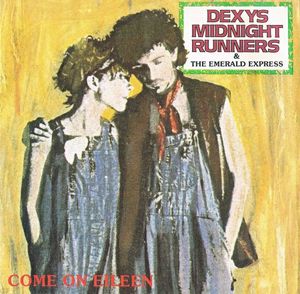
It starts with fiddles and a name half the room shouts back on cue. A banjo, a fiddle section, a band in ragged dungarees, and a chorus that speeds up until it nearly falls over itself. It sounds like a barn dance that wandered into a pop chart, and for one week in 1983 it did something almost nobody managed that year: it knocked Michael Jackson off the top.
"Come On Eileen" was a 1982 single by the British band Dexys Midnight Runners, fronted by Kevin Rowland, from the album Too-Rye-Ay. It reached number one on the UK Singles Chart and was Britain's best-selling single of 1982. In the US it hit number one on the Billboard Hot 100 for the week ending April 23, 1983, ending the long reign of Michael Jackson's "Billie Jean."
The week it beat Billie Jean
This is the fact that makes the song legend. "Billie Jean" had sat at number one for seven weeks, an immovable object at the height of Michael Jackson's Thriller era. Then, for the week ending April 23, 1983, a band of Englishmen in overalls playing Celtic soul knocked it off. It is one of the great chart upsets of the decade.
The reign did not last. "Come On Eileen" held number one for a single week, and then Jackson was right back on top, this time with "Beat It." So the band's moment of triumph is bracketed on both sides by Michael Jackson, which somehow makes it better. They did not beat him for long, but for one week, the biggest star on Earth had to stand behind a fiddle.
Who Eileen actually was
There was no real Eileen. Kevin Rowland has said she was a composite, invented to make a point about Catholic repression. The song comes from the feeling of being a teenager surrounded by Irish Catholic girls he was not supposed to touch, carrying urges he was told not to have. Under the party stomp is a fairly pointed lyric about desire and guilt.
The opening line reaches even further back. The song begins with "Poor old Johnnie Ray," a nod to the 1950s American singer, and the 1982 video, directed by Julien Temple in the Elephant and Castle area of South London, even used old footage of Johnnie Ray. Eileen herself was played on screen by Máire Fahey, sister of Bananarama's Siobhan Fahey. The band was pointing back at an older generation of pop while making something that sounded like nothing else on the radio.
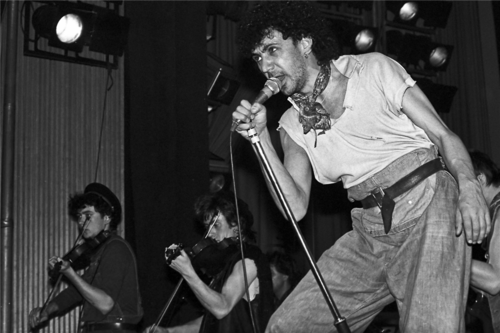
The look that stuck
Part of why the band feels frozen as a one-hit wonder is the image. The dungarees, the neckerchiefs, the deliberately scruffy gypsy-soul styling. It was a strong, specific look, and strong specific looks tend to trap a band in one moment. People remember the overalls as much as the song, and the two together became a single unforgettable snapshot of 1983.
The honest bottom line
In America, Dexys Midnight Runners are the definition of a one-hit wonder, and the song has been voted the top 80s one-hit wonder more than once, which is a backhanded kind of fame. The banjo-driven hook is close to a novelty, and the sped-up outro is pure gimmick. But it works because it commits completely, and because behind the hoedown there is a real, uneasy lyric about growing up wanting things you were taught to fear. A song this joyful hiding a nerve that raw does not come along often, which is why it still fills a room forty years later.
FAQ
What is "Come On Eileen" about? Kevin Rowland has said Eileen is not a real person but a composite meant to make a point about Catholic repression, drawn from being a teenager surrounded by girls he was not supposed to touch while feeling exactly the urges he was told not to have.
Who sang "Come On Eileen"? Dexys Midnight Runners, a British band fronted by Kevin Rowland. It came from their 1982 album Too-Rye-Ay.
Did "Come On Eileen" really beat Michael Jackson? Yes. It reached number one on the US Billboard Hot 100 for the week ending April 23, 1983, ending the seven-week run of "Billie Jean." The next week Jackson returned to number one with "Beat It."
How long was it number one in the US? One week. It topped the Billboard Hot 100 for a single week before Michael Jackson reclaimed the spot.
Who is Johnnie Ray in the song? Johnnie Ray was a popular 1950s American singer. The song opens with the line "Poor old Johnnie Ray," and the music video included archival footage of him, tying the track back to an earlier era of pop.
Are Dexys Midnight Runners a one-hit wonder? In the US, yes, "Come On Eileen" was their only major hit. In the UK they had other successes, including an earlier number one, so the label is again an American chart story.
Part of our guide to 80s One-Hit Wonders. See also Tainted Love.
Overalls and all, this one is told by people who were there.