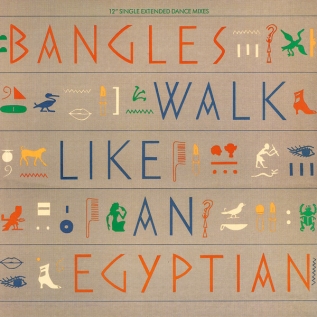
A songwriter got drunk on a cross-Channel ferry, watched the seasick passengers lurch around the deck with their arms out, and scribbled down a title. Toni Basil turned the song down. A producer found the demo on a mislabeled cassette marked "Rock & Roll Nightmare," recorded the rhythm by running in front of a microphone shaking a bean-filled papier mâché dog's head, and then split the verses between three of the four Bangles in a studio sing-off. The fourth Bangle, the drummer, got nothing. "Walk Like An Egyptian" is one of the goofiest number ones of the decade, and almost nobody who made it planned any of it.
"Walk Like an Egyptian" was written in 1984 by Liam Sternberg, who got the idea watching passengers stagger on a rough English Channel ferry crossing. After Toni Basil passed on it, Bangles producer David Kahne pulled the demo off a mislabeled tape and cut it at Sunset Sound Factory in Los Angeles, giving the three verses to Vicki Peterson, Michael Steele, and Susanna Hoffs. It reached US number one on December 20, 1986, and stayed four weeks.
The ferry, the wine, and the Egyptians
The origin is exactly as silly as the song. Sternberg, a songwriter out of the same Akron, Ohio new-wave scene that produced Devo, was crossing the English Channel when the boat started rolling. "I was in a ferry boat crossing the English Channel," he told the Akron Beacon Journal in 2021. The deck turned into a comedy of people trying not to fall over, arms thrown out sideways, and something clicked. "It was a pretty tipsy ride and I had too much wine to drink, so I was also pretty tipsy," Sternberg recalled. "So I just wrote it down: Walk like an Egyptian. It really came from wherever these things do."
The lurching passengers, arms out and heads turned, looked like the flat figures in ancient Egyptian tomb art, where the head faces sideways, the torso faces forward, and the limbs face sideways. That accidental resemblance is the entire concept. There was no dance. The people who inspired the "walk" were just trying not to be sick.
The mislabeled cassette
Sternberg wrote the song in 1984 and recorded a demo with fellow Akron native Marti Jones. It went nowhere at first. He offered it to Toni Basil, who had already scored with "Mickey," and she turned it down. Sound on Sound's account adds that "Lucky Number" singer Lene Lovich passed on it too. The song only reached the Bangles because their producer went looking for material and got lucky with a labeling error.
David Kahne, who had produced the Bangles' 1984 debut, was going through publisher tapes when he hit it. "The cassette said 'Rock & Roll Nightmare,'" he told Sound on Sound in 2021. "And I goes, 'Huh, well I don't like that title.'" He played it anyway and heard the riff. "I called the publisher and I told her there was this song about an Egyptian on it and she said, 'Oh, they put the wrong song on there. I'll send you it over.' I go, 'No no, I like this one.'" Kahne knew what he needed it for. The band already had "Manic Monday," written for them by Prince, and Kahne wanted a follow-up single with the same oddball charm.
The dog's head and the drum machine
Kahne built the track largely by himself before the band was fully on board, and his methods were strange. The song's distinctive swing comes from a shaker he recorded in one of the odder sessions in pop history. "I put the thing in record and I ran out in front of the mic with this papier mâché dog's head shaker," he told Sound on Sound. He stood there rattling it into the microphone. "I have this strong memory of staring at that dog's head for about 10 minutes while I was shaking it," he laughed. "I recorded it and then I edited the tape to get four minutes of shaker that was in the pocket."
Over that shaker he played a LinnDrum beat by hand, live to tape, rather than programming it. That choice created the band's biggest grievance. Debbi Peterson was the Bangles' drummer, and "Walk Like An Egyptian" barely needed a drummer. She played over the machine anyway, and even that got quietly cleaned up. "She played drums over it," Kahne admitted. "I might have fixed them a little bit when she wasn't there."
The sing-off nobody would run again
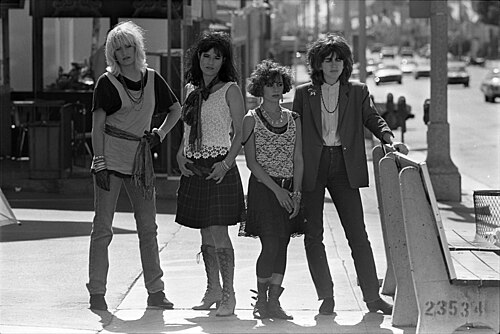
The Bangles were a band with no single frontperson. All four sang lead on different songs, and they took turns. As Kahne put it, "They all wanted to sing and be lead singers. They used to share. They would come in and it would be, 'OK, now it's Debbi's turn to sing.' I think a few people had noticed that the big songs were all sung by Sue." By the rotation, "Walk Like An Egyptian" was supposed to be Debbi Peterson's lead. She did not want it. "It didn't even get to rehearsal," Kahne recalled. "They just didn't want to record it. It was Debbi's turn to sing a song. She didn't want to do it, she thought it was a dumb song."
Vicki Peterson tells the recruitment from the band's side. "David Kahne, our producer at the time, showed up at rehearsal with a tape of a demo of the song, sung with a droll charm by [US singer] Marti Jones," she recalled in Sound on Sound. "I realised that we were never gonna write a song like that and there was nothing remotely like it on our album so far and I agreed to try it in the studio. We had a sing-off for the verses, with Kahne as head judge. Don't know that I'd ever do it that way again."
The lead vocal fell apart before the sing-off happened. Debbi tried to carry the whole thing first. "We started vocals and Debbi was out singing and we were working on it for a couple of days," Kahne said. "And it was OK, but it sort of deteriorated into this silent argument." His fix was to hold auditions. "So, finally it fell apart and then I was trying to figure out who else would sing it. They each tried it, and the other three ended up with a verse each." Vicki Peterson took the first verse, Michael Steele the second, Susanna Hoffs the last. The drummer, whose song it had been by rotation, ended up with only backing harmonies, a tambourine in the video, and a whistling part she mimed but did not play.
The whistle nobody believes
That whistling hook is the last of the song's small mysteries, and the tellings disagree. For decades the assumption has been that the whistle was a keyboard, a synth patch, part of the machine-made production. Kahne says flatly that it was his own lips. "I whistled on two songs that went number one," he told Sound on Sound. He whistled on this one and later on Sugar Ray's "Every Morning." "So, I'm never gonna try it again cause I don't want to break my record." The synth story persists anyway, which is fitting for a record where the shaker was a dog's head and the drummer barely drummed.
What it became, and how one Bangle felt about it
"Walk Like An Egyptian" was the third single from the Bangles' 1986 album Different Light. It reached number one on the Billboard Hot 100 on December 20, 1986, held for four weeks across the new year, and became the band's first US chart-topper. Billboard named it the number one single of 1987. It has outlived almost everything around it, though it briefly vanished from the airwaves: during the 1990-91 Gulf War, Clear Channel in the United States and the BBC in the UK pulled it from playlists over the lyric.
Not everyone in the band celebrated. When it hit number one, Debbi Peterson told Rolling Stone she "couldn't get along" with Kahne and called the record "a nice little novelty song kind of thing... but I don't feel like it's us." Kahne has heard the novelty charge for years and does not accept it. "Debbi was just bagging on me," he told Sound on Sound. "They called it a novelty song. So 'Manic Monday' is not a novelty song? I dunno. Any time you have a hit, it's a f**king novelty, right?" He notes the fallout plainly: "you might have noticed I didn't produce the next album." He did not. The Bangles made 1988's Everything, and its number one "Eternal Flame," with a different producer.
How the telling has grown over the decades
The story assembled from opposite ends. Liam Sternberg has told the ferry origin for years, most cleanly to the Akron Beacon Journal in 2021: the Channel crossing, the wine, the seasick passengers, the title jotted down on the spot. The band and studio side stayed quieter until much later. Debbi Peterson's dissatisfaction was on record early, in a Rolling Stone interview right after the song hit, which is why the "I don't feel like it's us" line has followed the track for decades. But the detailed making-of, the dog's head shaker, the mislabeled cassette, the vocal that fell apart, the sing-off, came out fully in David Kahne's and Vicki Peterson's 2021 recollections in Sound on Sound, thirty-five years after the fact.
The drift is honest and worth stating. The whistle is a genuine dispute: widely believed to be a synth, claimed by Kahne as his own whistling. The number of artists who rejected the song shifts by source, with Toni Basil named everywhere and Lene Lovich added in the Sound on Sound telling. And the emotional temperature of the record depends entirely on which maker is talking. To Sternberg it was a lark that paid off. To Kahne it was a hard-won production he is still proud of. To Debbi Peterson, for a long time, it was the hit that pushed her out of her own band's biggest song.
The honest bottom line
"Walk Like An Egyptian" is a novelty record, and its own drummer said so in print. It was written drunk on a boat, rescued off a mislabeled tape, built around a bean-filled dog's head, and sung by whoever won an audition, with the one member who was supposed to sing it frozen out entirely. None of that is a knock. The song's charm is exactly its accidents: a producer with a magpie ear, a band loose enough to try something ridiculous, and a hook whistled by the guy at the console. It sounds effortless because so much of it genuinely was improvised, and that looseness is why kids still throw their arms out to it forty years on. Earlier that year, Prince's cassette had given the Bangles Manic Monday and their first hit; two years later, Eternal Flame would prove Hoffs could write a ballad that divided the band and outlasted it.
FAQ
What is the story behind "Walk Like an Egyptian"? Songwriter Liam Sternberg came up with the title while drunk on a rough English Channel ferry in the early 1980s, watching passengers stagger with their arms out like figures in Egyptian tomb art. He recorded a demo, Toni Basil turned the song down, and Bangles producer David Kahne found it on a mislabeled cassette and recorded it with the band in 1986.
Who wrote "Walk Like an Egyptian"? Liam Sternberg, a songwriter from the Akron, Ohio new-wave scene, wrote it in 1984. None of the Bangles wrote it. Producer David Kahne brought it to the band after finding the demo.
Why doesn't Debbi Peterson sing on "Walk Like an Egyptian"? By the Bangles' rotation the lead was supposed to be Debbi Peterson's, but she thought the song was dumb and did not want to record it, and the track used a drum machine rather than her drumming. After her lead vocal attempt stalled, Kahne held a sing-off and gave the three verses to Vicki Peterson, Michael Steele, and Susanna Hoffs. Debbi later dismissed the record to Rolling Stone as "a nice little novelty song."
Is the whistling in "Walk Like an Egyptian" a real whistle or a synth? Producer David Kahne says it is him whistling, not a keyboard, and that he whistled on two number one records including this one. Many listeners still assume it was a synth.
Did "Walk Like an Egyptian" get banned from radio? Briefly. During the 1990-91 Gulf War, Clear Channel in the United States and the BBC in the UK removed it from playlists, judging the lyric potentially insensitive.
When was "Walk Like an Egyptian" number one? It reached number one on the US Billboard Hot 100 on December 20, 1986, and held the top spot for four weeks into January 1987. Billboard ranked it the number one single of 1987.
Sources
- Sound on Sound, "Classic Tracks: The Bangles 'Walk Like An Egyptian'" (Tom Doyle), May 2021, with quotes from producer David Kahne and Vicki Peterson
- Akron Beacon Journal, Liam Sternberg interview, September 26, 2021, as quoted by Word Histories, 2023
- Rolling Stone, Debbi Peterson interview, 1987, as quoted in Sound on Sound
- Stereogum, "The Number Ones: The Bangles' 'Walk Like An Egyptian'" (Tom Breihan)
- Billboard, "This Week in Billboard Chart History: In 1986, the Bangles Walked to No. 1"; Billboard Hot 100 weekly tables, December 1986 and January 1987
We walk like fact-checkers, all day long.
Part of Stories Behind the Songs. See also The Story Behind Manic Monday and The Story Behind Eternal Flame.