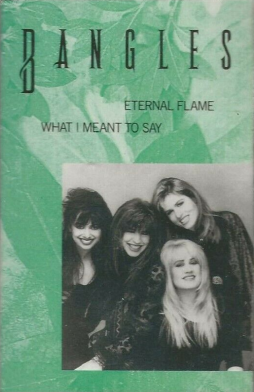
The flame that gave the song its title was not even lit the day the Bangles saw it. The other flame that gave the title its meaning was a small red light in a synagogue that one of the writers had stared at as a boy. The band's own manager heard the finished ballad and said it would never get on the radio because it had no drums. And the lead vocal that carried it to number one around the world was sung by a woman with no clothes on, because her producer told her a lie about Olivia Newton-John. "Eternal Flame" is a lullaby built out of an Elvis shrine, a childhood memory, and a practical joke, and its writers have been happy to explain all of it.
"Eternal Flame" was written by Bangles singer Susanna Hoffs with hit songwriters Billy Steinberg and Tom Kelly. The title came from a private Bangles tour of Graceland, where an eternal flame at Elvis Presley's grave sat unlit in the rain, combined with Steinberg's memory of the eternal flame at his childhood synagogue in Palm Springs. Produced by Davitt Sigerson, it topped the US Billboard Hot 100 on April 1, 1989.
The flame that was not lit
The song did not start as a song. It started as a story Hoffs told her co-writer. "Whenever I write with Billy Steinberg and Tom Kelly, we would always start first with me getting together with Billy and working on lyrics," Hoffs recalled in Bruce Pollock's 2025 book "They're Playing My Song." "So I told Billy the story about this official private tour of Graceland the Bangles had been given. The day we were there we were taken out to the Garden of Memories, and there was this little box which was supposed to have a lit flame in it, an eternal flame. Actually, that day it was raining so the flame was not on."
That was enough for Steinberg. "That led to Billy saying, 'Oh, eternal flame is a good title for a song,'" Hoffs said. "So we crafted the lyrics at Billy's house and then we took it over to Tom's studio. I was really thrilled when I had a demo of this somewhat simple, pure, melodic, almost like a lullaby that I came up with." So the answer to the question everyone asks, whether "Eternal Flame" is about Elvis, is no. Elvis is only where the phrase came from, and the flame at his grave happened to be off.
The synagogue in Palm Springs
The reason the title meant something to Billy Steinberg had nothing to do with Elvis at all. It reached back to his childhood. "Susanna was talking about the Bangles having visited Graceland, and she said there was some type of shrine to Elvis that included some kind of eternal flame," Steinberg told Songfacts. "As soon as those words were mentioned, I immediately thought of the synagogue in the town of Palm Springs, California where I grew up. I remember during our Sunday school class they would walk us through the sanctuary. There was one little red light and they told us it was called the eternal flame."
It had frightened and amazed him as a boy. "When I was a child I remembered thinking it never burned out, that it was something like the sun or something beyond our capacity to even contemplate. It seemed like a very profound thought when I was a child," Steinberg said. "I thought, 'Well that's a great title for a song,' so very quickly I wrote the rest of the lyrics for the song based on that title." Two eternal flames, an Elvis shrine and a Jewish ner tamid, met in one pop lyric about a love that will not burn out.
The Beatles song with no chorus
Musically, the writers were reaching for a very specific target. Steinberg is precise about it. "Tom started to write the chords and the melodies on an acoustic guitar at my house," he told Songfacts. "The bridge to the song, or the middle eight as the British would say, the part that starts, 'Say my name, sun shines through the rain,' that part in particular is very Beatlesque." He points out a structural oddity most listeners never notice. "One of the unusual things about that song, which is also attributable to its Beatlesque roots, is the fact that it really doesn't have a chorus."
The trick is that the title does the chorus's job from inside the verse. "The part that starts, 'Close your eyes, give me your hand,' that part sets out to be the verse of the song and then the title is incorporated in the last line of the verse," Steinberg explained. "By the end of the song when all the Bangles chime in and re-sing the first verse at the end of the song, the whole verse feels like a chorus. The Beatles used to write in that way." The demo was built on acoustic guitar, deliberately, because the Bangles had no keyboard player and Steinberg wanted the band to hear something they could imagine playing.
The song they almost forgot
Producer Davitt Sigerson reshaped it. Hoffs had been in a deep Patsy Cline phase, and Sigerson used that. "After I played it for Davitt, he said, 'You know, I have an idea for that song. I know you love Patsy Cline,'" Hoffs recalled in Pollock's book. "So he said, 'I'm envisioning a very kind of crafted little arrangement, kind of like a music box.'" The acoustic demo became a keyboard-driven piece built around a keyboard player, John Philip Shenale, with a guitar solo from Vicki Peterson.
It nearly did not get recorded at all. Because the ballad had no drum kit, it kept getting skipped. "Because 'Eternal Flame' didn't really have drum kit on it, we were halfway through the making of the record and we hadn't worked on it," Hoffs told Songfacts. "So I said, 'Hey, are we going to do 'Eternal Flame''? I was sort of afraid to mention it." Sigerson reassured her, and the song got made. "So I'm glad I brought it up. I'm not sure what would have happened if I hadn't." Even after it was finished, the doubt continued. As Hoffs remembered in Pollock's book, the band's manager was blunt: "I remember our manager at the time, Miles Copeland, came in and said, 'Nice song, but this'll never get played on the radio. It doesn't have drums on it.'" She spent the whole project protecting it. "Everything with the history of that song, I had to keep sort of protecting it and fighting for it. It just seemed like at any moment it would disappear."
The naked vocal
The most repeated story about the record is also, Hoffs confirms, true. It came from a Sigerson prank. He had the lead singer come in at night, on the theory that the voice relaxes in the evening, and then he set Hoffs up. "He told me that Olivia Newton-John, who he'd just worked with, sang in the nude on all her songs, and she'd never sung better," Hoffs recounted in Pollock's book. "Well, it wasn't true, but I fell for it. I said, 'Really? You're kidding!' I kind of thought, well, that's like skinny dipping." A folding screen went up between her and the control room, and she committed. "It became this funny thing where I sang most of the songs on that record in various stages of undress, including 'Eternal Flame.' It was just for that record; it's not something I ever did again." The lie about Olivia Newton-John is a small joke with a long shadow, since Newton-John's own "Physical" is another song whose making comes wrapped in stories.
What it became, and the band it helped end
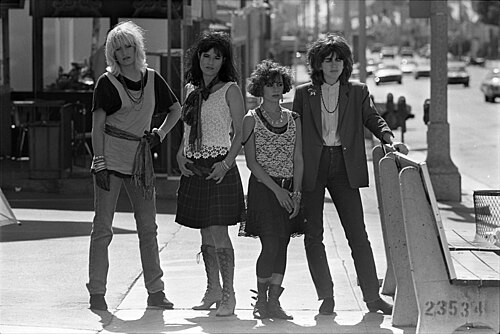
"Eternal Flame" was released from the Bangles' 1988 album Everything and became the biggest song of the band's career. It reached number one on the US Billboard Hot 100 on April 1, 1989, and topped the UK singles chart for four weeks from mid-April, hitting number one in nine countries in all. It was also the sound of a band pulling apart. The ballad diverged so far from the Bangles' garage-rock roots that not everyone wanted it. Guitarist Vicki Peterson, who praises the song now, resisted it then. "I was a freakin' rebel," she told The Independent in 2025. "I was determined to make The Bangles the rock band that we started out as. And I knew that to do something so blatantly pop... there was a resistance." The Bangles announced their breakup on September 21, 1989, less than six months after the song topped the US chart.
How the telling has grown over the decades
The story is unusually well documented because its writers are unusually willing to explain their own craft. Billy Steinberg's Songfacts interview is the songwriting spine: the Graceland-to-synagogue leap, the deliberately Beatlesque, chorus-free structure, the acoustic demo built for a keyboard-less band. Susanna Hoffs has told her side in interviews and, most fully, in her first-person account in Bruce Pollock's 2025 book, which supplies the Patsy Cline music-box arrangement, the near-forgotten scramble to record it, Miles Copeland's no-drums verdict, and the naked-vocal prank in her own words. Vicki Peterson's 2025 comments to The Independent add the band-internal resistance that the writers, looking back fondly, tend to soften.
The drift is minor but real. The popular shorthand that "Eternal Flame" is about Elvis flattens a two-part origin: the phrase surfaced at Graceland, but its emotional charge came from Steinberg's synagogue, and the flame at the grave was actually unlit that day. And the nude-vocal anecdote traveled for years as an unverified radio-DJ rumor before Hoffs confirmed it herself, prank and all. What every teller agrees on is the fragility of the thing: this worldwide number one kept nearly not existing, and one of its own writers had to keep rescuing it.
The honest bottom line
"Eternal Flame" is a calculated pop ballad, written to a formula by a band member teaming with proven outside hitmakers, aimed squarely at the sound of a Beatles deep cut, and produced into a music box after the demo. It divided the band that recorded it and arrived just as they broke up. None of that undercuts it. The writers are refreshingly honest that the title was half Elvis-shrine accident and half childhood memory, that the song almost got left off the record, and that the vocal was sung under a producer's practical joke. A lullaby assembled from that many odd parts has no business feeling as simple and true as this one does, and that is exactly why it has lasted. Two years earlier, Walk Like an Egyptian had turned the Bangles into a novelty sensation and Prince's cassette had given them Manic Monday; this was the song that proved they could write a number one without any of that.
FAQ
What is the story behind "Eternal Flame" by the Bangles? Susanna Hoffs told co-writer Billy Steinberg about a private Bangles tour of Graceland where the eternal flame at Elvis Presley's grave sat unlit in the rain. Steinberg connected it to the eternal flame he remembered from his childhood synagogue in Palm Springs, and the two, with Tom Kelly, built a Beatlesque love ballad around the title.
Is "Eternal Flame" about Elvis? No. It is a love song. The title came up because the Bangles had toured Graceland and seen the eternal flame at Elvis's grave, but the song is not about Elvis, and Billy Steinberg drew the title's meaning from his childhood synagogue rather than from Presley.
Who wrote "Eternal Flame"? Susanna Hoffs of the Bangles wrote it with the songwriting team of Billy Steinberg and Tom Kelly, who also wrote "Like a Virgin" and "True Colors." Kelly wrote the chords and melody on acoustic guitar, Steinberg shaped the lyric, and Hoffs came up with the demo.
Did Susanna Hoffs really record "Eternal Flame" naked? Yes, and she has confirmed it herself. Producer Davitt Sigerson pranked her by claiming Olivia Newton-John sang nude and had never sung better. Hoffs fell for it, sang behind a folding screen, and ended up recording most of the album that way. She has said she never did it again.
When did "Eternal Flame" reach number one? It topped the US Billboard Hot 100 on April 1, 1989, for one week, and spent four weeks at number one in the UK from mid-April 1989. It reached number one in nine countries.
Why does "Eternal Flame" not have a normal chorus? By design. Billy Steinberg has said the song is deliberately Beatlesque and has no traditional chorus. The title lands in the last line of the verse, and when the whole band re-sings the verse at the end, that verse ends up doing the job a chorus normally would.
Sources
- Susanna Hoffs, interview in Bruce Pollock, "They're Playing My Song," excerpted by SUNY Press, September 3, 2025
- Songfacts interviews with Billy Steinberg and Susanna Hoffs, "Eternal Flame"
- The Independent, Vicki Peterson interview, 2025, as quoted by Songfacts
- Stereogum, "The Number Ones: The Bangles' 'Eternal Flame'" (Tom Breihan); Billboard Hot 100 weekly tables, April 1989; UK Official Singles Chart, April 1989
An eternal flame deserves an accurate telling.
Part of Stories Behind the Songs. See also The Story Behind Walk Like an Egyptian and The Story Behind Manic Monday.