The lyric was written for Stevie Nicks, and Stevie Nicks did not want it. Kim Carnes did not want it either. Heart's own camp said it was not a Heart song, and the woman who talked them into it was the guitar player, not the singer, and she had a head cold the day she cut the vocal.
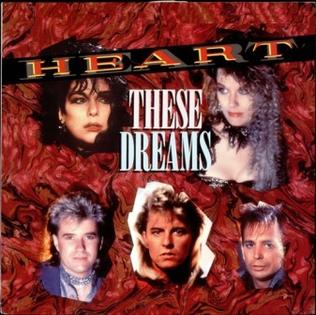
"These Dreams" was written by Bernie Taupin and Martin Page under the title "Boys In The Mist," a lyric Taupin aimed at Stevie Nicks. Nicks passed, Kim Carnes passed, and Page moved Taupin's bridge into the chorus and renamed it. Nancy Wilson fought to sing it over her own band's objections, cut the guide vocal with a cold, and the rasp stayed. It hit number one on March 22, 1986.
Bernie Taupin's other job
In the mid 1980s Taupin was working outside Elton John's orbit and looking for a more modern collaborator. He found one on Los Angeles radio. "I'd just arrived from England with my band, Q-Feel, and he'd heard Q-Feel because we were being played on KROQ," Martin Page told Songfacts in a 2014 interview with Carl Wiser. "Bernie wanted to move on a little bit into what at that time was more modern music."
Taupin handed him two lyrics as an audition. "'We Built This City' and 'These Dreams' were actually the first two songs that Bernie gave me," Page said. "It was really a tester from him to see if we could work well together. And just like he does with Elton, the lyrics come first." Both became number one records. Page's summary of that run, in a 2021 interview with Rediscover the 80s: "We were fortunate when we began writing together, in that our first two collaborations became number one hits."
The second lyric was not written with Heart anywhere in mind. "In fact, I can jump across to the other song, 'These Dreams,' which when it came to me was called 'Boys in the Mist,'" Page told Songfacts. "Bernie had written it for Stevie Nicks. She hadn't gone for it, so he passed it on to me as a song called 'Boys in the Mist.'"
Page can hear the intended voice in the words. "You can see with 'These Dreams' that he was writing a lyric that Stevie Nicks could have done: dreamlike, quite magical, quite medieval in its sense of going to a forest and a dream sense."

The title came out of the bridge
The song we know does not have the title Taupin gave it, and it does not have his structure either. "I didn't quite vibe off of that title, and although I'd only just started with Bernie, the bridge was the chorus to me," Page told Songfacts. "[I]t said 'these dreams' was the bridge. I moved the bridge into the chorus and used 'boys in the mist' in a verse setting."
He was new enough to the partnership to be scared of asking. "But I called him very nervously and said, 'Do you mind if I move a few things around?' And he said, 'No. Absolutely. That's what Elton does.'" Taupin's working position, as Page describes it, was that once the words left his hands the shape was somebody else's business: "That's your world now."
The music took almost no time. "'These Dreams' took me 10 minutes to write," Page told Songfacts, comparing it to a Robbie Robertson song that took him over a year. What he was chasing was not a power ballad at all. "When I sat down to write it, I wrote it as an electric hymn. I tried to do a demo which sounded like Orchestral Manoeuvres in the Dark doing 'Candle in the Wind.' To have an 'Enola Gay' feeling about it, so you had a feeling of a hymn."
Kim Carnes passed on it too
Before Heart ever heard it, Page played the song to Kim Carnes, who had already cut two of his songs. She liked it and then talked herself out of it. "I played her 'These Dreams,' and she loved it," Page told Songfacts. "But when she went to do the demo, she thought it was too scale-y and went too far melodically, so she passed on it."
Her verdict on herself, years later and quoted by Page: "When it became #1, she told me, 'I always pass on #1 songs, I'm very frustrated about that.'"
The Heart camp did not want it either
By the time the demo reached Heart, the band was listening to piles of outside material for the album that would rebuild their career. Nancy Wilson's account of the day is the closest thing this story has to a turning point.
"We were at Ann's house listening to cassette after cassette after cassette of outside writers, songs that we might want to try as for a Heart songs," she told Yahoo Entertainment in May 2021. The producer in the room set the song up as an outlier: "This is a really beautiful other kind of song. It's not a hard song, by any stretch of the imagination, but it's a beautiful song."
Nancy's reaction was immediate and, by her own account, not shared. "And so we heard this demo, and I was like, 'Oh my God, I love this song. I need to sing this song. I need it! I need this for me!' And they were like, 'Nah, that's not going to work out. ... No, no, no, no, no, we're not gonna do that song. It's just not a Heart song.' And so I said, 'Please, please, please, please. I gotta do this!'"
She won the argument in stages. She "talked everybody into allowing me to make a demo of it," and that demo is where the record was really made.
Martin Page tells the resistance from the outside, and puts it on the producer rather than the band. "Although their producer, Ron Nevison, was not convinced it was the right type of song for them, the sisters dug in their heels and demanded to cut the song," he told Rediscover the 80s in 2021.
The cold that became the sound
The rasp that makes the record is a virus. Nancy has told this part twice in the last five years, and the two versions do not resolve the same way.
In 2021 she told Yahoo Entertainment that the sick take simply stayed: "When I was singing on the demo, the mock vocal, I had a cold that day, so my voice was really scratchy. And they said, 'That's really a cool sound. We should keep that in the song.' So, it just came about, like every which way, for that song to actually become the very first ever No. 1 single we ever had."
In January 2026 she told Fox 5 Atlanta that the sick take did not stay, and had to be imitated afterward. "We were doing the mock vocals, and I was sitting in a little isolation booth, and I had a pretty bad cold. But I was singing the guide lead track ... It turned out that when we did the real vocals later, they kind of missed the sound of my vocal when I had the cold! So, we added some of that back in."
Both are hers, five years apart, describing the same booth. The audible result on the record is the same either way, and it is the reason a Heart single that Ann Wilson does not sing became the biggest thing the band ever had.
Ann was pissed
"These Dreams" was the first Heart single with Nancy on lead, and Nancy has been open for years about what that did inside the band. Her own summary, to Yahoo Entertainment: "and Ann was pissed!" She expands: Ann was "not happy, and she was not the kind to keep that under her belt."
The story has a punchline that Nancy tells at nobody's expense but the song's. "It's just so funny to me that she said, 'I want to try singing it sometime,' and I said, 'OK, why don't you do it?' So, we got a karaoke machine. We put 'These Dreams' on the karaoke machine, and she goes, 'Well, I can't sing that song. It makes it sound like jazz! So never mind. I'm never going to try to sing that again.'"
What it did on the chart
The single entered the Billboard Hot 100 at number 54 on the chart dated January 18, 1986, credited to writers B.J.P. Taupin and M. Page. Ten weeks later, on the chart dated March 22, 1986, it reached number 1, taking the top spot from "Sara" by Starship, the band whose comeback the same Taupin and Page song "We Built This City" had launched the previous year. It held number 1 for a single week, then slipped to number 2 behind "Rock Me Amadeus" by Falco on the chart dated March 29.
It was Heart's first number one single, and the first Heart single with Nancy Wilson singing lead.
Page's own opinion of the record has moved with time. "When I heard Heart's version, I thought it a little undone and under produced, but as the years have passed, I have recognized the minimalist strength of the production," he told Rediscover the 80s. Back in 2014 he had already landed on why the stripped version worked: "Heart broke it down to its essence and made it very simplistic. I think in a way that's what really made it such a successful record."
How the telling has grown over the decades
Martin Page's 2014 Songfacts interview is the spine: Taupin's audition, the Nicks rejection, the bridge moved into the chorus, the ten minutes, the Kim Carnes pass. His 2021 Rediscover the 80s interview added the Ron Nevison resistance, the Q-Feel origin of the arrangement idea, and his softened verdict on Heart's production.
Nancy Wilson's tellings run the other direction, from inside the band. Yahoo Entertainment's May 2021 interview, timed to the song's 35th anniversary, gave the cassette session at Ann's house, her begging for the song, and the friction that followed. Fox 5 Atlanta's January 2026 interview gave the isolation booth.
Two drifts are worth naming rather than smoothing.
First, the cold. Nancy in 2021 says the scratchy demo vocal was kept. Nancy in 2026 says the real vocals were recut later and the rasp was added back in afterward. Songfacts describes the second version. Nobody disputes that she was sick and that the sickness is on the record.
Second, and larger: Martin Page's 2021 telling passes along a version in which the wrong Wilson had the cold. "As the story or rumor goes, on the day that the lead vocal on 'These Dreams' was to be recorded, Heart's main lead singer Ann had a cold and couldn't perform it, leaving Nancy to do the vocal chores." Page flags it as rumor himself, and Nancy's own first-person account contradicts it in both of her tellings: she had the cold, and she got the song by asking for it, not by default. The songwriter's version and the singer's version of the same afternoon are not the same story.
The honest bottom line
Nothing about this record was anybody's plan. It is a Bernie Taupin lyric written at Stevie Nicks, rejected by her, rejected by Kim Carnes, retitled and restructured by a British synth musician who wanted it to sound like OMD covering Elton John, then talked onto a hard rock album by the band's guitar player over objections that it was not a Heart song, and sung through a head cold. The lyric is atmosphere rather than argument, and the band it made famous spent the next few years fighting about outside songwriters and MTV lighting. It still stops a room, because a demo vocal by someone who wanted it that badly is not a thing you can produce on purpose.
FAQ
What is the story behind "These Dreams" by Heart? Bernie Taupin wrote the lyric for Stevie Nicks under the title "Boys In The Mist." Nicks passed and Kim Carnes passed. Martin Page wrote the music, moved Taupin's bridge into the chorus and renamed it, and Nancy Wilson pushed her own band into recording it.
Who wrote "These Dreams"? Bernie Taupin wrote the lyrics and Martin Page wrote the music. Billboard credits the single to B.J.P. Taupin and M. Page. It was the second song the pair wrote together, after "We Built This City."
Was "These Dreams" written for Stevie Nicks? Yes. Page has said in interviews since at least 2014 that Taupin wrote the lyric for Nicks, that she did not go for it, and that Taupin then passed it to him.
Why does Nancy Wilson sound raspy on "These Dreams"? She had a cold when she sang the guide vocal. She told Yahoo Entertainment in 2021 that the scratchy take was kept, and told Fox 5 Atlanta in 2026 that the vocals were recut later and the rasp was added back in.
Is that Ann Wilson singing "These Dreams"? No. It was the first Heart single with Nancy Wilson on lead vocals. Nancy has said Ann was unhappy about the switch, and that Ann later tried the song on a karaoke machine and gave up on it.
When was "These Dreams" number one? On the Billboard Hot 100 dated March 22, 1986, its tenth week on the chart. It was Heart's first number one single and it held the top for one week before "Rock Me Amadeus" by Falco took over.
Sources
- Songfacts, "Martin Page: Songwriter Interviews," Carl Wiser, March 2014
- Rediscover the 80s, "Interview with Martin Page from Q-Feel, Songwriter and Solo Artist," August 2021
- Yahoo Entertainment, Nancy Wilson interview on her first solo album and the 35th anniversary of "These Dreams," May 2021
- Fox 5 Atlanta, "Legendary Heart musician Nancy Wilson talks sweet return to touring," January 2026
- Songfacts, "These Dreams by Heart"
- Billboard Hot 100 charts dated January 18, March 15, March 22 and March 29, 1986
These tellings survive because they were built to.
Part of Stories Behind the Songs. See also We Built This City and Bette Davis Eyes.