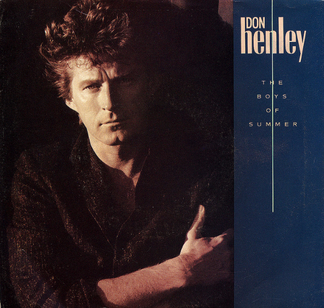
The music was written by a man in another band, who stayed up all night with a borrowed synth and a brand-new drum machine and then got told his demo was too jazzy. The words came from a former Eagle who cannot play a chord on a guitar. The most famous line was a real thing the singer saw on a freeway. And the whole record nearly died twice in the studio, once to a cassette error and once to peeling tape. "The Boys of Summer" is a song assembled out of near-misses, and both men who made it have told the story for decades.
"The Boys of Summer" grew from a demo Tom Petty and the Heartbreakers guitarist Mike Campbell built on a LinnDrum machine and a borrowed Oberheim synth around 1984. Petty and producer Jimmy Iovine passed on it as too jazzy for their album, so Iovine steered it to Don Henley, who was making his first solo record. Henley wrote the lyric, insisted on a key change, and turned it into a number 5 hit that won the 1986 Grammy for Best Male Rock Vocal Performance.
The all-nighter with a new drum machine
The song starts with a piece of gear almost nobody had yet. Mike Campbell knew Roger Linn, the inventor building the first affordable drum machines. "I had a friend named Roger Linn who used to work over at Leon Russell's house," Campbell said in a video interview recounted by MusicRadar. "Tom [Petty] and I would go over there and Roger would always be in the back room and we said, 'What's he doing back there?' They said, 'He's building a drum machine.'" Campbell bought a LinnDrum at what he called the "FOR" price, Friend Of Roger, and set it up in a spare-bedroom studio.
Then he borrowed a synth and lost a night to it. "I had borrowed an Oberheim OB-X synthesiser and I was playing around with the drum machine one night," Campbell told MusicRadar. "I stayed up all night, just typing in tambourines and claps and hands and drums and snares. I got a little pattern going." Over that pattern came the synth hook and the guitars. He had something, but he "didn't think much about it."
"A little jazzy for what we're doing"
Campbell played it for the people closest to him first, and they passed. "A week later Tom Petty and [producer] Jimmy Iovine were over at my house and I played them my demo and they said, 'I think that's a little jazzy for what we're doing right now' and I agreed with them," Campbell told MusicRadar. The Heartbreakers were making 1985's "Southern Accents," and the demo did not fit. "I put it aside and this song almost didn't happen," Campbell said.
Iovine did not forget it. A week later he called Campbell with a name. "He called me a week later and told me Don Henley was looking for some music for his first solo record, and I remembered that track and he did too," Campbell told MusicRadar. Henley needed exactly what Campbell had, because Henley does not write music on an instrument. As his former Eagles bandmate Don Felder once put it to MusicRadar: "He's a great singer, great lyricist and a great songwriter, but he doesn't play anything. He plays drums. He can't pick up a guitar and write chord progressions; he can't sit at a piano and write music underneath him."
"I thought he hated it"
Campbell handed the cassette to a musician he had never met, and the first reaction terrified him. "He sat at the end of a long table and he had a cassette player, he put a cassette on and he just did this," Campbell recalled to MusicRadar, miming folded arms and a bowed head. "He didn't tap a foot or move his head or anything. He listened to it all the way through and I thought he hated it." Henley said only that he would work on it.
The phone rang soon after. "It was Don, he said, 'I've written the best song I've written in ten years' and I said, 'Ok let's go and make the record.'" What Henley had written was a backward-looking meditation on lost time. He is a baseball fan, and the title comes from Roger Kahn's 1972 book about the Brooklyn Dodgers, which had in turn borrowed it from a Dylan Thomas poem, but Henley has always said the sport is not the subject. "It's not about baseball really, it's about life," he told Howard Stern in 2015. "I have a thing about looking back."
The Deadhead sticker on the Cadillac
The song's most quoted line was something Henley actually saw. He explained it to the NME in 1985: "I was driving down the San Diego Freeway and got passed by a $21,000 Cadillac Seville, the status symbol of the right-wing upper-middle-class American bourgeoisie". He described the driver's whole world, "all the guys with the blue blazers with the crests and the grey pants," and then the detail that stopped him: "there was this Grateful Dead 'Deadhead' bumper sticker on it!" The image of a counterculture badge stuck to a luxury car, rebellion turned into decoration, became the line "Out on the road today, I saw a Deadhead sticker on a Cadillac."
Henley has guarded that line since. When the punk band The Ataris covered the song in 2003 and changed it to a "Black Flag sticker," Henley was asked in a 2016 interview whether the swap bothered him. "No, not really ... And if you noticed, we haven't heard much from the Ataris since then," he answered, per Wikipedia's account.

The song that almost died in the studio
Getting the demo onto tape nearly ended in disaster. LinnDrum patterns were saved to cassette, and Campbell's would not load. "I pushed play and it just said 'error'," he told MusicRadar. "My song's gone, I'm gonna look like a fool, they're thinking I'm an idiot." He tried five or six times while the studio staff waited. "Boom! It loaded up by some miracle," Campbell said, and the part finally tracked to tape.
Then Henley moved the goalposts. Campbell had painstakingly recreated every guitar lick from his off-the-cuff demo, a week of overdubs and harmonies, when "Don comes in one day and says, 'I want to change the key.'" It cost another full week to re-track everything in F sharp major, and Campbell admits it was the right call. "He, in his singing genius, had realised that if it was higher he could push it and get certain things out of it," Campbell told MusicRadar. "And he was right. The Heartbreakers never did that. If we brought a song that was in A, it goes in A." Even mastering nearly wrecked it: Campbell watched the backing peel off the analog tape onto the floor in a pile before a staffer surgically glued it back together.
Tom Petty's regret, and the wall he punched
There is a well-worn legend that Tom Petty punched a studio wall and broke bones in his hand the moment he heard "The Boys of Summer" playing on the radio, gutted that he had let it go. Only half of that is true. Petty did break his hand punching a wall during the "Southern Accents" sessions, but not over this song. "There wasn't a particular reason why I turned around and punched the wall... I was just frustrated," Petty said in a clip cited by MusicRadar, describing ear fatigue from remixing.
The regret was real, though, and it came out gently years later. Campbell told the story on Brian Koppelman's The Moment podcast in 2020: "The two of us were sitting in the car and we turn on the radio and there's Boys Of Summer. I go, 'Oh!' and I change the channel. There it is again before I can even turn the cassette on. And he looks at me and goes, 'Boy, you know, you were really lucky with that. I wish I would have had the presence of mind to not let that get away.' That was a real brother moment we had." For Campbell, the song did more than earn a Grammy: its success paid off a family home he was about to lose to foreclosure.
How the telling has grown over the decades
The two halves of this story come from two men, and they have stayed remarkably consistent. Henley's earliest tellings, like the 1985 NME interview, nailed down the Cadillac and the meaning, that the song is about looking back and letting go, not baseball. He repeated the same read to Howard Stern thirty years later in 2015, and defended the Deadhead line against The Ataris in 2016. Mike Campbell's side, the demo and the studio near-disasters, came later and in more detail, most fully in his video interviews and his 2020 podcast account of Petty's regret.
One piece of lore needed correcting along the way. For years the wall-punch and the radio were welded into a single dramatic scene: Petty hears the hit he passed on, and breaks his hand in fury. Petty himself unstitched it. The punch happened, the broken bones happened, but the cause was studio frustration, not the sound of Campbell's song on the radio. The regret was real; the fist through the wall was a different night.
The honest bottom line
Strip away the atmosphere and "The Boys of Summer" is a piece of luck that survived a gauntlet of rejections and accidents. It was written by a guitarist for a singer who could not play it, in a band that turned it down, on machines almost nobody understood yet, and it nearly died to a cassette error, a last-minute key change, and literally peeling tape. None of that shows in the record. What survives is a wide-screen ache about time passing, anchored by one perfect image a man really did see on a freeway. Both makers know exactly how close it came to never existing, which is why they have never stopped telling how it did. That same year, Springsteen's Dancing in the Dark had been wrung out of a man who did not want to write another song, another record born from frustration that ended up sounding like a hit, and together the two songs prove that the best rock of 1984 came from people who thought they had nothing left.
FAQ
Who wrote "The Boys of Summer"? The music was written by Mike Campbell, guitarist for Tom Petty and the Heartbreakers, who built the demo on a LinnDrum machine and a borrowed Oberheim synthesizer. Don Henley wrote the lyrics and melody and recorded it for his 1984 solo album Building the Perfect Beast.
Why did Tom Petty turn down "The Boys of Summer"? Campbell played the demo for Petty and producer Jimmy Iovine, who felt it was too jazzy for the Heartbreakers album they were making, 1985's Southern Accents. Iovine later steered the demo to Don Henley. Petty said years afterward that he regretted letting it get away.
What does "a Deadhead sticker on a Cadillac" mean? Henley told the NME in 1985 that he saw a real Grateful Dead sticker on an expensive Cadillac Seville while driving on the San Diego Freeway. To him it captured a generation's rebellion fading into wealth and status, a counterculture badge reduced to decoration on a luxury car.
Is "The Boys of Summer" about baseball? No. The title comes from Roger Kahn's 1972 book about the Brooklyn Dodgers, which took the phrase from a Dylan Thomas poem, but Henley has said repeatedly the song is about looking back on lost love and the passage of time, not the sport.
How did "The Boys of Summer" do on the charts and at the Grammys? It reached number 5 on the Billboard Hot 100 and won Don Henley the 1986 Grammy for Best Male Rock Vocal Performance. Its video won Video of the Year at the 1985 MTV Video Music Awards.
Sources
- MusicRadar, "When an Eagle, Heartbreaker, Roger Linn and an Oberheim OB-X combined forces for a pop masterpiece: the Boys Of Summer story" (Mike Campbell and Don Felder quotes, and Petty and Henley quotes)
- NME, 1985 Don Henley interview (the Deadhead sticker line), as quoted by MusicRadar and Songfacts
- Howard Stern Show, Don Henley interview, 2015, as quoted by MusicRadar
- Brian Koppelman, The Moment podcast, Mike Campbell interview, 2020, as quoted by MusicRadar
- Wikipedia, "The Boys of Summer (song)" (Ataris cover, Henley 2016 response, chart and awards facts)
- Billboard Hot 100 weekly charts, 1984 to 1985 (chart peak)
Nobody on the road, nobody unverified, house rule.
Part of Stories Behind the Songs. See also In the Air Tonight and Rosanna.