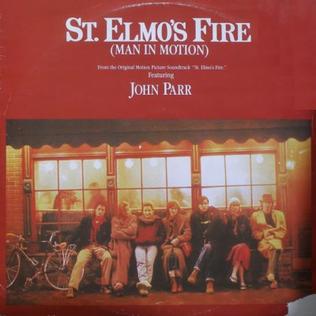
It is the theme to a Brat Pack movie about rich college kids, and the man who sang it refused to watch the film. The line everybody assumes is about a girl's Jeep is really about a wheelchair. And the "man in motion" of the title is not Rob Lowe or Emilio Estevez. He is a paraplegic athlete who was, at that exact moment, wheeling himself across four continents.
"St. Elmo's Fire (Man in Motion)" was written by John Parr and David Foster in 1985 as the theme to the film St. Elmo's Fire, but Parr secretly wrote the lyrics about Rick Hansen, the Canadian athlete then wheeling around the world for spinal cord research. Parr disguised the words so the studio thought they fit the movie. It hit number one on the Billboard Hot 100 on September 7, 1985 and stayed two weeks.
The song he almost turned down
The job came to Parr because David Foster liked his hit "Naughty Naughty" and asked him to perform the film's title track. There was already a song on the table, and Parr wanted no part of it. "That song sounded like Fame II or Flashdance II," he later said. "I thought the movie was supposed to have more class than that. It was a regurgitated song, and I didn't really want to sing it." So Foster and Parr agreed to write a new one from scratch, and they did it fast. By Parr's account they wrote it "between 2 and 4 on Friday afternoon," and the whole thing was created and edited inside 24 hours.
Director Joel Schumacher had given Parr a loose brief. "He wanted a song about determination," Parr recalled. "He wanted a song about kids who are growing up and have to make decisions about what to do with their lives. That's what the movie is about." Parr took the theme of determination and pointed it somewhere Schumacher never expected.
The news clip that changed the song
The turn came when Foster showed Parr a piece of Canadian television. "David showed me a video of Rick Hansen and I was inspired to write the story of his planned epic journey to circumnavigate the globe in his wheel chair," Parr told Songfacts. Hansen was a paraplegic Canadian athlete who had set out to push his wheelchair around the world to raise awareness and money for spinal cord injury research. That, not the movie, became the engine of the lyric.
Parr decided to smuggle Hansen's story into a major-studio theme song. He wrote words that would read as generic movie uplift to the film company while meaning something exact to him.
The double meaning hidden in plain sight
This is the part Parr has delighted in explaining for decades. The song is a Trojan horse. "I wrote the lyric ambiguously, so the film company would think 'all I needs these pair of wheels' referred to Demi Moore's jeep when actually I am referring to Rick's wheelchair," he told Songfacts. The trick did not stop at one line. As Parr put it, "'for once in his life a man has his time' actually refers to when Rick would end his journey wheeling back into Vancouver with a million people lining the streets, not when Emilio Estevez finally kisses Andie Macdowell."
So the anthem that soundtracked a movie about privileged twenty-somethings figuring out their lives was, underneath, a tribute to a man who could not walk pushing himself past the point most people would quit. The studio got its inspirational theme. Hansen got a number one hit written about him. And most of the audience never knew.
Why he refused to watch the movie
Parr protected the meaning by staying away from the film itself. "Fortunately I didn't see the film," he told Songfacts, "specifically because the phenomenal force of nature known as St. Elmo's Fire was a metaphor. To me it was the embodiment of a dream, a focus to strive towards as it glows in the sky." He knew a scene in the movie would have punctured his version. "In the movie Rob Lowe pulls out a gas canister and tells Demi Moore not to get too hung up about her problems. He lights the gas and as it ignites he dismisses her plight as no big deal just like St. Elmo's Fire. That would have killed it for me." To Parr, St. Elmo's Fire was mystical, "where paradise lies, like the end of the rainbow," not a bar and a lighter gag.
He was so disconnected from the movie that when the video paired him with its stars, he did not recognize them. The Brat Pack meant nothing in England. "I thought they were just kids," he told Songfacts. "When we were shooting it seemed like they weren't doing anything, so I was stupid enough to offer them the benefit of my experience. After all I had done a few school plays."
The real man in motion, and the number one
While the song climbed the American chart, the actual subject was out on the road. Rick Hansen had begun his Man in Motion World Tour on March 21, 1985 from Vancouver. Public attention was thin at the start, but it grew into a 26-month trek covering more than 40,000 kilometers through 34 countries on four continents. In September 1985, the week the song owned the top of the chart, Hansen was wheeling through Moscow.
The record did exactly what a great movie theme is supposed to do, and then some. "St. Elmo's Fire (Man in Motion)" reached number one on the Billboard Hot 100 on September 7, 1985 and held for two weeks, also topping the Cashbox and Canadian charts and earning Parr a Grammy nomination. It went on to become the anthem of the Rick Hansen Foundation, helping raise money for spinal cord research long after 1985, exactly the kind of enduring 80s anthem an all-80s stream from the Bubble was built to keep in rotation.

How the telling has grown over the decades
Parr has never hidden the secret; he has spent forty years revealing it. In the years after the hit, he laid out the Hansen inspiration and the disguised lyrics in interviews, including his detailed Songfacts telling, and posted the story on his own website. The account has stayed remarkably consistent: the rejected first song, the Foster news clip, the two-hour write, the wheelchair hidden inside "pair of wheels."
The one honest wrinkle is not a contradiction but a reframing. For a stretch, the song lived purely as a movie theme and a karaoke staple, its real subject unknown to most listeners. Over time, as Parr kept telling the truth and the Rick Hansen Foundation adopted the song, the Hansen story moved from hidden meaning to headline. By the song's 40th anniversary in 2025, Parr, Hansen, and Foster were publicly celebrating it together as what it always secretly was: a tribute to the man in the wheelchair.
The honest bottom line
Strip away the Brat Pack nostalgia and "St. Elmo's Fire (Man in Motion)" is a piece of clever contraband: a work-for-hire movie theme, banged out in two hours by a singer who would not watch the film, built to smuggle a paraplegic athlete's story past a studio that wanted an uplifting song about college kids. It should read as cynical. It does the opposite. The determination Schumacher asked for turned out to be real and off-screen, and the reason the song still lands is that Parr meant every word about someone who earned it. The best-kept secret in the lyric is also the thing that makes it true. That same summer, Simple Minds delivered a similar grudge-to-glory movie anthem with Don't You (Forget About Me), another work-for-hire hit recorded by a band who did not want it, and together the two songs are proof that the mid-80s movie tie-in peaked when nobody involved was trying.
FAQ
What is the story behind "St. Elmo's Fire (Man in Motion)"? John Parr and David Foster wrote it as the theme to the 1985 film St. Elmo's Fire, but Parr based the lyrics on Rick Hansen, a Canadian paraplegic athlete wheeling around the world for spinal cord research. Parr disguised the words so the studio thought they matched the movie, and it became a number one hit.
Who is the "man in motion" in the song? Rick Hansen. He is the Canadian athlete whose Man in Motion World Tour, pushing his wheelchair across 34 countries, inspired the lyric. The title refers to him, not to any character in the film.
Is "St. Elmo's Fire" actually about the movie? Only on the surface. Parr wrote the lyrics ambiguously so the film company believed lines like "all I need's this pair of wheels" referred to Demi Moore's Jeep, when he meant Rick Hansen's wheelchair. Parr has said he did not even watch the movie so his own meaning would stay intact.
Who wrote and produced "St. Elmo's Fire (Man in Motion)"? John Parr and David Foster wrote it together in 1985, with Foster producing. Foster first brought Parr in after being impressed by Parr's earlier hit "Naughty Naughty."
Did "St. Elmo's Fire (Man in Motion)" reach number one? Yes. It topped the Billboard Hot 100 for the week of September 7, 1985 and stayed at number one for two weeks. It also reached number one in Canada and earned Parr a Grammy nomination.
Did John Parr write the song quickly? Very quickly. Parr has said he and David Foster wrote it "between 2 and 4 on Friday afternoon," and the song was created and edited within 24 hours.
Sources
- Songfacts, "St. Elmo's Fire (Man In Motion) by John Parr," a direct John Parr interview (the disguised-lyrics and "didn't see the film" quotes)
- Wikipedia, "St. Elmo's Fire (Man in Motion)," for the rejected first song, the writing brief, and chart positions
- John Parr official site, johnparr.net, "St Elmo's Fire," for the Rick Hansen inspiration and tour facts
- Rick Hansen Foundation, "St. Elmo's Fire (Man in Motion) at 40," for the Man in Motion World Tour details and the disguised lines
- Billboard Hot 100, week of September 7, 1985
A man in motion still needs a checked map.
Part of Stories Behind the Songs. See also Eye of the Tiger and Footloose.