The man who wrote it turned up backstage, drunk, and pushed a cassette into somebody's pocket. The tape stayed in that pocket for about a month. The band it was written for said no, then said no again, and when they finally recorded it they were in and out of the studio in a few hours. It went to number one, and forty years later it is the only song most Americans can name by them.
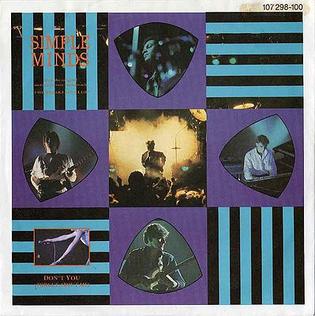
"Don't You (Forget About Me)" was written by Keith Forsey and Steve Schiff for John Hughes's The Breakfast Club. Simple Minds refused it repeatedly, because they did not record other people's songs and Jim Kerr found the demo generic. They changed their minds after meeting Hughes and Forsey, cut it in a few hours in London, and Billboard shows it at number one on May 18, 1985.
The cassette in the pocket
The standard version of this story has a songwriter delivering a demo to a band. Jim Kerr's own telling, given to The Hollywood Reporter in May 2025 for the song's fortieth anniversary, is considerably less dignified.
"A big part of the reluctance was the approach. It didn't come from the record company," Kerr said. "[The songwriter] Keith Forsey came backstage one night and ... he was a little inebriated. We didn't know who he was. There's always someone backstage saying they want to work with you, and stuffing a cassette in your pocket, and you think, who's this guy? And that cassette remained in someone's pocket for about a month, and we didn't get in touch with them."
Forsey was not a nobody. He had co-written the title song to Flashdance and would go on to co-write "Shakedown" for Beverly Hills Cop II, and he was in charge of the music for The Breakfast Club. Simple Minds just had no idea who they were talking to.
When the label did make contact, the band counter-offered with a song of their own. "Then, when the record company got in touch, we had this song 'Alive and Kicking,' and we thought, Hey, if you want to work with us, you work with this," Kerr told The Hollywood Reporter. "And they were saying, 'No, that won't work with the script,' which, of course, absolutely made sense."
That was the part they could not see at the time. "Don't You (Forget About Me)" had been written to the script. Forsey took the title from dialogue in the film, in the scene where the five students argue about whether they will acknowledge each other on Monday morning. The song could not be swapped for an existing Simple Minds track because it was built to answer a specific question the movie asks.
Why they kept saying no
Simple Minds had two objections and they were both about identity.
The first was a flat rule. They wrote their own material and that was the end of it. Kerr described the band's state of mind on the Songfacts Podcast in 2022 with unusual candor about how it looked from outside. "We were young, we were a bit brattish, we were insecure," he said. "We were loving what we were doing and thinking, 'Hang on a minute, you want us in 'cause you love us because we write these songs, but you want us to do your song?' We weren't even willing to listen initially. We were like, 'No, we don't do other people's songs. End of story.'"
The second objection was that the demo sounded like an imitation of them, which made the offer feel like an insult rather than a compliment. "And of course, later on it was explained, but the song was written to the script and every time they tried to make it more amenable, it sounded worse, because they would say, 'It sounds really like Simple Minds,' and we would be infuriated," Kerr said. "'How dare you rip us off and then try and sell us on an idea!'"
Songfacts records a third and more specific objection: that Kerr disliked the lyric, particularly the "vanity, insecurity" line. Kerr's own 2025 assessment of the demo is gentler and vaguer. Asked by The Hollywood Reporter what he thought when Forsey first played it, he said: "There was nothing wrong with it; just sounded a bit generic."
What changed their minds was context, not pressure. They met John Hughes, they were shown the film, and the lyric stopped sounding generic once they could see what it was sitting under. Forsey came to Scotland and got on with them. Then they went into a studio in London and were done in a few hours.
Who actually turned it down, and who says they did not
This is the part of the story that has been repeated wrongly for decades, and one of the people involved got tired enough of it to say so publicly.
The widely circulated version is that the song was offered to a series of stars who all passed, usually named as Bryan Ferry and Billy Idol. Songfacts reports that Forsey's first choice was Bryan Ferry of Roxy Music, and that Ferry turned it down.
Billy Idol denies flatly that it was ever offered to him. Keith Forsey produced Idol's records, which is where the assumption comes from, and Idol has corrected it in his own words. Posting on X on June 23, 2013, after hearing the claim repeated in the film Pitch Perfect, he wrote: "In the Pitch Perfect movie they say i turned down 'Don't You Forget About Me'. My producer wrote it 4 Simple Minds it was never offered 2 me."
That is a direct contradiction of the popular story from the person the popular story is about, and it is worth taking seriously rather than splitting the difference. It also sits awkwardly beside the Bryan Ferry account, because if Forsey wrote it for Simple Minds, as Idol says Forsey told him, then the story of a queue of rejected stars needs more evidence than it usually gets.
The few hours that fixed it
Every account agrees the recording itself was fast and went well immediately.
"Once we go into the studio, we don't know how to do things by half measure," Kerr told Songfacts. "The band was on fire anyway. Anything we jammed on sounded great."
The introduction that everyone recognizes was built there: guitarist Charlie Burchill found the riff, and Kerr improvised the "hey, hey, hey, hey" over the top. The resistance evaporated the moment they were playing rather than arguing.
"Suddenly it was game-on and we weren't thinking about ourselves, we were just thinking about what's coming out of the speaker, and every time someone did something that was cool, that encouraged us more," Kerr said. "We were kinda looking at each other going, 'It's good this? isn't it?'"
He drew a general lesson from it that reads like a note to his younger self. "This is the thing with music: You can analyze it and you can come with an attitude - and bands are notorious for politics - but once you start playing and you like how it makes you feel, everything else goes out the window. That's all that counts."
The most famous part of the song is a placeholder
The extended "la la la la" section that closes the record, the part crowds sing loudest, was never meant to be in the finished song. Neither Forsey nor Kerr could think of words for that stretch that made any sense, so they sang nonsense to hold the space. Kerr intended to write a real lyric and record it the following day. Then they played the track back, heard the placeholder in context, and left it exactly as it was.
Guilt at number one
"Don't You (Forget About Me)" entered the Billboard Hot 100 at number 90 on February 23, 1985 and reached number one on May 18, 1985, holding for one week before Wham!'s "Everything She Wants" replaced it on May 25. Billboard credits the writers as K. Forsey and S. Schiff, with Forsey producing, on A&M.
For a band that had spent years writing their own songs, playing clubs and chasing a deal, having their breakthrough arrive on someone else's song after a couple of hours of work did not feel like a triumph. It felt unearned.
"We thought, We didn't even work for this, we just jumped down there for a couple of hours and now it's #1 on the Billboard charts," Kerr told Songfacts. "It was a Calvinistic way of looking at it. We don't deserve this success. But there's this other thing that says, 'Don't look a gift horse in the mouth.' You know, take the break. Listen to all those people who worked so hard for it in the record company and people who believed in it, and the people at MTV who gave us a break and all that stuff. We owe them a ton."
Kerr also remembers exactly where he was when the news arrived, and he was busy writing the song he had wanted to give them instead. "I do, because it's not every day you get both a telegram and a fax saying, 'Your song's number one on the Billboard chart.' I was in the south of France for my sins," he told The Hollywood Reporter. He was sitting on the rocks with a Sony Walkman, writing the words to "Alive and Kicking," when the calls started coming into the hotel.
An all-80s radio stream from the Bubble is coming, and this is one of the songs that never left the rotation in the first place.
How the telling has grown over the decades
2013, Billy Idol on X. Not a telling of the song's creation but a correction to it, prompted by a movie repeating the myth. Idol states the song was written for Simple Minds and was never offered to him. This is the only first-person statement in this article from any of the artists supposedly in the rejection queue.
2022, the Songfacts Podcast. Kerr's most self-critical version. "We were young, we were a bit brattish, we were insecure." This is where the second objection surfaces clearly: the demo sounded like a Simple Minds pastiche, and being told so made them angrier rather than more interested.
Songfacts interviews with Jim Kerr. The studio account, the Calvinist guilt about an unearned number one, and the la-la placeholder that survived.
May 2025, The Hollywood Reporter (Lori Majewski). The fortieth anniversary telling, and the one that adds the most concrete new detail: Forsey backstage and inebriated, the unknown man with a cassette, the tape forgotten in a pocket for a month, and Kerr's insistence that the reluctance did not originate with the record company.
Where the tellings drift. Three places. First, how the song reached the band. Songfacts frames it as Forsey delivering a demo with an A&M A&R man named Jordan Harris pushing the band to record it, while Kerr in 2025 describes an anonymous drunk stranger backstage and says explicitly that the reluctance "didn't come from the record company." Second, what Kerr actually objected to. Songfacts says he disliked the lyric and singles out the "vanity, insecurity" line, while Kerr in 2025 says there was nothing wrong with the song and it merely "sounded a bit generic." Forty years tends to sand the edges off a specific complaint. Third, and most consequentially, the rejection queue. The Bryan Ferry claim is reported by Songfacts. The Billy Idol claim, repeated everywhere including in a Hollywood film, is denied by Billy Idol in his own words. This article carries the denial rather than the legend, because the denial is first-person and the legend is not.
The honest bottom line
Simple Minds' signature song is not a Simple Minds song. They did not write it, they did not want it, they thought it was a cheap copy of themselves, and they recorded it in an afternoon largely to be polite. It made them famous in America and it also flattened them: a band with a substantial catalogue of their own material is now, in most of the world, the group that did the Breakfast Club song. Kerr's own word for how it felt is guilt. What redeems the whole thing is that he has never pretended otherwise in any telling across forty years, and that the record itself, made grudgingly by people who thought it was beneath them, is unmistakably the sound of a band enjoying themselves once they stopped arguing. A year earlier, Ray Parker Jr. had gone through a similar grudge-to-glory arc with the Ghostbusters theme, another movie song knocked out under deadline pressure by someone who did not ask for the assignment, and both records prove that the decade's most durable movie anthems were made by people doing favors they regretted.
FAQ
What is the story behind "Don't You (Forget About Me)"? Keith Forsey and Steve Schiff wrote it to the script of The Breakfast Club, with Forsey taking the title from dialogue in the film. Forsey wanted Simple Minds to record it and gave them a cassette backstage, but the band refused because they only performed their own material. They agreed after meeting John Hughes and seeing the film, and recorded it in a few hours in London.
Why did Simple Minds refuse "Don't You (Forget About Me)"? Two reasons, in Jim Kerr's account. They did not record other people's songs: "We were like, 'No, we don't do other people's songs. End of story.'" And the demo sounded to them like an imitation of their own style, which made the pitch insulting rather than flattering.
Did Billy Idol turn down "Don't You (Forget About Me)"? He says no. Keith Forsey produced Billy Idol's records, which is where the story comes from, but Idol wrote on X in June 2013: "In the Pitch Perfect movie they say i turned down 'Don't You Forget About Me'. My producer wrote it 4 Simple Minds it was never offered 2 me."
Who wrote "Don't You (Forget About Me)"? Keith Forsey and Steve Schiff. Billboard credits them as K. Forsey and S. Schiff, with Forsey also producing the record. Schiff had played guitar in Nina Hagen's band, and Forsey had already co-written the title song to Flashdance.
What are the "la la la" lyrics at the end? A placeholder that was never replaced. Neither Forsey nor Kerr could find words for that section that made sense, so they sang nonsense to fill the space, intending to write a real lyric the next day. On playback it was obviously working, so it stayed.
When was "Don't You (Forget About Me)" number one? It topped the Billboard Hot 100 for one week on May 18, 1985, after debuting at number 90 on February 23, 1985. Wham!'s "Everything She Wants" replaced it the following week.
Sources
- The Hollywood Reporter, "The Story Behind Simple Minds' Hit Song 'Don't You Forget About Me'," Lori Majewski, May 16, 2025 (Jim Kerr interview)
- Songfacts Podcast, Jim Kerr, 2022, as quoted by Songfacts
- Songfacts, "Don't You (Forget About Me) by Simple Minds" (Jim Kerr interview quotes, the Forsey and Schiff background, the Bryan Ferry account, the la-la placeholder)
- Billy Idol, post on X, June 23, 2013 (denying the song was ever offered to him)
- Billboard Hot 100, weeks of May 18 and May 25, 1985 (chart positions, debut date, writer and producer credits, label)
La la la la la, the sourcing is not a placeholder.
Part of Stories Behind the Songs. See also Don't You Forget About Me and The Story Behind With or Without You.