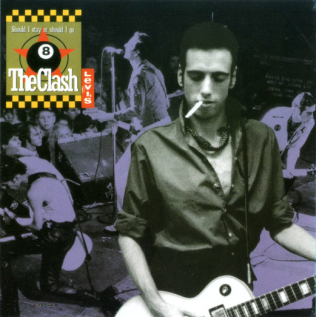
A song about not being able to make up your mind, written by the man who was about to be thrown out of his own band, that became the band's only number one nearly a decade after they broke up, because a jeans company put it in a television advert. The Spanish backing vocals everyone remembers were not a plan. They were a joke, translated into deliberately wrong Spanish by a Texan who happened to wander into the studio, with a little help from an engineer who phoned his mother. And the famous shout of "Split!" in the middle of the record is the sound of Mick Jones getting genuinely frightened. Almost nothing about "Should I Stay or Should I Go" happened the way it sounds like it did.
"Should I Stay or Should I Go" was written mainly by Mick Jones of The Clash and released on the 1982 album Combat Rock. Jones has always refused to pin the lyric to one meaning, calling it "just a good rocking song." The Spanish backing vocals were an on-the-spot, loosely translated echo added by Texas musician Joe Ely and Joe Strummer. It flopped as a single in 1982, then reached number one in the UK in 1991 after a Levi's commercial, the band's only UK number one.
The song nobody agrees the meaning of
Ask what "Should I Stay or Should I Go" is about and you get a shrug from the man who wrote it. Mick Jones has spent decades declining to explain it. "'Should I Stay Or Should I Go?' wasn't about anything specific and it wasn't pre-empting my leaving The Clash," he said, as quoted in the book 1000 UK #1 Hits. "It was just a good rocking song, our attempt at writing a classic." That is the flat, deflating answer, and Jones has mostly stuck to it.
He has also wobbled on it. The obvious reading is that a song about whether to stay or go, written by the band's guitarist right before internal chaos got him fired, must be about the band. Jones denied that, then softened. By 1991 he was allowing, "Maybe it was pre-empting my leaving," before concluding it was more likely about a "personal situation." That personal situation, according to a 2009 Rolling Stone piece, was his relationship with singer and actress Ellen Foley. Foley, asked directly, would not confirm it either. "I really don't know if it's about me," she told Songfacts in 2021. "It's a very good song though, whomever it's about." So the definitive answer is that there is no definitive answer, and everyone involved seems fine with that.
The Spanish that got made up on the spot
The thing people remember most, the Spanish call-and-response, was not composed. It was improvised by a Texan. Joe Ely, a singer the Clash had befriended years earlier after hearing his album Honky Tonk Masquerade, walked into the New York sessions and got drafted. "I'm singing all the Spanish verses on that, and I even helped translate them," Ely told Songfacts in a 2012 interview. "I translated them into Tex-Mex and Strummer kind of knew Castilian Spanish, because he grew up in Spain in his early life. And a Puerto Rican engineer (Eddie Garcia) kind of added a little flavor to it. So it's taking the verse and then repeating it in Spanish."
He was clear that the whole thing was Strummer's spur-of-the-moment idea and that accuracy was never the point. As Ely told Songfacts, "I think it was Strummer's idea, because he just immediately, when it came to that part, he immediately went, 'You know Spanish, help me translate these things.'" He went on: "My Spanish was pretty much Tex-Mex, so it was not an accurate translation. But I guess it was meant to be sort of whimsical, because we didn't really translate verbatim." He put it even more bluntly to the Austin Chronicle in 2000: "Strummer said, 'Hey, help me with my Spanish.' So, me, and Strummer and the Puerto Rican engineer sat down and translated the lyrics into the weirdest Spanish ever. Then we sang it all."
There is a second version of who supplied the Spanish, and it does not cancel the first. According to Strummer, the sound engineer Eddie Garcia called his mother in Brooklyn Heights and got her to translate some of the lyrics over the phone. Eddie's mother is Ecuadorian, which means the "Spanish" chanted all over one of the most famous British punk records is really loose, phoned-in Ecuadorian and Tex-Mex, assembled in an afternoon by people who were not trying to get it right.
"Split!"
That single shouted word about two minutes in has been read as some kind of statement. It is not. It is Mick Jones being ambushed. Ely and Strummer were stationed in a vocal booth yelling the Spanish echoes back while Jones sang lead, and they decided to prank him. "Me and Joe had snuck around in the studio, came up in the back of his booth where he was all partitioned off," Ely told Songfacts, "and we snuck in and jumped and scared the hell out of him right in the middle of recording the song, and he just looked at us and says, 'Split!'" Nobody stopped the tape, so the startled bark of a man telling two friends to get lost is now a permanent part of the record.
One more line got changed for a much less fun reason. The lyric "If you want me off your back" was originally the far blunter "On your front or on your back." When veteran producer Glyn Johns was brought in to cut Combat Rock down to a single, radio-friendly album, he had Jones re-record the line, worried American stations would not play something that suggestive. Those sessions were poisonous. Jones was furious about his mixes being reworked without him, and that bitterness fed straight into the collapse that got him sacked from the band in 1983.

The hit that arrived nine years late
The chart facts come from the Billboard and UK singles tables, not the interviews, and they are the strangest part. When "Should I Stay or Should I Go" first came out, it was not a hit. Released in the US in July 1982, it peaked at number 45 on the Billboard Hot 100 that September. In Britain it came out as a double A-side with "Straight to Hell" and stalled at number 17 in October 1982. That was it. The Clash never had a British number one while they were a functioning band, and by 1986 they were finished.
Then, in 1991, a Levi's jeans commercial used the song, and Britain fell for it a decade too late. Reissued on February 18, 1991, "Should I Stay or Should I Go" went all the way to number one on the UK Singles Chart, the only number one The Clash ever had, roughly five years after they had broken up and eight years after its author was fired. A song about indecision, sung by a man on his way out the door, finally won by outliving the band that could not hold itself together. This is exactly the kind of second life that keeps 80s records alive on the air, and an all-80s stream from the Bubble is on the way.
How the telling has grown over the decades
The drift in this story runs along two tracks, and both are honest to leave unresolved. The first is the meaning. Jones started by denying the song was about the band, drifted toward admitting it might have been, and settled on a vague "personal situation." Rolling Stone named Ellen Foley; Foley declined to claim it. Across forty years the song's own author and its rumored subject have both, on the record, refused to say what it is about, which is either evasive or perfectly fitting for a song called "Should I Stay or Should I Go."
The second track is the Spanish. Ely, in his 2000 and 2012 tellings, describes himself, Strummer, and the Puerto Rican engineer knocking out a loose Tex-Mex translation on the spot. Strummer's account adds the engineer's Ecuadorian mother translating over the phone from Brooklyn Heights. These are not really in conflict; they are two people remembering different corners of the same chaotic session. What every version agrees on is that the translation was never meant to be correct. The looseness is the point, and the small contradictions between the tellings are just what happens when a famous record gets built by accident and reconstructed years later from memory.
The honest bottom line
Strip the myth away and "Should I Stay or Should I Go" is almost an accident. The writer would not say what it means and half-suspects it means nothing. The unforgettable Spanish is deliberately bad Spanish improvised by a Texan and an engineer's mother. The dramatic "Split!" is a man getting startled by a prank. The lyric got sanitized by a producer the band was at war with. And it flopped on release, only becoming a number one after everyone had gone home and a jeans advert dug it up. None of that makes it less of a great record. If anything it is the most Clash thing imaginable: a ragged, argued-over, thrown-together track that shrugs at its own meaning and turns out to outlast everything built more carefully around it. The same album's other American hit, Rock the Casbah, came from the drummer and was misread just as completely, a song about freedom adopted as a war anthem.
FAQ
What is "Should I Stay or Should I Go" about? Mick Jones has never given a firm answer. He has called it "just a good rocking song" and denied it was about leaving the band, then later allowed it might have been, and hinted at a "personal situation," widely assumed to be his relationship with Ellen Foley. Foley herself says she does not know if it is about her.
Who wrote "Should I Stay or Should I Go"? It is credited to The Clash, but Mick Jones was the main writer and sang lead. Joe Strummer suggested the Spanish backing vocals, and Texas musician Joe Ely helped create and sing them.
Who sings the Spanish parts, and what do they mean? The Spanish is a loose echo of the English lyrics, sung by Joe Strummer and Joe Ely. Ely translated it into rough "Tex-Mex," and in Strummer's own telling the tape operator Eddie Garcia called his Ecuadorian mother in Brooklyn Heights and she translated lines over the phone. Ely has said plainly it was "not an accurate translation" and was meant to be whimsical.
Why does Mick Jones shout "Split!" in the song? Because Ely and Strummer snuck up and scared him mid-take. Jones yelled "Split!" at them, meaning get lost, and the accidental outburst was left in the final recording.
Did "Should I Stay or Should I Go" reach number one? Yes, but not at first. It flopped in 1982, reaching only number 17 in the UK and number 45 in the US. It hit number one in the UK in 1991 after a Levi's commercial, becoming The Clash's only UK number-one single, years after the band had split.
Sources
- Songfacts, "Should I Stay or Should I Go? by The Clash," including its 2012 interview with Joe Ely, the account attributed to Joe Strummer, Mick Jones from the book 1000 UK #1 Hits, and Ellen Foley's 2021 comment
- American Songwriter, "Behind the Song 'Should I Stay or Should I Go' by The Clash" (Jay McDowell), February 10, 2024, quoting Joe Ely's 2000 Austin Chronicle interview
- Rolling Stone, 2009 article on The Clash, as cited by Songfacts
- Wikipedia, "Should I Stay or Should I Go," for recording and chart history
- Billboard Hot 100 (1982) and UK Official Singles Chart (1982 and 1991)
Should you trust this telling? Yes, and here is why.
Part of Stories Behind the Songs. See also Rock the Casbah and The Safety Dance.