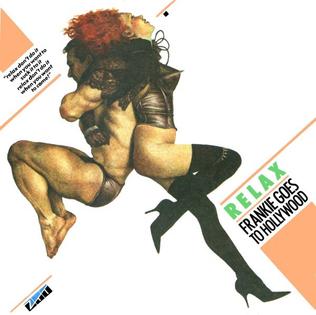
A singer worked out the hook while running late along a Liverpool dual carriageway. A producer who had just left a band of virtuosos found himself stuck with one that could barely play, recorded the song three times, hated all three, and threw everything out to start a fourth version from a drum pattern he called an English square dance. Then a radio DJ took it off his turntable in disgust, the BBC banned it, and the ban did what no amount of production ever could. "Relax" went to number one, and almost nobody who tells the story tells it the same way.
"Relax" was written by Frankie Goes to Hollywood's Holly Johnson, Mark O'Toole, and Peter Gill, with the hook coming to Johnson in winter 1982 while he hurried to rehearsal. Producer Trevor Horn signed the band to his ZTT label and rebuilt the song from scratch across four versions, the final one played mostly by session musicians. Released in 1983, it hit number one in the UK for five weeks in early 1984 after a BBC ban, and later reached number 10 in the US.
The idea on Princes Avenue
The hook came before the band was even fully formed. Holly Johnson has said the basic idea of "relax, don't do it" arrived in winter 1982, when he was late for rehearsals, "walking very quickly along the central reservation of Princes Avenue in Toxteth," as quoted by Songfacts. At that point Frankie Goes to Hollywood was just three people: Johnson, bassist Mark O'Toole, and drummer Peter Gill, the three credited writers. The song they built around that chant was raw, sexual, and nothing like the record the world would eventually hear.
The producer who could not walk away
Trevor Horn, fresh from producing Yes and a veteran of the Buggles, saw an early version of "Relax" and heard it again on the radio driving home. "When I heard it again the song really registered with me. I thought, 'that's a really catchy song,'" Horn recalled in a 2024 Top 2000 a gogo interview, as reported by MusicRadar. He signed the band to ZTT, and then reality set in. He had come straight from a band of seasoned professionals to one that had barely gigged.
"I had a bit of a shock because I'd just come from working with Yes," Horn said in that interview. "And Yes had probably done thousands of live shows and they were all brilliant players. Frankie Goes To Hollywood had done five shows and they could barely play. But they signed to my record label so I had to figure out, what am I gonna do, you know?" Getting a record out of them became an ordeal he only endured because he owned the label. "If they had been any other act that I was just doing as a job I would have walked away from it," Horn admitted. "It was too difficult. But because they were signed to my record label, I couldn't walk away from it. I had to do something."
Four versions, three thrown away
What Horn did was record "Relax" over and over. He cut it with the band. He cut it again using musicians from Ian Dury's backing group, the Blockheads, with Norman Watt-Roy on bass. He cut a third version with engineer Steve Lipson, keyboard player Andy Richards, and Fairlight programmer JJ Jeczalik. He kept none of them. Then he scrapped everything and started a fourth time, from a beat he had programmed himself on a drum machine.
Horn's own description of that beat is unglamorous. "It was like my pet drum pattern which I fiddled about with," he told Sound on Sound in a 1994 interview. "I thought it was more like an English square dance than anything else, but when I saw the effect that this had on the guys in the band, I realised that it was probably going to be a very good dance record." Lipson watched the finished track appear almost instantly. "Trevor had this rhythm and we just recorded it live, probably in one take," he told Sound on Sound. "The rhythm track is what did it. We flipped out. It didn't exist, and then suddenly it did." The vocal came the same night. "Then he called Holly and got him in to sing it there and then, that night, right in the middle of Studio One," Lipson recalled.
Lipson is clear about the scale of Horn's intervention. "When I first heard the track, it was a lot funkier than the finished version," he told Sound on Sound. "Trevor's brilliance was to then take it in a different direction and to a whole other level. He really went at it. Frankie were his first signing to ZTT, and he wasn't going to give up until he had a hit."
The ban that made it
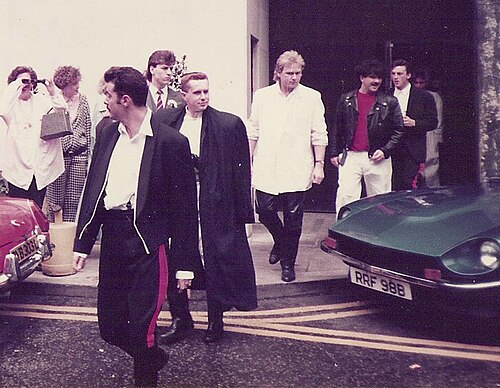
By January 1984 "Relax" was already climbing. Then, on January 11, Radio 1 DJ Mike Read pulled the record off his turntable on air, objecting to the sleeve and the lyrics, and the BBC banned it. The effect was the opposite of censorship. People rushed to hear the song they were not allowed to hear. As a spokesman at an Aberdeen record store told the press at the time, quoted by Songfacts, "Banning the record seems to have created an air of mystery about it. We have had people coming in asking to hear the record to find out what all the fuss is about." "Relax" rose to number two, then to number one the week of January 28, 1984, and stayed there for five weeks.
How the telling has grown over the decades
Few 80s hits have as many contested versions of their own story, and the drift is the interesting part. The first fault line is authorship. "Relax" is credited to Johnson, O'Toole, and Gill, and Johnson genuinely wrote the hook. But the record almost none of the band played on. The final track was Horn's programmed beat, Lipson's guitar, Richards's keyboards, and Jeczalik's Fairlight, with Johnson's vocal on top. As Sound on Sound put it, the fact that none of the other Frankie members contributed to the track, along with their absence from touring in 1984, "would fuel 'Frankie can't play' rumours." Both things are true at once: they wrote it, and Horn built it.
The second fault line is the ban itself. The legend says Mike Read banned "Relax." Read has spent years denying it. "I didn't ban 'Relax.' I didn't have the power to ban it because I'm just an individual," he said, as quoted by Songfacts, describing how the BBC, not he, made the decision. The man history blames insists he was not the one who did it.
Even the lyric drifts. The single's sleeve printed the line as "when you want to suck it to it," which Sound on Sound calls an accidental misinterpretation of "sock it to it." Johnson later muddied it further, telling interviewers the line was something else again. Forty years on, the makers still do not fully agree on what the most famous banned song in British chart history actually says, or on who is most responsible for any of it. That disagreement is the story.
The honest bottom line
Strip away the myth and "Relax" is a song its own band could barely play, rebuilt four times by a producer who wanted to quit, sold to number one by a ban its most famous censor says he never ordered. It is one of the most manufactured records of the decade, assembled by session players around a hook a singer worked out on a Liverpool street. None of that makes it less thrilling. Horn took a chant and a rumor and a scandal and welded them into three minutes of pure 1984, and the fight over who did what is a fair price for a record that still sounds like the moment the decade lost its inhibitions. A year earlier, New Order had proved the same point from the opposite direction with Blue Monday, another electronic record too unconventional for radio that became the best-selling format of its kind, and together the two records mark the moment British dance music stopped asking permission.
FAQ
What is the story behind "Relax" by Frankie Goes to Hollywood? Holly Johnson wrote the hook in 1982, and the band recorded early versions of the song. Producer Trevor Horn signed them to ZTT and rebuilt the track from scratch across four attempts, the final one played largely by session musicians. Released in 1983, it hit number one in the UK in 1984 after the BBC banned it.
Who wrote "Relax"? It is credited to Holly Johnson, Mark O'Toole, and Peter Gill of Frankie Goes to Hollywood. Johnson came up with the central "relax, don't do it" idea. The final recording, however, was constructed by producer Trevor Horn and his session team.
Why was "Relax" banned by the BBC? Radio 1 DJ Mike Read objected on air to the single's sleeve and sexually suggestive lyrics on January 11, 1984, and the BBC banned it from its stations. The ban backfired: the controversy drove sales and pushed the song to number one, where it stayed for five weeks. Read has since said he personally did not have the power to ban it.
Did the band actually play on "Relax"? Mostly not. After scrapping three versions, Horn built the final recording with engineer Steve Lipson, keyboardist Andy Richards, and Fairlight programmer JJ Jeczalik, with Holly Johnson singing lead. The other band members' absence fueled long-running "Frankie can't play" rumors.
How did "Relax" do on the charts? It reached number one in the UK the week of January 28, 1984 and held for five weeks, spending 42 consecutive weeks on the chart. In the US, its first release stalled at number 67, but a 1985 re-release reached number 10.
Sources
- Sound on Sound, "Classic Tracks: Frankie Goes To Hollywood 'Relax'," interviews with Steve Lipson and Trevor Horn (Horn quotes from a 1994 interview)
- MusicRadar, "Trevor Horn on the making of Relax," May 2025 (quoting Horn's 2024 Top 2000 a gogo interview)
- Songfacts, "Relax by Frankie Goes to Hollywood," including Holly Johnson and Mike Read quotes
- Wikipedia, "Relax (song)," chart tables citing Billboard and the Official Charts Company
- Billboard Hot 100, week of March 16, 1985 (Relax at number 10)
Relax, the facts have been checked.
Part of Stories Behind the Songs. See also Owner of a Lonely Heart and Video Killed the Radio Star.