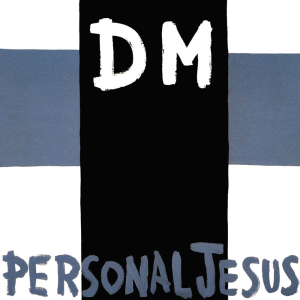
The most famous song about faith of the late 1980s is not about Jesus. It came out of a book about a marriage, written by a woman who watched her husband get treated like a god. And the band that made its name on synthesizers built it on a blues riff and the sound of people jumping on flight cases.
"Personal Jesus" was written by Martin Gore in the summer of 1989 after reading "Elvis and Me," Priscilla Presley's 1985 memoir. Gore has said it is about being a Jesus for someone else, the way a partner becomes a god in a love relationship. Depeche Mode cut it in Milan with producer Flood, built it on a bluesy single-note riff, and it peaked at number 28 in the United States on March 3, 1990.
A book about a marriage, not a gospel
The title has been getting the band in trouble since 1989, mostly with people who never got past it. The source is domestic, not theological. Gore had been reading Priscilla Presley's 1985 memoir "Elvis and Me," about her life with Elvis Presley, and what he took from it was a pattern he recognized well outside Graceland.
His explanation, given to Spin and quoted by Songfacts and Ultimate Classic Rock in the same words: "It's a song about being a Jesus for somebody else, someone to give you hope and care. It's about how Elvis was her man and her mentor and how often that happens in love relationships - how everybody's heart is like a god in some way, and that's not a very balanced view of someone, is it?"
That last clause is the whole song. The record is not endorsing the arrangement, it is describing it, which is why the same lyric can be read as blasphemy or as a warning depending on who is holding it.
Gore has also been direct about his own position on the religious material, which is not the hostility his critics assumed. "I think Jesus was one of the greatest figures that ever walked the earth. He never said a word of shit," he told Spin, in a quote Ultimate Classic Rock carries. "Every book I read about him, I fall in love with him more and more, but unfortunately that doesn't help me become a Christian because Christianity is something else."
Dave Gahan, who has to sing it every night, has always described it as the warmest thing on the record. In a 1998 interview with Gear magazine he called it a "very optimistic song" about "having somebody you can really trust and talk to and get the right answers from". His reading, in full: "What it's saying is that if you can grasp on to something that's much bigger than yourself and believe in it, then you have a faith and it's always there. Really, I think it's just about believing in yourself. The answers are inside, if you dig deep enough."
The band that put down the synthesizers
Depeche Mode had spent the decade being filed as a synth-pop group, and in America as dance music, a label Gore resented. Then their next single arrived built around a guitar figure.
The song was written in the summer of 1989 while the band was recording with producer Flood at Logic Studios in Milan. Martin Gore's demo of it was about as far from a synth record as it gets: he played the melody on an acoustic guitar and tapped out the beat with his foot.
Alan Wilder, the member who handled much of the band's studio construction from 1982 to 1995, has described what they did with it. He called the track "a significant move forward" that still kept elements of the band's "former experimental self." He likened Gore's main theme to a John Lee Hooker riff sitting on top of what he called "Kraftwerk-style synth parts." And the stomp that drives the record, the thing that sounds like a stadium, is not a drum machine: Wilder said it was a recording of "two or three people jumping up and down on flight cases."
That is the joke at the center of the arrangement. The most physical, most human-sounding percussion on a Depeche Mode single is several men in a room abusing the road cases.

The classified ads
The promotional campaign is as famous as the record and it is genuinely strange. Before release, small black classified advertisements appeared in regional papers and magazines reading "Your own personal Jesus," with nothing but a telephone number underneath.
Call it and you got a preview of the song. The Financial Times, in its Life of a Song feature, describes what came down the line: two notes, then the command "Reach out and touch faith," then the riff. Some publications pulled the ad once they worked out what it was selling. The FT notes why the placement worked as camouflage in the first place: those personal columns were already full of phone lines and religious outfits fishing for lonely people, which is precisely the transaction the lyric is about.
Who thought of it depends on who is telling it. The FT credits the marketing department at Warner Bros. Far Out, writing in 2026, describes the band teasing the release themselves. Nobody disputes the ads ran or that some papers refused them.
MTV, the silhouette and the horse
Anton Corbijn's video put the band in Western wear in a dusty town, and it became the first Depeche Mode clip to get serious MTV rotation. It also got cut. The problem was a stretch of heavy breathing rendered in silhouette, followed immediately by a shot of a horse's hindquarters, which the network read as an implication nobody involved will admit to intending.
Gore's response: "I don't know if Anton was consciously trying to be perverted, I think it was more coincidental that it happened at that point," he told Uncut. "These video people see things very strangely."
Corbijn re-edited the sequence and MTV played it heavily, which is a large part of why an American audience that had shrugged at this band for eight years suddenly knew who they were.
What it did on the chart
The single was released in Britain in August 1989 and entered the Billboard Hot 100 at number 97 on the chart dated December 9, 1989, credited to M.L. Gore. It climbed slowly and steadily all winter: number 46 on February 3, number 33 on February 17, and its peak of number 28 on the chart dated March 3, 1990, its thirteenth week, in a week when Janet Jackson's "Escapade" held number 1. The Financial Times puts its British peak at number 13.
Number 28 does not sound like a landmark. It functioned as one. It was the lead single from "Violator," released months ahead of the finished album, and the record that moved Depeche Mode out of the specialist racks in America for good.
How the telling has grown over the decades
The core Gore quote has been in circulation since 1990 and has been drifting through secondhand hands ever since, which makes this a useful case study in why we cite outlets.
Ultimate Classic Rock and Songfacts both attribute it to Spin and print it identically, ending with "and that's not a very balanced view of someone, is it?" The Financial Times attributes what is essentially the same passage to Rolling Stone. Far Out, in 2026, and Louder, syndicated in December 2025, both credit Spin but split the passage in two, ending the first part at "how everybody's heart is like a god in some way" and giving the rest as a separate sentence that begins "We play these god-like parts for people, but no one is perfect." Same words from the same man, cut three different ways, with two different magazines named. That is what a thirty-five-year-old quote looks like after it has been repeated enough times.
Gahan's tellings run parallel and stay consistent: the Gear magazine interview in 1998 gave the optimistic reading, and in 2017 he told Entertainment Weekly about the day Gore called him with Johnny Cash's request to cover it. Gore, he said, was "kind of umming and ahhing about it, whether to give permission." Gahan's answer: "And I was like, 'What? Are you crazy? That's like Elvis asking! Of course you let him do it!'"
That is the loop closing. The song came out of a book about Elvis Presley, and the moment its singer knew it had outgrown them was when the closest thing left to Elvis asked to sing it.
The honest bottom line
The lyric is thin on the page. It is a handful of commands and a phone-line come-on, and its most quoted line, "Reach out and touch faith," is a slogan before it is a thought. What makes the record is everything around the words: a blues riff played by a band with no business playing blues, a stomp made of luggage, a video that got censored for a horse, and a marketing stunt that put the song's own premise in the classified ads. Gore found something true in Priscilla Presley's book about how people hand each other godhood, and then Depeche Mode buried it under enough leather and reverb that most of the people singing along have never once thought about it. Both of those things are the song. Two years earlier, INXS had stripped a pop song down to the same skeleton with Need You Tonight, another late-decade groove that ran on a riff and an attitude rather than a lyric, and the two records between them map the moment the 1980s figured out that a minimal idea could hit harder than a maximal production.
FAQ
What is "Personal Jesus" about? Martin Gore has said it came from Priscilla Presley's memoir "Elvis and Me" and is about being a Jesus for someone else: the way a partner becomes a mentor and a god in a love relationship, which he pointed out is "not a very balanced view of someone."
Who wrote "Personal Jesus"? Martin Gore of Depeche Mode. Billboard credits the single to M.L. Gore. He wrote it in the summer of 1989 and demoed it on acoustic guitar, tapping the beat with his foot.
Is "Personal Jesus" a religious song? Not in the way its title suggests. Gore told Spin that he considers Jesus one of the greatest figures who ever lived while making clear that this does not make him a Christian. The song describes people treating other people as saviors.
What are the classified ads about "Personal Jesus"? Before release, small ads reading "Your own personal Jesus" with a phone number ran in regional papers and magazines. Callers heard a preview of the song. Some publications stopped running them once they learned what was being advertised.
Why did MTV edit the "Personal Jesus" video? Anton Corbijn's clip cut from a silhouetted heavy-breathing sequence to a shot of a horse's rear. MTV objected, and the sequence was re-edited before the network put the video into heavy rotation.
How high did "Personal Jesus" chart in America? It peaked at number 28 on the Billboard Hot 100 dated March 3, 1990, its thirteenth week on the chart, after entering at 97 in December 1989.
Sources
- Songfacts, "Personal Jesus by Depeche Mode," carrying Martin Gore's quotes on the song's origin and his Uncut quote on the video
- Ultimate Classic Rock, "Depeche Mode Personal Jesus," September 2024, carrying Gore's Spin quotes
- Louder, Depeche Mode Personal Jesus feature, syndicated December 2025, carrying Alan Wilder on the arrangement and Dave Gahan's Gear magazine interview from 1998 and Entertainment Weekly interview from 2017
- Financial Times, Life of a Song: "Personal Jesus," on the classified ad campaign and the chart run
- Far Out, on the advertisements placed to promote "Personal Jesus," March 2026
- Billboard Hot 100 charts dated February 3, February 17 and March 3, 1990
Reach out and touch the actual sources.
Part of Stories Behind the Songs. See also Blue Monday and Sweet Dreams.