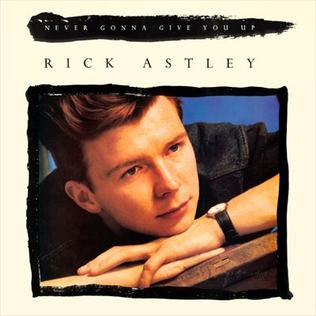
The singer was making the coffee. The producers were not sure his voice was even attractive. The title may have described the producer's girlfriend rather than his own, and to this day the singer says he cannot remember the phone call at the center of the title's origin story. The man who wrote the last line of the chorus got paid nothing for it and no credit. Rick Astley and Mike Stock have been telling the story of "Never Gonna Give You Up" for over thirty years, and the more they tell it, the stranger the record's birth looks.
"Never Gonna Give You Up" was written and produced by Mike Stock, Matt Aitken, and Pete Waterman for Rick Astley, who at the time worked as the SAW studio tea boy and tape operator. Waterman handed over the title, Stock and Aitken built the track over weeks around a bass rhythm borrowed from Colonel Abrams, and Astley cut the vocal. Released in July 1987, it hit UK number one for five weeks and US Billboard number one on March 12, 1988.
The tea boy who made the coffee
Astley did not walk into Stock Aitken Waterman as a star. He walked in as staff. Pete Waterman had seen him singing with a Warrington soul band called FBI in 1985, on a tip from his girlfriend, and signed the voice without the group. Then, as Astley told Newsweek in 2022, the deal came with a wait: "At that point, I signed to their production company," he recalled, "and they said, 'Look, we're not going to get around to making a record with you for a while. Do you want to come and hang out at the studio and you can help with the other kids and do all the different preparation at sessions and all that?'" That was the tea boy job.
Mike Stock framed the arrangement plainly on the Song Exploder podcast in 2022: "We used to call them 'Tea Boys' or 'Tape Ops.' A tape op was a guy that used to make sure the tape was wound on the spools... And in the meantime, he makes tea." Engineer Mark McGuire, who cut the record, told Sound on Sound in February 2009 that the role was cover for something else entirely. "That's part of the folklore," McGuire said. "Rick was the nicest artist I worked with there. He was extremely down-to-earth, but also incredibly shy." Waterman feared the shyness would freeze him at the microphone. "He was, therefore, employed there as an 'assistant', but not really to work as an assistant. It was merely a way of introducing him to the studio."
So Astley learned the building from the inside. "I've prepared their sessions and I learned stuff from the tape ops, the engineers," he told Newsweek. "I got to do my demos at night and on the weekends with the engineers that are making No. 1 records, which was absolutely crazy." He was making tea for the label's other acts while the machine warmed up for him. As he put it on Song Exploder: "I made tea for Dead or Alive, Bananarama, Mel and Kim loads of artists that were having massive Top 5 and Top 10 records."
The voice they were not sure about
The strangest part of the story is that Stock Aitken Waterman, the most reliable hit factory in Europe, could not agree on whether Astley's voice was good. Stock said so directly on his own website in 2017. "When Rick sang for me in the studio neither Matt or I were certain about his voice," Stock wrote. "There was something unusual about it. Sure, he had a BIG voice, but it was either on or off. It was always full volume and there was no subtlety. Matt wasn't convinced by it."
What settled it was not a producer at all. It was Waterman's girlfriend Gaynor, who had recommended Astley in the first place. "We asked Gaynor why she thought his voice was so good and she said it made her go all funny, it made her wobbly," Stock wrote. "It made her wobbly! That was good enough to convince us."
The first thing they actually recorded on him was a cover. "The first time I heard Rick sing was when Rick got behind the mic and sang 'Ain't Too Proud to Beg,'" Stock said on Song Exploder. "Which is a cover of a Temptation song," Astley added. The cover convinced Stock the voice deserved its own material. "Rick had that extra ingredient: he could sing soulfully, bluesily, powerfully." Astley has always been funnier about the mismatch than his producers. "I don't think they really knew what to do with me because I looked about 11 years old and sang like a middle-aged man who drank too much," he said on the same episode.
Where the title really came from
Here is the part the tellings cannot agree on, and both men know it. The popular version is that "Never Gonna Give You Up" was about Astley's own devotion to a childhood sweetheart. Astley tells a different origin, and flags his own doubt about it. "Pete Waterman, he actually had a girlfriend in the little town that I'm from," he said on Song Exploder. "And he says that I said to him, about having a bad phone call with his girlfriend and slamming the phone down in the car, I don't really remember it, but he says to this day that I said, 'yeah, but you're never going to give her up anyway.'" Then the honesty: "Now whether that's true or not, I don't know, but I like the story. Do you know what I mean?"
Stock will not vouch for it either. "Sounds like a good story to me. I don't know that's true," he said. "But Pete did say to me, let's do a song something like 'Never Gonna Give You up.'" What Stock is certain of is how he worked once Waterman handed him a title. "You put that on the wall, 'Never Gonna Give You Up,' and you throw darts at it and you're aiming to hit it every time," he explained. The childhood-sweetheart angle then became the emotional frame: "Rick had already told me, he was still dating his girlfriend, whom he went to junior school with at the age of five or six, they knew each other. And so I thought, well, this is a lifelong fidelity."
Weeks and weeks: building the track
The record that sounds effortless took longer than anything SAW had built. "Matt and I spent weeks and weeks on the accompaniment to Never Gonna Give You Up," Stock wrote in 2017. "We drove ourselves barmy working on that record. I would go to bed with a tape loop buzzing around my head after 12 hours in the studio. It was torturous!"
The groove came from a specific, credited source. McGuire told Sound on Sound the starting points were other artists' records: "Mike and Matt would use the template that they thought would be ideal for a given artist, and the launchpad for 'Never Gonna Give You Up' consisted of Steve Arrington and Colonel Abrams." Stock named the exact debt: "In the end we hit upon the idea of adapting the bass line rhythm from a 1985 Colonel Abram song called Trapped. We took the basis of the rhythm, which was very syncopated, and it seemed to do the trick." On Song Exploder he walked through the tempo hunt: "I tried it, you know, that song a bit faster, about 120 beats a minute, in a more sort of house-y style. We slowed it down to 114 beats a minute," and then, "if we're going to be this slow. We ought to syncopate the bass a bit to energize it." The famous bounce is Matt Aitken's hands: "Matt actually ended up playing it," Stock said.
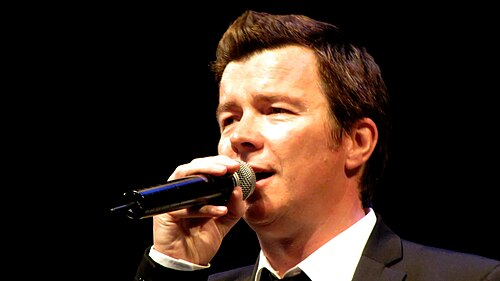
One line of the chorus came from the engineer. Stock has never hidden it. "I started work on the chorus but was stuck for a line to finish it. I knew I wanted it to rhyme with cry and goodbye and it was my engineer Mark McGuire who came up with Tell A Lie." McGuire got no songwriting credit for "Never gonna tell a lie and hurt you." He did get one strange reward: when a woman later claimed in court that SAW had stolen the song after hearing her sing it on a bus, McGuire testified for the defense. "I don't think they ever took the bus," he quipped to Sound on Sound.
The record they forgot, then the world took
When it was finished, the track was shelved. Astley had an early cassette and knew what he was holding before anyone released it. "I had a cassette of it and I went on a ski holiday with a friend who was one of the engineers at the studio," he told Newsweek. "This is six months before it was released, so this was an early version of it. I remember listening to it and just thinking, 'Well, that's a hit. The way they produced it, I think that's a hit.'"
Stock tells the rediscovery as an accident on a staircase. As he wrote in 2017, the finished record sat "pretty much forgotten about" while RCA kept asking when the first single would arrive, until one day in spring 1987 Stock and Waterman heard it playing in an office, asked who it was, and set the release rolling immediately. It went to Capital Radio in a one-minute teaser, got an instant reaction, and was rushed out.
The numbers back the instinct. "Never Gonna Give You Up" was released in July 1987 and spent five weeks at UK number one, the best-selling British single of the year. It reached number one on the US Billboard Hot 100 on March 12, 1988, and held for two weeks, topping the charts in 25 countries in all and earning Astley a Grammy nomination for Best New Artist. Astley still marvels at where it landed. "That was one of those tunes that broke all the borders down," he told Cheshire Life in 2014. "It got played on all kinds of radio stations in America. It was the number one R&B record, which is kind of ridiculous for a white guy from Newton-le-Willows."
How the telling has grown over the decades
The story arrived in layers, and the layers came from different people. Sound on Sound's February 2009 "Classic Tracks" piece by Richard Buskin is the technical spine: engineer Mark McGuire supplied the assistant-that-was-not-an-assistant framing, the Steve Arrington and Colonel Abrams launchpad, the uncredited chorus line, and the bus-court-case quip. Cheshire Life in 2014 caught Astley the elder statesman, remembering Waterman's "red leather pants and a Jag" and marveling at the R&B chart placing. Mike Stock's own 2017 telling on his website is the producer's confession: that he and Aitken were not sure about the voice, that Gaynor's wobble settled it, that the backing track nearly broke them. Newsweek in 2022 gave the tea-boy and ski-cassette details from Astley's side. And the 2022 Song Exploder episode is the only telling where Astley and Stock narrate together, which is exactly why the title's origin comes apart on tape: both men say, on the record, that they cannot swear the phone-slamming story is literally true.
The drift is real and worth naming. Whose girlfriend inspired the title, Astley's or Waterman's, depends on who is talking and which decade it is. The "recorded in a day" folklore sits next to Stock's account of weeks of work on the backing track. What every version agrees on: the singer was the studio junior, the producers borrowed the bassline on purpose, and the engineer who finished the chorus went uncredited.
The honest bottom line
Strip away the meme and this is assembly-line pop, built to a formula by producers who openly modeled the groove on someone else's club record, sung by a signed employee who was pouring coffee while it was written. The title's romantic origin story is one the singer himself will not confirm. None of that has dented it. The craft was real, the voice was a genuine freak of nature, and the honesty of the people who made it, admitting the doubts, the borrowing, and the uncredited help, is a large part of why the record still feels trustworthy thirty-plus years and a billion rickrolls later. Two years earlier, Stock and Aitken had built a similar hit with Dead or Alive's You Spin Me Round, another dance single powered by a borrowed groove and a voice the producers had to figure out how to record, and the two records between them show what the SAW machine could do when it caught the right singer.
FAQ
What is the story behind "Never Gonna Give You Up" by Rick Astley? Astley was working as the tea boy and tape operator at Stock Aitken Waterman's studio when the trio wrote and produced the song for him. Pete Waterman supplied the title, Mike Stock and Matt Aitken built the track around a bassline adapted from Colonel Abrams' "Trapped," and Astley sang it. It became a worldwide number one in 1987 and 1988.
Who wrote "Never Gonna Give You Up"? Mike Stock, Matt Aitken, and Pete Waterman are the credited writers. Stock has said engineer Mark McGuire contributed the chorus line "Never gonna tell a lie and hurt you" without receiving a songwriting credit.
Was Rick Astley really a tea boy? Yes, though it was partly a device. Waterman worried Astley was too shy to record, so he had him work at the studio first to settle in. Engineer Mark McGuire called it "merely a way of introducing him to the studio."
What is "Never Gonna Give You Up" actually about? Lifelong fidelity. Mike Stock built the lyric around Astley's real childhood sweetheart, whom Astley had known since junior school. The often-repeated claim that the title came from Astley teasing Pete Waterman about Waterman's own girlfriend is one both men say they cannot fully verify.
Did "Never Gonna Give You Up" reach number one in America? Yes. It topped the US Billboard Hot 100 on March 12, 1988, and held the spot for two weeks. It had already spent five weeks at UK number one in 1987 and topped the charts in 25 countries.
What song did Stock Aitken Waterman base the bassline on? Mike Stock has said they adapted the syncopated bass rhythm from Colonel Abrams' 1985 single "Trapped." Engineer Mark McGuire also cited Steve Arrington and Colonel Abrams as the track's "launchpad."
Sources
- Song Exploder, Episode 233, "Rick Astley: Never Gonna Give You Up" (host Hrishikesh Hirway), transcript, August 2022
- Mike Stock, "Never Gonna Give You Up" story, mikestockmusic.com, 2017
- Sound on Sound, "Classic Tracks: Rick Astley 'Never Gonna Give You Up'" (Richard Buskin), February 2009
- Newsweek, "Rick Astley Looks Back at 'Never Gonna Give You Up' Turning Thirty-Five" (David Chiu), June 30, 2022
- Cheshire Life (Great British Life), Rick Astley interview, 2014
- Billboard, "Rewinding the Charts, 1988: Rick Astley Rolled to No. 1"; Billboard Hot 100 weekly tables, March 1988; UK Official Singles Chart, 1987
Never gonna let you down, that is literally the policy.
Part of Stories Behind the Songs. See also The Story Behind Don't You Want Me and The Story Behind Girls Just Want to Have Fun.