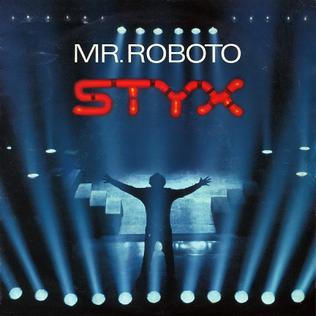
The man who wrote it did not think it was a single. His wife did. It went to No. 3, it put a Japanese phrase into American slang, and eleven weeks after it peaked the guitarist quit the band onstage in Washington, D.C. Then Styx refused to play their own hit for thirty-five years.
"Mr. Roboto" was written by Styx keyboardist and singer Dennis DeYoung as a transitional piece to bridge the short film that opened the band's 1983 concerts and the live show itself. He has said repeatedly that he never thought it would be a single. It peaked at No. 3 on the Billboard Hot 100 dated April 16, 1983, and the fight over it and the Kilroy Was Here concept behind it split Styx apart after the tour.
It was written to solve a staging problem
Start with what the song was for, because almost nobody remembers this part. "Kilroy Was Here" was DeYoung's concept: a rock star named Robert Orin Charles Kilroy, jailed by a group called the Majority for Musical Morality, escaping prison inside the shell of a robot guard. Styx commissioned a short film to open every concert on the tour. The band then picked up the story live onstage.
The song existed to get the audience from the movie into the concert. DeYoung told Songfacts in an interview published May 13, 2020: "I wrote the song because it fits a transitional piece from the backstory movie from our live show to the concert stage. I never thought it was going to be a hit record ..."
His wife disagreed. In the same interview, DeYoung gave the exchange: "And my wife said, 'Yes, it is.' And I said, 'No, it isn't. What are people going to think when I yell out, I'm Kilroy!?'"
He was wrong and he knows exactly how wrong. "They yell 'Kilroy' like they're out of their minds at the end of the song when I play it, and I still don't know why, because I guarantee you, 75% of them have no idea what Kilroy is doing in there," DeYoung told Songfacts.
Where the concept came from
The censorship idea was not invented for a story. In the early 1980s the First Assembly Church of God in Ankeny, Iowa, made news burning records it considered satanic, and Styx were on the list for no better reason than the band name: in Greek myth the river Styx runs through Hades. Songfacts documents that this got DeYoung thinking about censorship, which became the spine of the album, and that he later merged it with two other interests, a documentary he had seen about robots replacing factory workers and the Japanese culture the band had encountered on tour.
The sound came from a piece of gear that had just hit the market. According to Songfacts, DeYoung built the song's robotic texture on a Roland synthesizer with a new arpeggiator, holding a key and letting the machine run the pattern. It is a small detail with a big consequence: half of what makes "Mr. Roboto" sound like 1983 is a musician being early to a new box.
The Roboto mask itself was designed by Stan Winston, years before The Terminator, Aliens and Jurassic Park made him famous.
The band did not want it
DeYoung's bandmates were not persuaded, and they have said so on the record for decades.
Guitarist James Young backed the concept at first, out of deference. "I backed up Dennis doing that because he led the charge," he told the Arizona Daily Star in July 2019. "He was the most significant writer; 'Lady' was the first hit and he sang and wrote that and I felt he deserved the benefit of the doubt. But it really broke up the band."
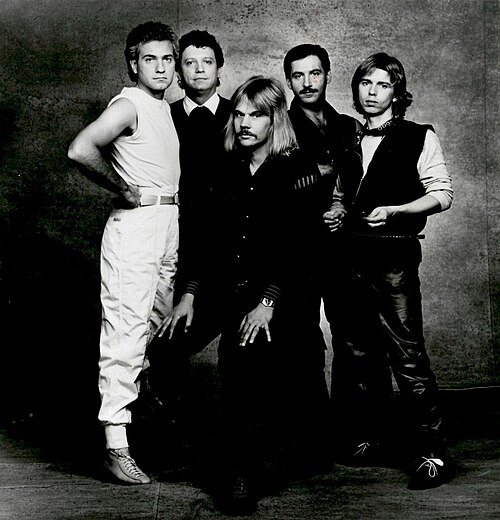
Young called Kilroy the "hard left turn on the wheel" that ended the band's imperial run, and put numbers to the ambition: "He had this grand scheme for the project. We spent a million dollars on a 10-minute feature film to be part of our live presentation and we spent money like water and then 'Mr. Roboto,' which was the lead song, alienated probably half of our male rock audience if not more."
What happened next, in his telling, was not a decision. It was attrition. "Ultimately we stopped working after that because it was an ugly battle after battle after battle, and unhappiness after unhappiness after unhappiness. We just had to go off on our own for awhile."
June 2, 1983
Tommy Shaw quit onstage. DeYoung has kept the date. In a long Facebook statement reported by Ultimate Classic Rock on June 4, 2018, he wrote: "And so now, 35 years later nearly to the day, June 2, 1983, Tommy quit the band onstage in D.C. because of Kilroy and 'Mr. Roboto' and now it's resurrected. Hallelujah."
DeYoung's account of the aftermath puts the damage on his own refusal to move on. In a Facebook post quoted by Big 95's Dewayne Wells in September 2023, he wrote: "The biggest problem was Tommy quit to pursue a solo career right after the tour. And when I refused against JY and Chuck and John Panozzo's wishes to replace him, 'Roboto' lingered for six years as the last song remembered [until we reunited in 1990]. Would it have been better if I had replaced Tommy in '84? You tell me. I still don't think so."
Styx reformed in 1990 without Shaw, who was busy with Damn Yankees. He returned in the mid-90s. DeYoung left in 1999 and never came back. The song went with him: for thirty-five years, Styx would not play "Mr. Roboto" in full.
The song came back, and everybody's story changed shape
The reversal started with the merchandise table. Young told the Arizona Daily Star: "The merch guy who's worked with us for years selling t-shirts got five to 10 people a night asking for the song."
Shaw found his own way back in. Speaking with Eddie Trunk on SiriusXM in a conversation reported by Ultimate Classic Rock on February 10, 2025, he pushed back on the whole legend: "We didn't hate 'Mr. Roboto,'" he said, "we just didn't like the (recorded) version." What changed his mind was hearing a cover, by the band the Protomen. "They did it the way we do it now. They played it as a rock song," Shaw said. "It was awesome! So I went back to the band and I said, 'Here's how we play Mr. Roboto. It's a rock song.' And man does it live up to its reputation."
Styx put it back in the set on May 30, 2018, in the encore, at FivePoint Amphitheatre in Irvine, California. Young, the man who had lobbied against the song in 1983, told Songfacts in 2024: "It really brought us to a whole new audience because it became a hit single." He went further: "I was against the song, but nobody else really joined me in being negative on that. And in hindsight, I'm glad I was out-voted on it, because we play it every night in our shows and people like it."
DeYoung, watching from outside the band, had predicted exactly that in his 2018 statement: "I predict that Roboto will ultimately become Styx's most popular song over time. Not because it's one of our best songs, but because it is what it is. Go figure. I never thought it was a hit record when I wrote it and said so then." He also delivered the best one-line description anyone has managed of the thing he made, calling it "a bad penny or a wooden nickel or simply a damn catchy tune; your choice."
What it actually did on the chart
"Mr. Roboto" entered the Billboard Hot 100 on February 12, 1983. On the chart dated April 16, 1983, in its tenth week, it reached No. 3, up from No. 5. It held No. 3 the following week and slipped to No. 4 on April 30. That was the peak, and it was the band's last US Top 5 single for eight years. In Canada it went to No. 1 on the RPM national singles chart, and in Cash Box, which ran its own competing chart, it reached No. 1.
One correction worth carrying, because the wrong version is everywhere: the Wikipedia entry states the song peaked on April 30. The Billboard weekly tables show it was already at No. 3 two weeks earlier and had begun falling by April 30.
How the telling has grown over the decades
The remarkable thing about this story is that the tellers keep revising, in public, decades later.
May 13, 2020, Songfacts. DeYoung, interviewed by Greg Prato, gives the cleanest origin statement: the song was a transition device, he never thought it was a hit, his wife told him he was wrong. He also predicts its future bluntly: "That's going to be, like it or not ... the defining song over all of them. Because going forward, robots are going to matter."
June 4, 2018, Ultimate Classic Rock. DeYoung's Facebook statement, published the week Styx put the song back in the set, supplies the date of the rupture, June 2, 1983, and his prediction that the song would end up Styx's most popular.
July 24, 2019, Arizona Daily Star. James Young supplies the money and the damage: a million dollars on a ten-minute film, half the male rock audience alienated, battle after battle.
2024, Songfacts. Young reverses his own verdict on the record: he was against it, he was out-voted, he is glad he was.
February 10, 2025, Ultimate Classic Rock. Shaw reframes the entire legend. It was never hatred of the song, he says, only of the recorded version, and the fix was to hear another band play it as rock and copy them.
The drift here is not about dates, it is about blame, and it moves in both directions. Young in 2019 describes a song that alienated half the audience; Young in 2024 describes a song that won them a new one. DeYoung's telling holds that Shaw quit "because of Kilroy and 'Mr. Roboto'"; Shaw's 2025 telling holds that the band did not hate the song at all, just its arrangement. Both men were in the room. Forty years on, they still do not describe the same fight, and neither account has been abandoned.
One more honest note. The origin details behind the concept, the Iowa record burnings, the robotics documentary, the Japanese influence, and the new Roland arpeggiator, are documented by Songfacts rather than carried in a maker's direct quote in the sources listed below. Everything attributed to DeYoung, Young and Shaw in this piece is their own wording.
The honest bottom line
"Mr. Roboto" is not a great Styx song and its own author has never claimed it was. It was written to cover a scene change, it was released as a single at the last minute in place of "Don't Let It End," and it handed a hard-rock band a novelty catchphrase they spent three decades trying to outrun. It also cost them a guitarist, a tour, and six years. And it is the one Styx song a person who owns no Styx records can sing. The band that hated it now closes with it, the man who wrote it was right that nobody in the crowd knows who Kilroy is, and everyone yells it anyway. Three years later, Europe's The Final Countdown would follow the same arc, a keyboard hook written as functional stage furniture that outlasted its own band, and both records prove that the songs the 1980s are most embarrassed by are the ones it cannot stop singing.
FAQ
What is the story behind "Mr. Roboto"? Dennis DeYoung wrote it as a bridge between the short film that opened Styx's 1983 concerts and the live show, for a concept album about a rock star jailed by an anti-rock movement who escapes inside a robot's shell. DeYoung has said he never expected it to be a single. It reached No. 3 and the fallout split the band.
Who wrote "Mr. Roboto"? Dennis DeYoung, alone. He also sang it, played the Kilroy character in the film and video, and came up with the Kilroy Was Here concept.
Why did Styx stop playing "Mr. Roboto"? The song and the theatrical Kilroy tour caused a rupture. Tommy Shaw quit onstage in Washington, D.C. on June 2, 1983, and after DeYoung's 1999 departure the band left the song off the setlist entirely for 35 years, until May 30, 2018.
Did Tommy Shaw hate "Mr. Roboto"? He says not. Speaking to Eddie Trunk in 2025 he said the band did not hate the song, they disliked the recorded version, and that hearing the Protomen play it as a rock song convinced him Styx should perform it that way.
How high did "Mr. Roboto" chart? No. 3 on the Billboard Hot 100 on the chart dated April 16, 1983, held for two weeks. It hit No. 1 on Canada's RPM chart and No. 1 on the rival Cash Box Top 100.
What does "domo arigato, Mr. Roboto" mean? It is Japanese for "thank you very much, Mr. Roboto." The line entered American slang almost immediately and has stayed there.
Sources
- Songfacts, Dennis DeYoung Songwriter Interview (Greg Prato), May 13, 2020
- Songfacts, "Mr. Roboto by Styx," including Dennis DeYoung to Songfacts in 2020 and James Young to Songfacts in 2024
- Ultimate Classic Rock, "Dennis DeYoung Comments on Styx Finally Performing 'Mr. Roboto'" (Martin Kielty), June 4, 2018, quoting DeYoung's Facebook statement
- Ultimate Classic Rock, "Tommy Shaw Insists Styx 'Didn't Hate Mr. Roboto'" (Corey Irwin), February 10, 2025, reporting Shaw's SiriusXM conversation with Eddie Trunk
- Arizona Daily Star, "One song, 35 years: The tale of the song that broke Styx" (Cathalena E. Burch), July 24, 2019, interview with James Young
- Big 95, "Dennis DeYoung talks 'Kilroy Was Here' and how it broke Styx up" (Dewayne Wells), September 2023, quoting DeYoung's Facebook posts
- Billboard Hot 100 weekly charts, April 16, April 23 and April 30, 1983
- Wikipedia, "Mr. Roboto," for the February 12, 1983 chart entry, Canadian and Cash Box peaks, Stan Winston credit and the last-minute single switch
Domo arigato for reading the standards.
Part of Stories Behind the Songs. See also Don't Stop Believin' and Heat of the Moment.