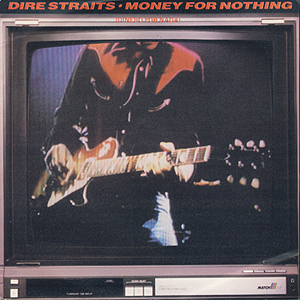
A guitarist walked into a New York shop, watched a delivery man in a hard hat insult everybody on MTV, borrowed a pen, and wrote it all down while it was still coming out of his mouth. The riff that carries it was not in the song at first. The guitar sound everyone recognizes came from somebody knocking a microphone onto the floor. And the man whose actual words became the lyric never got a penny.
"Money for Nothing" was written by Mark Knopfler from lines he transcribed verbatim in a New York appliance store, where a worker watching MTV on a wall of televisions was mocking the musicians on screen. Sting sang the "I want my MTV" hook to the melody of the Police's "Don't Stand So Close to Me," which is why he shares the credit. Billboard shows it at number one for three weeks from September 21, 1985.
The shop, the pen, and the reporter's habit
Before Dire Straits, Mark Knopfler worked as a newspaper reporter on the Yorkshire Evening Post, and he has said flatly that this is the skill the song came out of. "I was reporting, verbatim, what a particular guy thought about music," he told Uncut. "I transcribed his words there and then. He was a meathead. To him being a rock star was easy, hence 'that ain't working.'"
The scene was a New York appliance store with a wall of televisions tuned to MTV, and an employee in work clothes providing commentary. Knopfler asked for a pen and paper and started taking it down where he stood. Songfacts records that he wrote the song in the store, sitting at a kitchen display the shop had set up, and that many of the lyrics were things the worker actually said.
What Knopfler heard in the man was not simple hostility, and his 1985 account to Rolling Stone is more sympathetic than the song's reputation suggests. "The singer in 'Money for Nothing' is a real ignoramus, hard hat mentality," he said. "Somebody who sees everything in financial terms. I mean, this guy has a grudging respect for rock stars. He sees it in terms of, well, that's not working, and yet the guy's rich. That's a good scam. He isn't sneering."
That last sentence is the whole argument about this song in three words. Knopfler wrote a character, not a manifesto, and he knew even in 1985 that the distinction would not survive contact with the radio. Speaking to Rolling Stone about the anger over the slur in the second verse, he said: "Apart from the fact that there are stupid gay people as well as stupid other people, it suggests that maybe you have to be direct. I'm in two minds as to whether it's a good idea to take on characters and write songs that aren't in the first person."
The riff was not there
The version of this song that exists in everyone's memory opens with that guitar. It was not in the song when the band started working on it. Keyboardist Alan Clark told Mojo what the track sounded like before Knopfler found it. In the beginning, he said, "'Money For Nothing' sounded more like a Stones track and it didn't have the iconic guitar riff. Mark developed that messing around to a click track on his own on Montserrat."
The tone was a second accident, layered on top of the first. Knopfler was chasing ZZ Top. Producer Neil Dorfsman put it plainly to Sound On Sound in May 2006: "We were going for a ZZ Top sound, but what we ended up getting was kind of an accident."
Bassist John Illsley told Uncut exactly what the accident was. "Somebody knocked over a microphone, it was lying on the ground, and Mark started playing. Neil Dorfsman stood up and said, 'Don't move anything, that's the sound.' So the rather extraordinary guitar sound on 'Money For Nothing' was produced by somebody knocking something over."
A microphone on the floor at the wrong angle in a studio on a Caribbean island is the reason the most recognizable rock guitar tone of 1985 sounds the way it does.
Sting, five notes, and a holiday
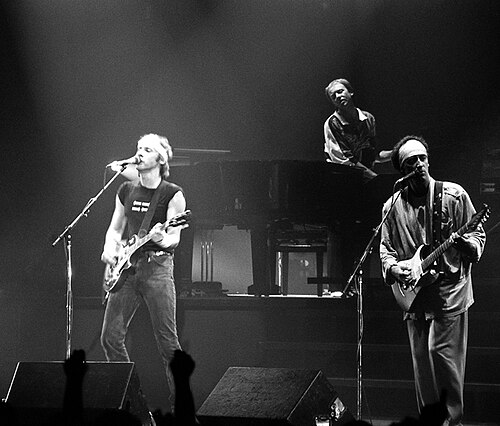
Dire Straits cut Brothers in Arms at AIR Studios on Montserrat, the studio George Martin built. The Police had made Ghost in the Machine and Synchronicity there, so Sting knew the island, and he was on it, on holiday, while Dire Straits were working.
Knopfler's own account of what happened next is specific and unglamorous. He had been thinking about the network's advertising campaign, the one where musicians shouted the slogan between videos. "I'd seen the Police doing an MTV advert, saying 'I want my MTV,' just saying it all together; and I thought, 'If I set that to the notes of "Don't Stand So Close to Me" it'll work,'" he told Uncle Joe Benson on the Ultimate Classic Rock Nights radio show, as reported by Ultimate Classic Rock in June 2019. "I remember saying to the guys, 'I'd really like to get Sting to do this.' We knew them anyway because we'd done a lot of gigs together in Germany. One of them said, 'That's fine, because he's here on holiday.'"
The co-writing credit follows directly from those five borrowed notes, and Knopfler has never expressed a grievance about it. "And because I'd used the five notes from 'Don't Stand So Close to Me,' that's how the co-writing thing happened," he said. "Which is fine; it's absolutely fine with me and it worked out well."
He also remembers Sting walking into a session that was going suspiciously smoothly. "I remember quite clearly Sting coming into the studio and saying, 'What's wrong?' I said, 'What do you mean?' He said, 'Nobody's fighting!'"
Billboard credits the song to M. Knopfler and Sting, and lists M. Knopfler and N. Dorfsman as producers.
The video Knopfler did not want and was wrong about
Knopfler disliked music videos, and he has been cheerfully honest about the fact that his own concept for this one was worse than the one he got. "To me it was almost like a dream sequence," he said of his idea. "I'd visualized a kid in his bedroom with that 'I want my MTV' thing happening and the camera rushing over the landscape ... as I've said before, it's a good thing I never had anything to do with the video!"
What got made instead was directed by Steve Barron, who had already made the videos for Michael Jackson's "Billie Jean" and, that same year, a-ha's "Take On Me." Barron understood exactly what he was building, and said so in the MTV oral history I Want My MTV by Rob Tannenbaum and Craig Marks: "The song is so damning to MTV in a way. That was an ironic video. The characters we created were made of televisions, and they were slagging off television. Videos were getting a bit boring, and they needed some waking up. And MTV went nuts for it. It was like a big advertisement for them."
A song mocking MTV, wrapped in a video made of televisions, built on a slogan lifted from MTV's own ad campaign, became one of the most-played things on MTV. Nobody involved seems to have minded.
What it did
"Money for Nothing" entered the Billboard Hot 100 at number 87 on July 13, 1985, and reached number one on September 21, 1985. It held the top for three weeks, through the chart dated October 5, before Ready for the World's "Oh Sheila" replaced it on October 12. It was the only Dire Straits single ever to reach number one in America.
One footnote about that July 13 chart. The same week "Money for Nothing" debuted at 87, a-ha's "Take On Me" debuted at 91. Both spent the rest of the summer climbing, and both were carried there by videos made by the same director.
An all-80s radio stream from the Bubble is coming, and this is one of the records that defined what that dial sounded like.
How the telling has grown over the decades
Late 1985, Rolling Stone. The first substantial telling, and the one that frames the narrator as a character rather than a spokesman. This is where "he isn't sneering" and the "hard hat mentality" description come from, and where Knopfler admits he is "in two minds" about writing in a voice that is not his own. Notably, he is defending the song within months of releasing it.
Uncut, undated in the Songfacts record. The reporter angle, which is the detail that makes the story make sense. "I was reporting, verbatim." Also Illsley's account of the knocked-over microphone.
Sound On Sound, May 2006. Neil Dorfsman's engineering account, which independently confirms that the guitar tone was not designed. Twenty years after the fact, the producer and the bassist agree it was an accident and disagree about nothing.
Mojo, undated in the Songfacts record. Alan Clark's account, the only one that describes what the song was before the riff existed.
June 2019, Ultimate Classic Rock Nights. Knopfler, more than thirty years on, telling the Sting half in the most detail he ever has, including the five-note calculation and the "Nobody's fighting!" line.
Where the tellings drift. Three places worth naming. First, the shop itself: Songfacts calls it a New York department store, Stereogum's chart history calls it an appliance store, and Knopfler's own quoted accounts describe the televisions and the worker without settling the label. Second, how long Sting's part took: Songfacts says he sang it in one take, while Stereogum says the vocal took about an hour. Nobody disputes it was fast, and nobody agrees how fast. Third, and most substantively, the credit. Knopfler's telling is simple and warm: he used five notes, so the credit followed, and that is fine. The widely repeated other half of the story, that Sting did not want the credit and his label pushed for it, is reported by Songfacts and by Stereogum, but this article does not carry a first-person Sting quote saying it, because none was found in a source that could be checked. The distinction matters. Knopfler's side is documented in his own voice. Sting's side, as of this writing, is documented in other people's.
One thing nobody has ever added. The man in the shop has never been identified, never been interviewed, and never been credited. His words are on one of the best-selling albums ever made.
The honest bottom line
This is a song built on borrowed material at nearly every level. The lyric was taken down verbatim from a stranger who was not asked and not paid. The hook's melody was lifted from another band's single, which is why that band's singer is a credited co-writer. The catchphrase was an advertising slogan owned by the network the song is mocking. The famous guitar tone was a mistake nobody could reproduce on purpose. By any purist standard it should be a cynical record, and the slur in the second verse has kept it genuinely contested for forty years, which is a fair outcome for a line Knopfler chose to leave in. What keeps it alive is that the reporting is honest. Knopfler wrote down what a working man actually said about rich musicians, including the ugly part, and refused to clean him up into someone more comfortable to listen to.
FAQ
What is the story behind "Money for Nothing" by Dire Straits? Mark Knopfler overheard a worker in a New York appliance store insulting the musicians on MTV, which was playing on a wall of televisions in the shop. He borrowed a pen and paper and transcribed what the man said on the spot, and many of those lines went into the song almost unchanged.
Did Mark Knopfler really overhear the lyrics to "Money for Nothing"? Yes, and he credits his old job for the instinct. "I was reporting, verbatim, what a particular guy thought about music," he told Uncut. "I transcribed his words there and then." Knopfler had worked as a newspaper reporter on the Yorkshire Evening Post before his music career.
Who sings "I want my MTV" on "Money for Nothing"? Sting. Knopfler set the line to the five-note melody of the Police's "Don't Stand So Close to Me," and Sting, who was on holiday on Montserrat while the band was recording there, came into the studio and sang it.
Why does Sting have a songwriting credit on "Money for Nothing"? Because of that borrowed melody. In Knopfler's words: "And because I'd used the five notes from 'Don't Stand So Close to Me,' that's how the co-writing thing happened," and, "Which is fine; it's absolutely fine with me and it worked out well." Billboard lists the writers as M. Knopfler and Sting.
How did the guitar sound on "Money for Nothing" happen? By accident. Producer Neil Dorfsman told Sound On Sound, "We were going for a ZZ Top sound, but what we ended up getting was kind of an accident." Bassist John Illsley explained the mechanics: a microphone was knocked over and left lying on the floor, and when Knopfler started playing, Dorfsman said, "Don't move anything, that's the sound."
How long was "Money for Nothing" number one? Three weeks on the Billboard Hot 100, from the chart dated September 21, 1985 through October 5, 1985. It had debuted at number 87 on July 13, 1985, and it was the only Dire Straits single to top the American chart.
Sources
- Rolling Stone, Mark Knopfler interview, late 1985, as quoted by Songfacts and by Stereogum's The Number Ones column
- Uncut, Mark Knopfler and John Illsley quotes, as quoted by Songfacts
- Mojo, Alan Clark quote, as quoted by Songfacts
- Sound On Sound, Neil Dorfsman interview, May 2006, as quoted by Songfacts
- Ultimate Classic Rock, "When Mark Knopfler and Sting Connected for 'Money for Nothing'," Martin Kielty, June 24, 2019, quoting Knopfler's interview with Uncle Joe Benson on Ultimate Classic Rock Nights
- Steve Barron, quoted in I Want My MTV by Rob Tannenbaum and Craig Marks, via Stereogum and Songfacts
- Songfacts, "Money For Nothing by Dire Straits"
- Stereogum, The Number Ones: Dire Straits' "Money For Nothing," Tom Breihan
- Billboard Hot 100, weeks of September 21, October 5, and October 12, 1985 (chart positions, debut date, writer and producer credits)
The facts here were not for nothing, we earned them.
Part of Stories Behind the Songs. See also The Story Behind Take On Me and The Story Behind Billie Jean.