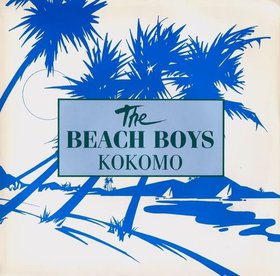
There is no Kokomo. The song that took the Beach Boys back to number one, twenty-two years after their last one, was built on a demo that had no chorus, written for a Tom Cruise bartending movie, and cut by a version of the band missing the man who invented their sound. And when you ask the people who were there why Brian Wilson is not on it, you get three answers that do not line up.
"Kokomo" started as a chorus-less demo by John Phillips and Scott McKenzie. Producer Terry Melcher brought it to the Beach Boys, and Mike Love wrote the island-name chorus and flipped the lyric to present tense. Brian Wilson never played on the record. It hit number one on the Billboard Hot 100 the week of November 5, 1988, the band's first chart-topper in twenty-two years. Why Brian is absent depends entirely on who is telling it.
It began as a John Phillips demo with no chorus
The song did not come from the Beach Boys at all. When director Roger Donaldson wanted music for his film "Cocktail," the band handed the job to their producer, Terry Melcher, and Melcher reached back to an old friend, John Phillips of the Mamas and the Papas, whose "California Dreamin'" the Beach Boys had recently covered. By 1986 Phillips was demoing tracks with Scott McKenzie, the singer of the Phillips-written 1967 smash "San Francisco (Be Sure to Wear Flowers in Your Hair)." One of those tracks was "Kokomo."
Phillips' original was a quieter, sadder thing. As Brad Shoup described it for Stereogum in 2018, "His 'Kokomo' is stately and wistful. Other than Florida, Kokomo is the only place mentioned, making the composition a sort of paean to a lost paradise of the mind." It has been suggested Phillips was thinking of Mustique, the Grenadines island owned by his friend Colin Tennant. Whatever the inspiration, Shoup wrote, "the 'Kokomo' demo was missing a chorus. And that's where Mike Love enters."
Mike Love sang Melcher a map
Love added the part everyone can recite. He wrote the chorus that runs down a list of tropical islands, and he suggested changing the lyric from past tense to present, which turned the whole mood of the song from regret to invitation. Stereogum put the shift in character terms: "his gift is punch-ups: tweaking phrases and adding earworms. He scrapped Phillips' past tense. It sounded like regret, which is not Love's bag. All he's ever wanted to do is provide escape." When it was time to build the hook, Shoup wrote, "Love sang Melcher a map."
The record was assembled by overdubbing new parts onto the Phillips and McKenzie demo, in sessions biographer Mark Dillon dates to March 22 and April 5 and 6, 1988. Van Dyke Parks arranged the steel pans and played accordion; studio saxophonist Joel Peskin cut the solo. The finished writing credits went to Phillips, Love, Melcher, and McKenzie.
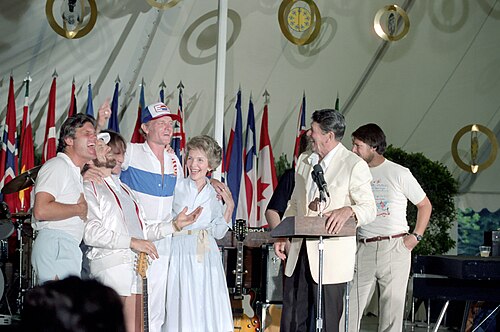
Why Brian is not on it: three tellings that do not line up
Every current Beach Boy sang on "Kokomo" except the one who had defined the band. Brian Wilson was, in this period, almost entirely under the control of his live-in therapist and business manager Eugene Landy, a man Stereogum described flatly as "Brian's personal therapist, business manager, and professional ghoul." On the band's 1985 album, Landy had already secured three songwriting credits under the name E. E. Landy; at one point, by Stereogum's account, the family had to sell some of Brian's publishing rights to cover Landy's fee, which the same piece put at "$430,000-a-year."
Here is where the story splits into three accounts, and they have never been reconciled.
Brian Wilson's account. In his 1991 memoir "Wouldn't It Be Nice: My Own Story," Wilson wrote that he could not take part because he was committed to recording his first solo album, and that his bandmates deliberately did not tell him the session date until it was too late.
Mike Love's account. Love says the reason was Landy, not scheduling. Speaking to Ultimate Classic Rock, he recalled: "We tried to get [Brian] to record with us on that song," but Brian, he said, "was under the tutelage, if you will, or under the spell, as some people would say, of Dr. Landy," who "governed his every move." The block, in Love's telling, was a demand. Landy would not "let Brian record with us," Love said, and would agree "only if Landy could be the co-writer or co-producer of the record." Love told Dillon the same thing in different words, that Landy would not "let Brian sing on it unless Landy was a producer and co-writer," that Melcher did not "feel he needed Landy since he had produced some number-one records," and that "It was pathetic of Landy to do that, but he controlled Brian completely at that time."
The biographer's check. Mark Dillon, who dug into the actual session records for his book "Fifty Sides of the Beach Boys," does not accept Brian's version. Of the claim that the band hid the session date, Dillon wrote: "Available session-date information does not substantiate this claim, however."
So one teller says he was frozen out on a technicality, one says his own doctor priced him out, and the biographer says the paperwork does not back the first story. Stereogum, hedging between them, wrote only that "Brian was unable to attend the sessions, possibly due to his doctor's interference." What nobody disputes is the ending: "When he first heard the song on the radio, he didn't even recognize it as a Beach Boys tune."
The number one nobody in the band seems proud of
"Kokomo" was released on July 18, 1988, and went nowhere until moviegoers heard it under Tom Cruise. Then it climbed. It reached number one on the Billboard Hot 100 for the week of November 5, 1988, and held the top for a single week. It was the group's first number one since "Good Vibrations" in 1966 and their last top-40 hit of any kind. It picked up a Golden Globe nomination for Best Original Song and lost, as Stereogum noted, to Phil Collins' "Two Hearts."
The video did the song no favors with critics. It was shot at the newly opened Grand Floridian at Walt Disney World, with the band miming instruments they had not played on the record and actor John Stamos on a steel drum he did not play either. NME later ranked it the seventeenth worst music video ever made: "It was as if Mike Love had taken the 'Beach Boys' name straight out of Brian Wilson's hands and we were forced to watch footage of Tom Cruise mixing up Bloody Marys. Thanks guys." The reviews of the record were no gentler. The Rolling Stone album guide called it a "joyless ditty," and Stereogum's Tom Breihan opened his own history with the plain fact that "People hate 'Kokomo.'"
How the telling has grown over the decades
The story of "Kokomo" is unusual because the disagreement is baked in from the start, and time has hardened the two sides rather than merging them.
1991, Brian Wilson's memoir. The scheduling version enters the record: solo album, no notice of the session, too late to join.
Mike Love, across interviews and in print. Love has told the Landy version repeatedly and consistently, both to Ultimate Classic Rock and in the material Mark Dillon gathered for "Fifty Sides of the Beach Boys." The two Love tellings differ in wording but not in substance, and both name Landy's credit demand as the wall.
2012, Mark Dillon's biography. Dillon is the first teller to check Brian's specific claim against the session dates, and he reports that the dates do not support it. This is the drift point that matters: it does not prove Love right, but it does undercut the idea that the band simply hid the date from Brian.
Where the tellings drift. Two things never resolve. First, cause: Brian frames his absence as something done to him by the band, Love frames it as something done by Landy, and Dillon frames the band-conspiracy version as unsupported. Second, tone: Brian remembered it as exclusion, while Love remembers it as a rescue that Landy sabotaged. This article carries all three and joins none of them, because the honest shape of this story is a three-way split, not a clean answer.
The honest bottom line
Strip the tropical gloss off and "Kokomo" is a song the Beach Boys did not write, built on another man's demo, finished by overdub, sung by a band that had been reduced to state fairs, and topped off with a video full of instruments nobody actually played. Its own author, Brian Wilson, was missing, and even now no two of the people involved agree on why. It is also, undeniably, a number one, the last big cultural moment a legendary band ever had, and the only Beach Boys song a whole generation can sing start to finish. Both of those things are true at once, and pretending otherwise is how you get the myth instead of the story.
FAQ
Why isn't Brian Wilson on "Kokomo"? There are three accounts. Brian Wilson wrote in his 1991 memoir that he was busy with his solo album and was not told the session date in time. Mike Love says Brian's therapist Eugene Landy blocked it, demanding a producer or co-writer credit in exchange. Biographer Mark Dillon checked the session records and wrote that they do not support Brian's claim that the date was hidden. The accounts have never been reconciled.
Is Kokomo a real place? No. There is no island called Kokomo in the Florida Keys or anywhere in the Caribbean. The name was invented for the song. After it became a hit, several bars and resorts adopted the name, and Sandals briefly renamed a Montego Bay property "Kokomo Island."
Who wrote "Kokomo"? John Phillips, Scott McKenzie, Mike Love, and Terry Melcher. Phillips and McKenzie wrote the original verse and demo, Love added the island-name chorus and changed the lyric to present tense, and Melcher produced the record.
Was "Kokomo" the Beach Boys' last number one? Yes. It reached number one on the Billboard Hot 100 for the week of November 5, 1988, held the top for one week, and was the band's first number one since "Good Vibrations" in 1966. It was also their final top-40 hit.
Did "Kokomo" win any awards? It was nominated for a Golden Globe for Best Original Song and lost to Phil Collins' "Two Hearts." The record has since become a fixture on worst-song lists despite its commercial success.
Sources
- Mark Dillon, "Fifty Sides of the Beach Boys: The Songs That Tell Their Story" (ECW Press, 2012): session dates, the Brian Wilson memoir claim and Dillon's session-date rebuttal, and Mike Love's account of the Landy credit demand, as compiled and quoted on the Wikipedia entry for "Kokomo (song)"
- Brian Wilson, "Wouldn't It Be Nice: My Own Story" (1991): Wilson's own account of why he did not attend the sessions
- Ultimate Classic Rock, "30 Years Ago: The Beach Boys Release Their Last No. 1, 'Kokomo'," Martin Kielty, July 24, 2018: Mike Love's recalled quote on Landy
- Stereogum, "'Kokomo' Is 30: The Strange Backstory To The Beach Boys' Last Cultural Gasp," Brad Shoup, July 23, 2018: the Phillips demo, the missing chorus, Mike Love's chorus, the Landy background and fee, Brian's absence and non-recognition, release date, and Golden Globe loss
- NME, "50 Worst Music Videos Ever," November 21, 2011: the video ranking and quote, as quoted on the Wikipedia entry for "Kokomo (song)"
- The Rolling Stone Album Guide ("joyless ditty") and Stereogum's "The Number Ones" by Tom Breihan ("People hate 'Kokomo.'"): critical-reception quotes, as quoted on the Wikipedia entry for "Kokomo (song)"
- Wikipedia, "Kokomo (song)": the compiling source for the Mark Dillon book quotes, the NME quote, and the critical-reception quotes above (saved both as rendered plaintext and raw wikitext)
- Billboard Hot 100, week of November 5, 1988: chart position and number-one status
We will get there fast and then take the facts slow, bubble method.
Part of Stories Behind the Songs. See also The Story Behind The Power of Love and The Story Behind Don't You (Forget About Me).