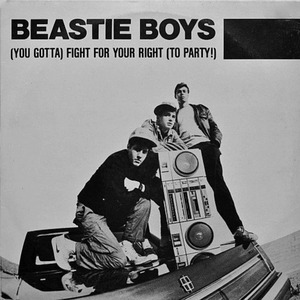
Three New York art-punk kids wrote a song making fun of beer-soaked party anthems, and it worked so well that beer-soaked party guys adopted it as their anthem. It was never supposed to be the single. Within a year the band was standing on stages looking out at rooms full of exactly the people the song was mocking, and it took them the rest of their careers to get out from under it.
"(You Gotta) Fight for Your Right (To Party!)" was written in the summer of 1986 by Adam Yauch with band friend Tom Cushman, originally for Yauch's side project Brooklyn, as a goof on party-and-attitude rock songs like "Smokin' in the Boys Room" and "I Wanna Rock." Rick Rubin and the label made it the focus of Licensed to Ill. It peaked at number seven on the Billboard Hot 100 on 7 March 1987, the band's only top-ten hit.
It was written as a joke, and the band has never pretended otherwise
Terry Gross put the question to the Beastie Boys directly on NPR's Fresh Air in 2006, citing Yauch's own liner notes: that the song began as a goof and started as a satire of "I Want to Rock" kind of songs.
Yauch agreed with the framing and added the crucial part, which is that nobody expected the joke to become the calling card. "It was just kind of like just one of those like 'Smoking in the Boys Room' type things. Just thought it was kind of funny," he said. "But I don't think we realized that it was going to be sort of the main focus of the album... I think the way we were looking at it, we were just kind of making this dumb song that it'd sit somewhere on the album."
Then the decision that changed everything, and it was not the band's: "But I think that CBS and Rick saw it as being able to be something much larger than what we imagined. And they kind of made it the main focus of the album."
Mike D's account of the writing session, given in 1987, is the closest thing to a scene anyone has. "It was summer 1986. We wrote it in about five minutes," he recalled in a quote carried by Far Out Magazine. "We were in the Palladium with Rick Rubin, drinking vodka and grapefruit juice, and 'Fight for Your Right' was written in the Michael Todd Room on napkins on top of those shitty lacy tables. I remember we made a point there of like, 'Look, we gotta get shit done,' and we sat at one table, really determined to accomplish something."
Five minutes on cocktail napkins, in a nightclub, for a different band. According to the Beastie Boys Book, as reported by Songfacts, Yauch first intended the song for his side band Brooklyn and never recorded it there, and brought it out again when the group was assembling its debut.
The wrong audience showed up
The song did not just find an audience. It found the wrong one, in bulk, and the band watched it happen from the stage.
"I think maybe we just ended up with a different bunch of fans than we expected," Yauch told Gross. His regret was specific and about track selection, not about the joke: "if I could have known how much that song would have informed everyone about the album, I probably... my choice would have been more to pick, like, a different song to be the main single, like 'Hold It Now' or 'Slow and Low' or 'Posse In Effect' or one of the other cuts."
The result, in his words: "And so, the next thing you knew, we would go out and play shows and the whole place would just be full of, like, frat boys, like drunken frat boys. And so it was... and so there we were."
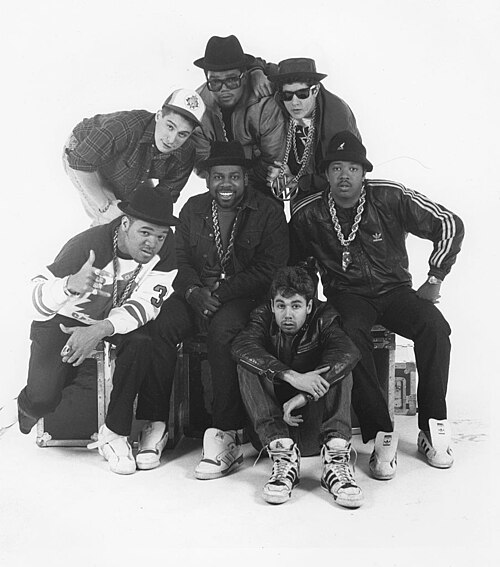
Mike D had come out of a completely different circuit. As he pointed out in the same conversation, the band had toured opening for Run-DMC, Whodini and LL Cool J, in front of hip-hop crowds. Yauch's summary of the switch is the line that captures the whole predicament: "To then all of a sudden go into this world of, like, kind of like, I don't know, I guess a more pop audience and, like, kind of college kids wanting to party and drink beer and go see a Beastie Boys show, that was completely foreign to us and beyond anything we ever imagined."
Becoming the thing they were mocking
The most honest part of the record is that the band does not claim it stayed above the joke. All three of them have said, on the same microphone, that they turned into it.
Gross read Yauch his own liner note back to him, the line about drinking so much beer and acting like sexist macho jerks that they actually became just that. Yauch's first response was a deadpan "I never said that," and the room laughed. Then he answered it straight: "I think in a way, you know, it's almost like we started out kind of like goofing on it but then just sort of became it, in a way."
Ad-Rock, immediately: "It's the become-what-you-hate syndrome. It happens."
And Mike D, giving the mechanism in one sentence: "You set out with an agenda of parody, and a certain amount of time goes by, and you kind of cross that line."
Ad-Rock's analogy for it is better than any critic's: "It's kind of like when you go to England, and you do a British accent the whole time, and then you come home and you have a fake British accent."
Mike D has also stated the cost plainly, in a later interview quoted by Far Out Magazine and repeated by American Songwriter in 2025: "The only thing that upsets me is that we might have reinforced certain values of some people in our audience when our own values were actually totally different." He went on: "There were tons of guys singing along to [Fight for Your Right] who were oblivious to the fact it was a total goof on them. Irony is often missed."
The video that welded the image on
The song was already a radio hit before the clip existed. MTV, knowing exactly what its young male audience would do with it, held a hot-rotation slot open while the video was being shot.
Ric Menello and Adam Dubin directed it on a two-day shoot for 20,000 dollars, in the apartment of Sunny Bak, a friend of the band who shot album art. Menello modeled the party on the chaotic party scene in Breakfast at Tiffany's, including the man with the eye patch. Rubin appears in it. So does a pre-fame Tabitha Soren, who has said the whipped cream was scavenged from supermarket trash cans because there was no budget for it and the room ended up smelling like rotten eggs.
Menello, quoted in the book I Want My MTV, understood precisely what he had made and what happened to it: "The idea of the video was infantile rebellion. Some people, like frat boys, didn't see the satire of it. It's not so much satire as a kind of blanket, cartoonish rejection of anything adult."
Twenty-five years later Yauch wrote and directed a sequel short, Fight for Your Right Revisited, released in 2011 to mark the anniversary, with a cast of actors playing the band. He got the last word on his own joke.
The chart run, and the year it all detonated
The single entered the Billboard Hot 100 at number 86 on 20 December 1986 and peaked at number seven on the chart dated 7 March 1987, blocked from higher by, among others, Bon Jovi at number one that week. It was the group's highest-charting single and their only top-ten hit. The same week, Licensed to Ill was the number one album in America, the first rap album ever to top that chart.
The Rock and Roll Hall of Fame later listed it among its 500 Songs That Shaped Rock and Roll, which is a strange fate for a five-minute napkin joke aimed at Twisted Sister.
How the telling has grown over the decades
The story has been remarkably stable, because the band started telling on themselves early. Mike D was already describing the Palladium napkins in 1987, within a year of the record. Yauch put the goof-and-satire framing in writing in the liner notes of the group's Best Of collection, which is where Terry Gross got it. In 2006 all three sat with Gross on Fresh Air and gave the fullest version, including the admission that they became the joke, and NPR rebroadcast that conversation after Yauch's death in 2012. The Beastie Boys Book in 2018 added the origin detail that the song was first meant for Yauch's side band Brooklyn.
Two things do not line up. Songfacts states the band stopped performing the song when their touring ended in 1987. Wikipedia states the opposite, that they continued playing their early hits including this one on later tours. Both claims sit in the standard reference sources on this song, and neither traces to a band member's own words, so the live-performance history is not settled here. The other loose thread is the writing credit itself: Wikipedia records the song as written by Yauch with Tom Cushman, but the registered credits went to Yauch, Ad-Rock and Rick Rubin, and Mike D's 1987 telling describes a group of them at the table. Who physically wrote which line has never been pinned down by anyone involved.
The honest bottom line
The uncomfortable truth is that the joke was not very well made. A parody that requires liner notes to be legible as parody has failed as parody, and the band effectively conceded that for years afterward. They also cashed the check: the frat-boy tour, the cage dancers, the beer. What redeems it is that they said so, repeatedly, in public, while the money was still coming in, and then went and made Paul's Boutique instead of a second Licensed to Ill. Very few bands ever admit their biggest hit was a bit that got away from them. These three said it into a microphone on public radio and then laughed about it. A year later, Walk This Way would prove the opposite was possible, a rock-rap collision where nobody was joking and nobody planned it and it changed the genre anyway.
FAQ
Is "Fight for Your Right" a parody? Yes. Adam Yauch wrote in the liner notes of the band's Best Of collection that it began as a goof and a satire of "I Wanna Rock" style songs, and he confirmed that to NPR's Terry Gross in 2006, comparing it to "Smokin' in the Boys Room."
Who wrote "Fight for Your Right"? Wikipedia records the song as written by Adam Yauch with band friend Tom "Tommy Triphammer" Cushman, originally for Yauch's side band Brooklyn. The registered writing credits went to Yauch, Adam Horovitz and producer Rick Rubin.
Why did the Beastie Boys come to dislike the song? Because the audience took it straight. Yauch said shows filled up with drunken frat boys, and Mike D said guys sang along "oblivious to the fact it was a total goof on them." All three have said they ended up becoming the character they were mocking.
Was "Fight for Your Right" supposed to be the single? No. Yauch said the band assumed it would just sit somewhere on the album, and that CBS and Rick Rubin made it the focus. He said he would have picked "Hold It Now," "Slow and Low" or "Posse In Effect" instead.
How high did "Fight for Your Right" chart? It peaked at number seven on the Billboard Hot 100 on 7 March 1987, after debuting at number 86 on 20 December 1986. It was the band's only top-ten single.
Who directed the "Fight for Your Right" video? Ric Menello and Adam Dubin, on a two-day shoot with a 20,000 dollar budget, modeled on the party scene in Breakfast at Tiffany's.
Sources
- NPR, Fresh Air with Terry Gross, interview with the Beastie Boys recorded in 2006, rebroadcast and transcribed after Adam Yauch's death in 2012
- Far Out Magazine, "The reason why The Beastie Boys hated one of their biggest tracks" (Joe Taysom), 30 December 2020, carrying Mike D's 1987 recollection and his later interview comments
- American Songwriter, "It Was a Total Goof on Them" (Melanie Davis), 30 October 2025
- Songfacts, "(You Gotta) Fight for Your Right (To Party!)" song page, carrying the Yauch liner notes summary, the Beastie Boys Book origin detail and Ric Menello's quote from the book I Want My MTV
- Wikipedia, "(You Gotta) Fight for Your Right (To Party!)," for writing credits, video details and the Fight for Your Right Revisited short
- Billboard Hot 100 weekly chart, 7 March 1987
We fought for the right to verify everything.
Part of Stories Behind the Songs. See also Walk This Way and Whip It.