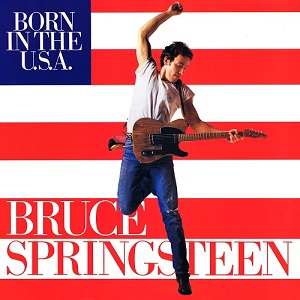
The song was called "Vietnam" first. The title that replaced it belonged to somebody else, sitting unread on a coffee table in New Jersey. The two men who built the arrangement in the studio remember that afternoon completely differently, and one of them says so out loud.
"Born in the U.S.A." began as an acoustic Nebraska-era song called "Vietnam," written after Springsteen read Ron Kovic's memoir Born on the Fourth of July. He took the title from an unread Paul Schrader screenplay on his table. The E Street Band cut it live at the Power Station in April 1982. Released as a single in late 1984, it peaked at number nine and was misheard as a flag-waving anthem almost immediately.
The title he admits he stole
Paul Schrader, who wrote Taxi Driver and Raging Bull, had a screenplay about a blue collar bar band and wanted Springsteen to star in it. He has told the story himself, to Deadline in 2025.
"There was a moment there when Bruce was being courted by the studios. Paramount had it, and they would have given anything to star him in a movie," Schrader said. He sent the script through Springsteen's manager. "I met with and gave the script to [Springsteen's manager Jon] Landau, and he got back about a month later and said, 'Bruce has been thinking about it and he's not going to be in movies. He thinks it's a trap and that he'll end up like Elvis.'"
Schrader went to Japan to make Mishima. He came home to hear a hit record carrying the exact title of his unmade film. The explanation came later, face to face.
"We met in Los Angeles and [Springsteen] said, look, I never did read your script," Schrader told Deadline. "I was working on this song called 'Vietnam' and I thought that was a bit too-on-the-nose. Your script was on the coffee table, and I kept walking past it every day. And finally it caught in my head and, I stole it."
Schrader got a thank-you in the album's liner notes and decided that was enough. "I suppose there could have been some financial advantage for me, but I just didn't want to be that kind of guy, who would milk Bruce's head for X amount of dollars. And he didn't ever forget it." Springsteen later wrote Schrader a song for the film, which came out in 1987 under the title of that song instead: "Light of Day."
Where the song actually came from
The lyric predates the title by years. Springsteen bought Ron Kovic's Vietnam memoir Born on the Fourth of July at a stop in Arizona in 1978, then met Kovic by the pool at the Sunset Marquis in Los Angeles not long after. Kovic connected him to Vietnam Veterans of America cofounder Bobby Muller, and in August 1981 Springsteen and the E Street Band played a benefit for that organization with disabled veterans seated at the side of the stage.
His own stake in it was not abstract. Springsteen failed his draft physical in 1968 because of a concussion from a motorcycle crash, and the guilt outlasted the relief. In his 2016 memoir Born to Run he wrote about wondering who was sent in his place.
Back home the next month, writing the songs that became Nebraska, he started something called "Vietnam." Early drafts, described in Brian Hiatt's book Bruce Springsteen: The Stories Behind the Songs and excerpted in Rolling Stone in 2019, are startling: a discarded chorus line sarcastically saluting "the American way," a verse about Nixon never spending a day in prison, and an explicit passage confirming that the line about being sent to fight "the yellow man" was written as an antiracist statement, because they would not treat "the white man that way."
He compressed all of it. What survived is four verses and a chorus that sounds like a stadium chant.
The riff, and the argument about who found it
Springsteen cut the song on his four-track with the rest of the Nebraska material. In April 1982, at Studio A in the Power Station, he pulled it out for the band, playing it on acoustic guitar rather than running the demo.
Roy Bittan says he heard a hook inside the vocal line. "When I heard him sing it, I said, 'That's a riff,'" Bittan told Hiatt. "A very succinct, simplistic riff." He went to his new Yamaha CS-80 to find a sound for it. "I was always intensely listening to the lyrics to see what the hell the song was about," he said. "So I heard what he was talking about, and what I tried to conjure up is a Southeast Asian sort of synthesized, strange sound. And I played the riff on that."
Max Weinberg started hammering his snare against it, and Springsteen stopped everything. "Bruce heard Max and me, and he said, 'Wait, wait, wait. Stop. Okay. Roll the tape,'" Bittan said. "'Does everybody have the chords?' Yes, everybody had the chords. 'Okay, roll the tape.' Boom. There it was."
Weinberg remembers it differently. In his account they first tried the song as "a country trio" with a country beat, and the breakthrough came when Springsteen started strumming something that reminded him of the Rolling Stones' "Street Fighting Man." "Everybody else came out," Weinberg recalled, "and he said, 'Just keep playing this riff over and over again.' And he kinda arranged it."
Weinberg does not try to win the argument, which is the best thing about it. "Roy may have gotten that riff. You can call this chapter Rashomon!"
The take on the album is an early live one with a few minutes of jamming cut out. During it, Weinberg says, Springsteen raised his hands and mimed a drum solo, and Bittan and Danny Federici, positioned where they could not see him, kept playing the riff until they felt the rhythm stop.
The snare that caused the misunderstanding
Engineer Toby Scott put gated reverb on Weinberg's snare, using a broken reverb plate, and the overloaded room microphones in the studio ceiling did the rest. Bob Clearmountain made it bigger still in the final mix. The result is a drum sound that reads to most ears as artillery or fireworks, depending entirely on what you already think the song is.
Six hours after the session ended, Springsteen drove to Weinberg's house with a boom box.
"We sat on my deck having freshly squeezed orange juice, and we listened to 'Born in the U.S.A.' about twenty times," Weinberg said. "I'll never forget it, because I went from 'I could have lost this job' to the drums on that record. He told me, 'The drums on this song are as important as the vocal. Because it sounds like confusion and bombs and you perfectly illustrated what I thought the song was about.'"
The misread, and why he refused to fix it
The song reached radio in a country in the middle of a triumphant reelection campaign. President Reagan invoked Springsteen by name at a 1984 New Jersey campaign stop: "America's future rests in a thousand dreams inside your hearts. It rests in the message of hope in songs so many young Americans admire: New Jersey's own Bruce Springsteen."
Springsteen has been correcting the record ever since, and in his memoir he called the song a protest song outright. What he has never done is apologize for the arrangement.
"On the album, 'Born In the U.S.A.' was in its most powerful presentation," he wrote in Born to Run. "If I'd tried to undercut or change the music, I believe I would've had a record that would've been more easily understood but not as satisfying."
His verdict on the whole forty-year misunderstanding is the calmest sentence anybody has written about it: "Records are often auditory Rorschach tests. We hear what we want to hear."
What the chart actually did
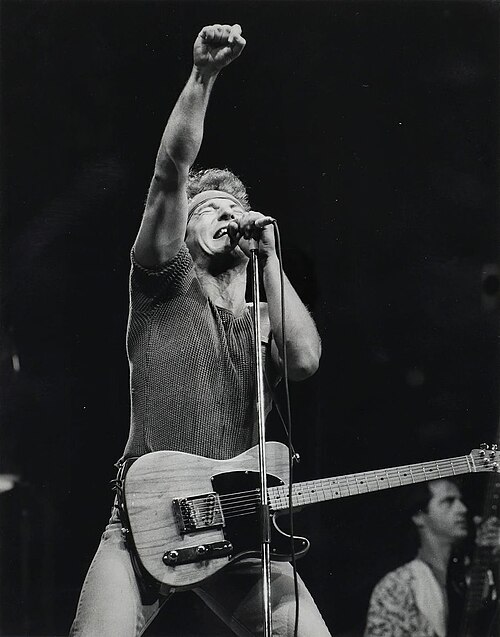
"Born in the U.S.A." was one of seven top ten singles pulled from the album. As a single it debuted on the Billboard Hot 100 at number 52 on November 10, 1984 and peaked at number nine on the chart dated January 19, 1985. It never came close to the number two that "Dancing in the Dark" reached. The song people think of as his biggest hit was, on the chart, one of his smaller ones.
How the telling has grown over the decades
- 1984: the misreading begins in real time, with Reagan's New Jersey campaign line and radio treating the chorus as a chant.
- 2016 (Born to Run, memoir): Springsteen states in print that it is a protest song, defends the arrangement, and gives the Rorschach line. He also writes about the draft physical and wondering who went in his place.
- March 2019 (Rolling Stone, excerpting Brian Hiatt's book): the makers other than Springsteen finally speak. Bittan's CS-80 riff, Weinberg's country-trio memory, the Rashomon admission, the orange juice on the deck, and the early drafts with Nixon in them.
- October 2025 (Deadline, via Den of Geek): Schrader tells the title story from his own side, including Springsteen's admission that he never read the script.
The drift is real and worth naming. Bittan and Weinberg contradict each other on how the arrangement was found, and Weinberg volunteers that fact rather than hiding it. The Schrader story also shifts depending on the teller: the 2019 book excerpt has the screenplay simply sent to Springsteen, while Schrader in 2025 says he pitched it as a starring vehicle and got turned down through Landau.
The honest bottom line
The most misunderstood song of the decade was misunderstood for good reasons. The title was borrowed from a script about a bar band. The drum sound was an accident of a broken reverb plate and some overloaded ceiling microphones. The chorus is four words repeated at full volume, and the verses that explain them are buried under it. Springsteen knew all of that and shipped it anyway, because the version that would have been easy to understand would have been a smaller record. He was right, and he has paid for being right at every campaign rally since.
FAQ
What is "Born in the U.S.A." actually about? A Vietnam veteran who comes home to no job, no help and a country that has moved on. Springsteen called it a protest song in his 2016 memoir. It started life as a song titled "Vietnam," written after he read Ron Kovic's memoir Born on the Fourth of July.
Where did the title "Born in the U.S.A." come from? From a Paul Schrader screenplay about a Cleveland bar band that was sitting on Springsteen's table. Schrader has said Springsteen told him directly: "I never did read your script... Your script was on the coffee table, and I kept walking past it every day."
Was "Born in the U.S.A." written for a movie? No. The title came from a screenplay, but the song was written for Springsteen's own record. He later wrote Schrader a separate song, "Light of Day," for the film that eventually got made.
Why do people think "Born in the U.S.A." is patriotic? The chorus is a shouted four-word hook over an enormous drum sound, and the verses that carry the meaning sit underneath it. Springsteen has said records are auditory Rorschach tests and people hear what they want to hear.
Who wrote the synth riff in "Born in the U.S.A."? Roy Bittan says he pulled it out of Springsteen's vocal line and played it on a Yamaha CS-80. Max Weinberg remembers the arrangement arriving a different way. Weinberg has said openly that both memories may be partly right.
How high did "Born in the U.S.A." get on the charts? Number nine on the Billboard Hot 100, on the chart dated January 19, 1985. "Dancing in the Dark" remains his highest-charting single at number two.
Sources
- Rolling Stone, exclusive excerpt from Brian Hiatt's Bruce Springsteen: The Stories Behind the Songs, March 24, 2019, including interviews with Roy Bittan and Max Weinberg
- Deadline interview with Paul Schrader, as reported by Den of Geek, October 20, 2025
- Bruce Springsteen, Born to Run (memoir, 2016), as quoted by Rolling Stone and Mental Floss
- Mental Floss, "How Bruce Springsteen's Anti-Vietnam Anthem Got Lost In Translation," July 7, 2020, for the Reagan campaign quote
- Billboard Hot 100 weekly charts, January 26 1985 and February 2 1985
The most misread song of the decade gets a telling that reads the record.
Part of Stories Behind the Songs. See also Dancing in the Dark and Hungry Heart.