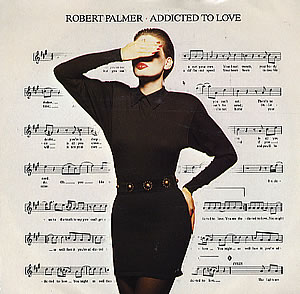
Two singers met in a club, liked each other immediately, and cut a song together the same week. Then the lawyers got involved, one of the voices was wiped off the tape, and the man left behind sang her harmony parts himself. The record went to No. 1 anyway, and forty years later she is still angry about it.
"Addicted to Love" was recorded by Robert Palmer at Compass Point Studios in the Bahamas, produced by Chic's Bernard Edwards, and was originally sung as a duet with Chaka Khan after the two met by chance at a club. Khan's record company would not release her to appear on Palmer's label, Island. Her vocal was erased, Palmer sang the high parts himself, and she kept the vocal-arrangement credit. It hit No. 1 on the Billboard Hot 100 dated May 3, 1986.
"She's the one singer I've always wanted to sing with"
Palmer died in 2003, so his side of this story lives in the archive. The fullest version he gave while it was still fresh ran in the Los Angeles Times on April 20, 1986, with the song sitting at No. 2 in the country. Dennis Hunt got him talking about meeting Chaka Khan.
"I bumped into her at a club," Palmer said. "We hit it off immediately. I spent the evening with her. I was impressed. She's the one singer I've always wanted to sing with."
It moved fast from there. "I told her I was recording and she wanted to come to the studio," he told the Times. "She showed up and we sang this song together that I was working on. The record sounded great."
That is the version of "Addicted to Love" almost nobody has heard. It exists. It has never been released.
"Politics intervened"
By the time the album came out, Khan was gone from the track and the background vocals were credited to Fonzie Thornton and Benny Diggs. Hunt described Palmer as seething while he explained why.
"Politics intervened," Palmer said. "Her people said it was a conflict of interest. She'd have three singles out at the same time."
Erasing her from the tape, he said, was heartbreaking. He also refused to erase her from the paperwork: "She threw parts in and helped develop the song. I couldn't use her vocals but she deserves credit for what she contributed to the arrangement." Khan is still credited with the vocal arrangement in the album's liner notes, which is why the credit reads strangely to anyone who listens for her and cannot find her.
Chaka Khan's version, decades later
Khan has told it too, and she does not describe a scheduling conflict.
Speaking to Andy Cohen in 2022, in a conversation reported by MusicRadar in January 2026, she recalled the moment in the studio when they both thought they had it: "We went into the studio and we sang together. He said 'they're going to love this'. I said, 'Yeah the label is going to be so happy. What the f*** can they say?' Well, they sure found something..."
Then she named what she believes happened: "My own label took me off... I just get the sense it was a racist ass move. He (Palmer) was upset. Robert didn't understand it. He didn't believe that racism existed like that."
She said the same thing again to the Daily Telegraph, in an interview MusicRadar quotes: "That was a totally racist decision. We killed that song together. But they couldn't see the greatness for the trees. We were both deeply hurt."
The two accounts do not agree, and this piece is not going to pretend they do. Palmer, in 1986, described a label objection about release schedules and competing singles. Khan, decades later, describes a racial decision by her own label. Both are first-person accounts from the two people in the room. What they share is the outcome and the feeling about it: he called erasing her heartbreaking, she says they were both deeply hurt. What is not in dispute is that the duet was recorded, that Warner Bros. was Khan's label at the time, and that the finished version buries the collaboration under Palmer's own multi-tracked harmonies.
The room it was built in
Riptide was cut at Compass Point Studios in Nassau, where Palmer was living. The lineup on the record is a who's-who of the era: Bernard Edwards of Chic produced it and played the bass, Tony Thompson played the drum intro that opens the song, Eddie Martinez played most of the guitar parts including the solo, Andy Taylor of Duran Duran added rhythm guitar, and Wally Badarou played keyboards.
Palmer had just come off The Power Station, the project that put him in a band with two members of Duran Duran and Thompson, and he told the LA Times he had deliberately turned toward that sound: "I had been leaning toward more basic arrangements and a more heavily guitar-oriented sound," he explained. "The music ended up being quartet arrangements, which tend to be in a rock direction. I wanted to change and that just felt like the right direction."
Almost everyone who built the record is now gone. Bernard Edwards died in 1996. Palmer and Tony Thompson both died in 2003. What is left is what they said at the time, which is why the 1986 interview matters more than any retrospective could.
The video that ate the song
Terence Donovan, a British fashion photographer, directed the video: Palmer in a suit, fronting a band of five expressionless models in identical dark makeup. The models were Julie Pankhurst, Patty Kelly, Mak Gilchrist, Julia Bolino and Kathy Davies. They were not musicians and were not pretending to be, and the shoot went about as you would expect.
Mak Gilchrist, who held the bass, told Q what the day was actually like: "I was 21 and got the part on the strength of my modelling book. We were meant to look and 'act' like showroom mannequins. Director Terence Donovan got us tipsy on a bottle of wine but as we were having our make-up retouched, I lost balance on my heels and knocked the top of my guitar into the back of Robert's head, and his face then hit the microphone."
VH1's Pop-Up Video later reported that a musician had been hired to teach the models basic fingering technique and gave up after about an hour, and pointed out that they move out of sync with each other and, in places, out of time with the song. It made no difference. The video finished third on VH1's Top 20 Videos of the 1980s, Palmer reused the concept for "I Didn't Mean to Turn You On" and "Simply Irresistible," and it has been parodied by everyone from Weird Al Yankovic to Shania Twain to Love Actually.
What it did
"Addicted to Love" entered the Billboard Hot 100 for the week ending February 8, 1986. On the chart dated May 3, 1986, in its thirteenth week, it went to No. 1, up from No. 2. It held the top for one week, falling back to No. 2 on May 10. It also topped the Top Rock Tracks chart and went to No. 1 in Australia, reached No. 5 in the UK, and earned a gold certification for half a million American shipments. It became Palmer's signature song and stayed that way for the rest of his life.
How the telling has grown over the decades
April 20, 1986, Los Angeles Times. Palmer tells it while it is happening, at No. 2 with the wound fresh: the club, the studio, "politics intervened," the heartbreak of erasing the tape, and his insistence that Khan keep the arrangement credit.
2022, Andy Cohen's radio show. Khan gives her side on camera for a wide audience: the two of them in the studio certain they had a hit, the label finding a reason anyway, and her belief about what the reason really was.
Later, the Daily Telegraph. Khan repeats the charge in blunter form and adds the line that gives the story its shape: "We killed that song together."
January 24, 2026, MusicRadar. Beth Simpson assembles the two sides for the song's fortieth anniversary and states plainly that it remains unclear why the decision was made, and that the original duet version is still in the vaults.
Two limits worth stating instead of hiding. First, Palmer's first-person record on this song is thin by necessity: he died in 2003, and the 1986 LA Times interview is the substantial account located for this piece. Second, Andy Taylor played on the track and has written a memoir, but no telling from him about these sessions could be verified here, so none is quoted. Where the makers are silent or gone, this page stays silent too.
The honest bottom line
"Addicted to Love" is a monster of a record and it is also a document of what the music business would do in 1986. Two artists at the top of their powers made something together in a room, and a contract negotiation neither of them was in decided the public would never hear it. Palmer got the No. 1, the signature song, and the most parodied video of the decade. Khan got a line in the liner notes and forty years of being asked about a performance nobody can play back. That same summer, Peter Gabriel topped the American chart with Sledgehammer, another record whose video defined it more than its origin story, and the two of them back to back in 1986 mark the moment the MTV spectacle became the song. He called it heartbreaking, she calls it worse than that, and the version they made together is still sitting in a vault.
FAQ
What is the story behind "Addicted to Love"? Robert Palmer met Chaka Khan at a club, invited her to the studio, and they recorded "Addicted to Love" as a duet. Khan's record company would not clear her to appear on Palmer's label, so her vocals were erased and Palmer sang the high parts himself. She kept the vocal-arrangement credit and the duet version has never been released.
Was "Addicted to Love" really supposed to be a Chaka Khan duet? Yes, and it was actually recorded that way. Palmer confirmed it to the Los Angeles Times in April 1986, and Khan has described the session herself in interviews since.
Why was Chaka Khan removed from "Addicted to Love"? The two people involved give different reasons. Palmer said in 1986 that her people called it a conflict of interest because she would have three singles out at once. Khan has said in recent years that her own label's decision was racially motivated. Both accounts are on the record.
Who played on "Addicted to Love"? Bernard Edwards of Chic produced it and played bass, Tony Thompson played drums, Eddie Martinez played most guitar including the solo, Andy Taylor of Duran Duran played rhythm guitar, and Wally Badarou played keyboards. It was recorded at Compass Point Studios in the Bahamas.
Were the women in the "Addicted to Love" video real musicians? No. They were models, directed by photographer Terence Donovan. One of them, Mak Gilchrist, has described being given wine before the shoot and accidentally hitting Palmer in the back of the head with her guitar.
Did "Addicted to Love" go to number one? Yes. It reached No. 1 on the Billboard Hot 100 dated May 3, 1986, held it for one week, and also topped the charts in Australia.
Sources
- Los Angeles Times, "With a Hit, Palmer Gets 'Addicted'" (Dennis Hunt), April 20, 1986
- MusicRadar, "That was a totally racist decision. We killed that song together" (Beth Simpson), January 24, 2026, quoting Chaka Khan to Andy Cohen in 2022 and to the Daily Telegraph
- Wikipedia, "Addicted to Love (song)," for the personnel, the chart entry week, the certification, the video credits, and Mak Gilchrist's account as given to Q
- Billboard Hot 100 weekly charts, May 3 and May 10, 1986
Might as well face it, we check everything.
Part of Stories Behind the Songs. See also Hungry Like the Wolf and Every Breath You Take.