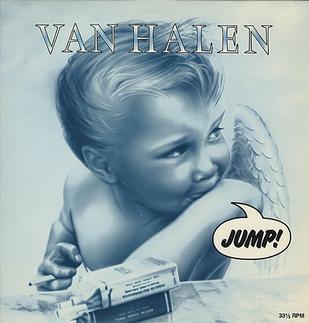
A guitar hero writes the most famous keyboard riff in rock, and his own band tells him to knock it off. The synthesizer he writes it on keeps catching fire. The producer hears the finished lyric and thinks it is about a man killing himself. And the singer has spent forty years telling two completely different stories about what the song actually means. "Jump" is the biggest hit Van Halen ever had, and almost nobody in the room wanted it.
"Jump" was written by Eddie Van Halen around 1981 on a synthesizer, and his bandmates rejected it because they thought a guitar hero should not play keyboards. Producer Ted Templeman eventually talked David Lee Roth into writing a lyric. Roth built it off a TV news report about a man threatening to jump off a building, flipping "might as well jump" into a dare to take a chance. Released in late 1983, it became the band's only number one.
The riff the band did not want
The most recognizable keyboard hook in rock almost never left Eddie Van Halen's bedroom. He had the synth part as early as 1981, and when he brought it to the band, they shut it down. "I put it down with a Linn drum machine," Eddie told Guitar World, "but when I played it for the rest of the guys in the band they said, 'Look, Edward, you're a guitar hero. Don't stretch yourself too thin. Don't start playing other instruments.'"
The pushback was loudest from the frontman, and Eddie's answer became one of his most-quoted lines. "Dave said I shouldn't be playing keyboards," he told Guitar World. "My response was if I want to play a tuba or Bavarian cheese whistle, I will do it." The resistance was not really about that one riff. Roth had laid out the band's whole philosophy to Rolling Stone years earlier: "The idea is to keep it as simplistic, as innocent, as unassuming and as stupid as possible." A synth-driven pop song was the opposite of that. Eddie sat on it for two more years.
The synthesizer that kept catching fire
When Eddie finally got to record the idea, the gear fought him. He wrote it on a Sequential Circuits Prophet-10, one of the first synths that could play full chords, and it could not take what he was doing to it. "I wrote Jump on a Sequential Circuits Prophet-10 in my bedroom while the studio was being built," he told Guitar World. "Every time I got the sound that I wanted on the right-hand split section of the keyboard, it would start smoking and pop a fuse. I got another one and the same thing happened." In a 1984 interview he described the same machine bluntly: "It started smoking. You know, everything I touch blows up."
The synth that survived onto the record was a different one, an Oberheim OB-Xa, and it is the sound every music-store keyboard buyer has been banned from playing ever since. The whole thing waited on the room itself. Eddie was building his own studio, 5150, and "Jump" was among the first things cut there, which is part of why the band could not ignore it any longer.
The lyric a producer heard as a suicide
Once Roth agreed to try a lyric, the next objection came from producer Ted Templeman, and it was not a small one. Templeman was not sold on the song to begin with. He told Guitar Player, "Ed played me the riff and I went, 'Uh... I don't know. That's so pop.'" He was even harsher to Rolling Stone in 2020: "It's not one of my favourite things. It's stupid because I produced it. But the keyboards just hit me as wrong."
Then he heard where the words seemed to be pointing. Templeman thought Roth had written a scene of a crowd egging on a suicide. "I said, 'That sucks. That's horrible,'" he told Guitar Player. "That sounds like somebody is going jump out of the window because he has so many issues.' And Dave went, 'No, "might as well jump" means for somebody to take a chance!' So I said 'okay.'" That reframe is the entire song. The same three words that sounded like a tragedy became a dare to leap at life.
Two stories about what "Jump" is really about
Roth has never told the origin the same way twice, and he seems to enjoy that. The version he gave in a 1984 interview is the concrete one. "I was watching television one night and it was the five o'clock news and there was a fellow standing on top of the Arco Towers in Los Angeles and he was about to check out early, he was going to do the 33 stories drop," Roth said. He remembered "a whole crowd of people in the parking lot downstairs yelling 'Don't jump, don't jump' and I thought to myself, 'Jump.'"
The other version he tells is that the song is about a stripper. Both accounts are on the record, and he has never bothered to reconcile them. What is consistent is where he wrote it. According to the band's own accounts, Roth worked out the lyric while riding in the back of his 1951 Mercury, with roadie Larry Hostler driving him around Los Angeles and playing the track on repeat. Roth later told Musician magazine that Hostler was "probably the most responsible for how it came out." Templeman remembered the speed of it: "Dave wrote the lyrics that afternoon in the backseat of his Mercury convertible. We finished all vocals that afternoon and mixed it that evening."
How the telling has grown over the decades
The pieces of this story come from different people who each remember their own corner of it, and the corners do not always line up. Roth's 1984 interviews are the source for the Arco Towers news report and the "might as well jump" reframe. Eddie's later Guitar World interviews are where the "guitar hero" veto, the "Bavarian cheese whistle" retort, and the smoking Prophet-10 live. Templeman's tellings, in Guitar Player and a 2020 Rolling Stone piece, are the producer's angle: his own doubts about the song and his misread of the lyric as a suicide.
The honest drift is worth naming. Roth gives two different subjects for the song, a suicidal jumper and a stripper, and does not choose. Eddie and Roth disagree on who was holding the band back, with Eddie framing the resistance as coming from Dave. And there is the Kiss on My List wrinkle: Daryl Hall of Hall and Oates has said Eddie told him where the sound came from. "[Eddie] Van Halen told me that he copied the synth part from 'Kiss on My List' and used it in 'Jump,'" Hall said. "I don't have a problem with that at all." Nobody in the story fully agrees on where "Jump" started, which is fitting for a song the whole band spent years talking each other out of.
The honest bottom line
Strip the anthem away and "Jump" is a song built on things its own makers were suspicious of. The riff was vetoed. The keyboards annoyed the producer. The lyric was almost a suicide note. The synth sound may have been lifted from a Hall and Oates record. And the writer will not tell you straight what it is about. None of that has dented it. "Jump" became Van Halen's only number one and the sound of a band being dragged, against its instincts, into the biggest moment it would ever have.
FAQ
What is the story behind "Jump" by Van Halen? Eddie Van Halen wrote the synth riff around 1981, and the band rejected it because they thought he should stick to guitar. Two years later, producer Ted Templeman got David Lee Roth to write a lyric off a TV news report about a man threatening to jump off a building. Roth turned "might as well jump" into a dare to take a chance, and the song became the band's biggest hit.
Why did Van Halen use synthesizers on "Jump"? Because Eddie Van Halen wanted to. He was a trained keyboardist as well as a guitarist, and he had the riff sitting around for years. He wrote it on a Sequential Circuits Prophet-10 and recorded the final sound on an Oberheim OB-Xa, over the initial objections of his own band.
Did David Lee Roth hate "Jump"? Roth was part of the resistance to Eddie playing keyboards, and Eddie has said "Dave said I shouldn't be playing keyboards." But Roth wrote the lyric that made it a hit and has talked about the song, in his usual tall-tale way, for decades. The bigger tension came later, around the video, and Roth left the band in 1985.
What is "Jump" actually about? It depends on when you ask David Lee Roth. He has said it came from watching a TV news report about a man threatening to jump off a building, and he has also said it is about a stripper. In the finished song, "might as well jump" is a push to take a risk and go for it.
Was "Jump" a number one hit? Yes. Released in late 1983 as the lead single from the album 1984, it reached number one on the Billboard Hot 100 in early 1984. It is the only Van Halen single ever to top the chart.
Who really wrote "Jump"? The music is Eddie Van Halen's, written on synthesizer. The lyric is David Lee Roth's, with the band crediting roadie Larry Hostler for helping shape it during the drives when Roth worked it out. Producer Ted Templeman pushed to get it recorded at all.
Sources
- Guitar World interviews with Eddie Van Halen (as compiled by MusicRadar, "the first known recording of Eddie Van Halen playing Jump's synth part," 2023)
- MusicRadar, "Van Halen's Jump at 40," quoting Ted Templeman in Guitar Player and Rolling Stone (2020)
- WCSX 94.7, "Van Halen 'Jump': The Story Behind The Song" (2024), quoting a 1984 David Lee Roth interview and a 1984 Eddie Van Halen interview
- American Songwriter, "The Mixed Meanings Behind One of Van Halen's Final Hurrahs Together: 'Jump'"
- Wikipedia, "Jump (Van Halen song)," for release and chart data, the Ted Templeman recording account, and the Daryl Hall quote
- Billboard Hot 100 weekly charts, 1984
Might as well jump to the standards page.
Part of Stories Behind the Songs. See also The Story Behind Eye of the Tiger and The Story Behind Summer of '69.