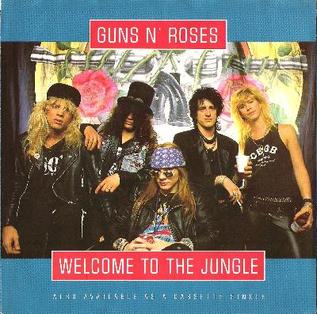
The most famous opening line in hard rock was handed to Axl Rose by a stranger who wanted to scare him. The riff under it was already in Slash's hands before there were any words. The whole thing came together in a few hours in a house full of bandmates who lived on top of each other. And to this day the members of Guns N' Roses cannot agree on which city the song is even about, because the frontman has named three of them in three different interviews. The confusion is not sloppy memory. It is the point.
"Welcome to the Jungle" grew out of a warning a stranger shouted at Axl Rose after he got off a bus, something close to "you're in the jungle, baby, you're gonna die." Slash already had the main riff. The band, Slash, Rose, Izzy Stradlin, and Duff McKagan, arranged the whole song in roughly three hours. It appeared on Appetite for Destruction in 1987 and, after a 1988 re-release, reached number 7 on the Billboard Hot 100.
The line came from a stranger
The hook of the whole song, the title itself, is a threat someone made to a scared young Axl Rose. In a 1999 SPIN feature, Rose located the moment in New York, stepping off a bus with a friend and getting confronted by a man who wanted to rattle the obvious out-of-towner. The line Rose remembered has become the song's DNA: "You know where you are? You're in the jungle baby; you're gonna die!" He kept the menace and built a lyric around the feeling of arriving somewhere that intends to eat you alive.
Slash already had the riff
The music did not chase the words. It was waiting for them. Slash has said the central riff existed before the song did, and that he played it for Rose on an acoustic guitar to see what would happen. "I had this riff," Slash recalled to Louder, "and I remember playing it for Axl on an acoustic guitar. I said: 'Check this out.'" It clicked immediately, and it became the first thing the whole band made together. "It was really the first thing we all collaborated on," Slash said. "And it's really a combination of everybody's input." He has described the feel he was chasing in careful terms. "I don't want to say the word 'bluesy,' but it had a really cool kind of soulful feel," he told Louder.
Built in an afternoon
Because the five of them were living in and around the same house, the song went from riff to finished arrangement almost immediately. Slash has put the writing time at a single sitting. "The song was written in approximately three hours," he said. There was no demoing it for months, no committee. Rose brought the lyric, Slash brought the riff, and the band arranged it on the spot. Slash has framed the band's whole method as following the singer's instinct. "If Axl went here, the band went with him," he told Louder. "There was something magical in all of that."
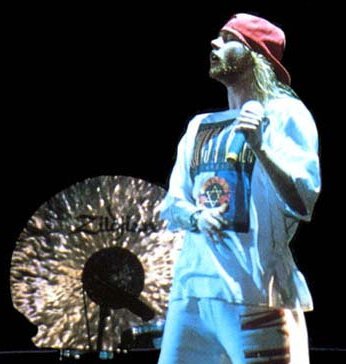
Which city is the jungle?
Here is where an honest telling has to stop and refuse to pick a side, because the band never has. Rose has named a different origin city depending on the year and the interviewer. In his 1988 Hit Parader interview, he said the lyrics were written in Seattle while he was visiting a friend, and even Songfacts, chasing down the setting, concluded that "Axl himself was kind of vague as to which city he was actually talking about." In the 1999 SPIN telling, the founding moment is unmistakably New York, with the stranger and the bus. Meanwhile his own bandmates point at home. Izzy Stradlin flatly called the song "about Hollywood streets; true to life." Slash tied it to their own Los Angeles survival. "If you lived in Los Angeles, and lived in the trenches, so to speak, you could relate to it," he told Louder. "And knowing Axl, I could relate to exactly where it was coming from." So the writing may have happened in Seattle, the confrontation may have happened in New York, and the world it describes is Hollywood. Three cities, three band members, no reconciliation. The song is about all of them because it is about the feeling, not the map.
What it became
"Welcome to the Jungle" opened Appetite for Destruction in 1987, but it did not become a hit on the first try. The single flopped on release. Only after "Sweet Child O' Mine" cracked the band open in 1988 did the label push "Welcome to the Jungle" back out, and this time it climbed to number 7 on the Billboard Hot 100. It became the song that introduced Guns N' Roses to most of the planet, the one that still opens the show and still functions as a dare. Slash has always insisted there was no strategy behind any of it, just a riff, a line a stranger shouted, and five people crammed into a house who happened to catch lightning in an afternoon.
How the telling has grown over the decades
The spine of this story is remarkably stable: a stranger's warning, a riff Slash already had, and a fast collaborative arrangement. What shifts, and shifts a lot, is geography, and it shifts inside the same man's mouth. The 1988 Hit Parader interview put the writing in Seattle. The 1999 SPIN feature moved the origin to a New York bus stop and preserved the exact threat that became the title. Slash's tellings, gathered in interviews like the Louder history, never bother with which city and instead root the song in the band's Los Angeles reality, which is where Izzy Stradlin planted it outright. Rather than three sources contradicting each other by accident, this reads like three people describing different true parts of the same thing: where Axl physically wrote it, where the frightening line was said to him, and where the life it describes actually happened. When a story drifts this consistently across decades, the drift itself is the honest record.
The honest bottom line
Strip the mythology and "Welcome to the Jungle" is a song assembled in a few hours by a broke band, built on a borrowed threat from a stranger whose name nobody knows, that failed as a single the first time out. It needed another song to become a hit before anyone cared. None of that dims it, because the menace in it was real, the players meant every note, and the band has never tidied up the messy, contradictory story of how it happened. A song about a place that wants to destroy you was made by people who were actually living there, and you can hear that it is not an act. The same album produced Sweet Child o' Mine, a ballad built on a riff its guitarist spent decades talking down, and together the two songs drew the full arc of what Guns N' Roses could be.
FAQ
What is "Welcome to the Jungle" about? It is about arriving in a big, predatory city as a young unknown. The title and hook come from a warning a stranger gave Axl Rose, something like "you're in the jungle, baby, you're gonna die." The band members have variously tied the song to New York, Seattle, and Los Angeles.
Who wrote "Welcome to the Jungle"? All four principal members: Axl Rose wrote the lyrics, Slash created the main riff, and the song was arranged by the band, with Izzy Stradlin and Duff McKagan. Slash has said the whole thing was written in about three hours.
What city is "Welcome to the Jungle" about? There is no single answer, and the band has never agreed. Axl Rose said in 1988 he wrote the lyrics in Seattle, and in 1999 placed the inspiring confrontation in New York. Izzy Stradlin called it a song about Hollywood streets, and Slash roots it in their Los Angeles life.
Did "Welcome to the Jungle" reach number one? No. The single flopped on its first release in 1987. After "Sweet Child O' Mine" made Guns N' Roses famous in 1988, the song was re-released and reached number 7 on the Billboard Hot 100.
Where did the riff come from? Slash has said he already had the main riff and played it for Axl Rose on an acoustic guitar. It became the first song the whole band wrote together, and Slash described its feel as soulful rather than strictly bluesy.
Sources
- SPIN feature on Guns N' Roses, 1999 (the New York origin and the stranger's line), via Wikipedia
- Hit Parader interview with Axl Rose, 1988 (the Seattle account), via Songfacts and Wikipedia
- Louder / loudersound.com, "Welcome To The Jungle: the story behind the song" (Slash quotes)
- Songfacts, "Welcome To The Jungle" Seattle place page
- Izzy Stradlin quote and songwriting credits via Wikipedia
- Billboard Hot 100 weekly charts, 1988 (peak number 7)
Welcome to the jungle, we have got receipts.
Part of Stories Behind the Songs. See also Sweet Child o' Mine and Jump.