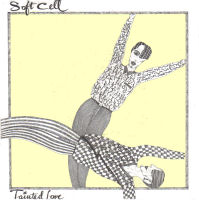
The song failed three times before it worked. Written in 1964, it flopped as a B-side, flopped again when its original singer re-cut it, and might have stayed a collector's obscurity forever. Then two art students from the north of England, who nearly recorded a different song entirely, slowed it down, ran it through a synthesizer, and kept a vocal take that was only ever meant to be a sound check. "Tainted Love" became the biggest-selling British single of 1981 and set a record on the American charts that stood for years.
"Tainted Love" was written by Ed Cobb and first recorded in 1964 by Gloria Jones, whose version flopped. It became a Northern Soul club favorite in England, where Soft Cell's Dave Ball and Marc Almond discovered it. In 1981 the duo remade it as electronic pop, dropping the key and slowing the tempo, and kept Almond's first run-through vocal. It hit number one in the UK and reached number 8 in the US, where it set a then-record 43 weeks on the Billboard Hot 100.
A song that failed before Soft Cell found it
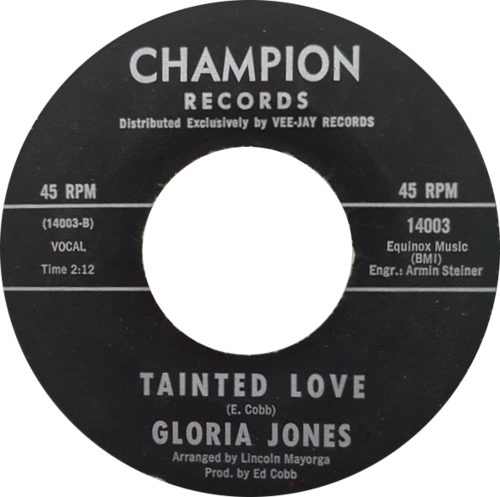
"Tainted Love" is not a Soft Cell original, and its road to them is a chain of flops. Ed Cobb, formerly of the vocal group the Four Preps, wrote it, and Gloria Jones recorded it in 1964. It came out in 1965 as the B-side of "My Bad Boy's Comin' Home" and vanished. It only survived because a DJ named Richard Searling found a copy in Philadelphia in 1973 and started spinning it at Va-Va, a Bolton club at the heart of Britain's Northern Soul scene. Jones re-recorded it for her 1976 album Vixen, co-produced with her partner Marc Bolan, and that version flopped too.
That is where two Leeds art students came in. Dave Ball, the instrumentalist, was the Northern Soul obsessive. "Dave loved '60s obscure soul records, which we in the U.K. called 'Northern Soul' because it was played in Northern U.K. nightclubs at all-night events," Marc Almond told People in 2025. It very nearly was not this song at all. "We listened to a number of songs and nearly settled on 'The Night' by Frankie Valli," Almond told People, "but we fortuitously landed on 'Tainted Love' because I loved the title and the lyrics."
Why an electronic band covered a soul record
The appeal was the mismatch. A synthesizer duo playing a stomping soul number was a joke that worked. "I loved it so much and we wanted an interesting song for an encore number in our show," Almond recalled in the 2005 book 1000 UK Number One Hits. "Dave loved Northern Soul and it was a novelty to have an electronic synthesizer band doing a soul song. When we signed with our record company, they wanted to record it."
The label did not immediately trust the arrangement. As Almond told the same book, "They told us to put bass, guitar and drums on it as they said it was too odd. They put it out anyway and the next thing it was gathering radio play and then it was #1." Almond has described the finished sound with real affection for its imperfections: "A mixture of cold electronics with an over-passionate, over-exuberant, slightly out of key vocal."
Ball built the machine underneath it. "On 'Tainted Love' I used a Roland Compurhythm CR78 drum machine," he told The Electricity Club in 2016. The bass came from his Korg. In their hands the song lost the frantic soul tempo, slowed down, and dropped from the key of C to G so Almond could sing it in his lower register.
The vocal they kept by accident
The most famous thing about the recording is that its lead vocal was never supposed to be the take. Producer Mike Thorne set up at Advision in London, and while he and engineer Paul Hardiman were still dialing in the sound, Almond sang it through once. "When we were still working on getting the right sound, Marc did a run-through, and it's fortunate that we recorded it because that's the one we ended up using," Thorne told Sound on Sound. "He poured his heart out on it and what you hear is a complete take."
They tried to beat it and could not. "Marc subsequently recorded about five takes of 'Tainted Love'," Thorne said, "but when we went back to the sound check we realised that none of them captured the energy or spontaneity of that original run-through." The recording rig was as improvised as the take. "We recorded him with a [Neumann] U87 and an EMT plate, with some pantyhose stretched over a coat hanger as a pop shield," Thorne told Sound on Sound.
The 'bink bink' that opens the record
That metallic pulse that opens "Tainted Love" was Almond's idea. In his 1999 autobiography Tainted Life, Almond wrote that beyond the vocal, his main contribution was suggesting the track open with that instantly recognizable sound. Thorne built it: "A snare-ish noise was mangled through a distinctive delay line, Delta Labs' DL4, to generate that metallic ringing effect," he told Sound on Sound. His verdict on his singer was flat admiration. "Marc was always a very, very good arbiter of taste. He understood his music. He isn't just a singer, he's a musician."
How the telling has grown over the decades
Because "Tainted Love" was a remake, its makers have spent forty years telling two stories at once: where the song came from, and what they did to it. The tellings are unusually consistent, which is itself worth noting, because the drift that exists is in emphasis, not in fact. Almond's 1999 memoir Tainted Life put his stamp on the arrangement, the opening sound. The 2005 book 1000 UK Number One Hits captured his memory of the label's cold feet. Producer Mike Thorne's Sound on Sound account added the run-through vocal and the pantyhose pop shield. Dave Ball, in interviews across the years and in his 2020 memoir Electronic Boy, kept the focus on the machines. In 2025, Almond told People the near-miss detail that they almost recorded Frankie Valli's "The Night" instead, a fork in the road that would have erased the whole thing.
The one layer that arrived later, and that the makers did not plan, was meaning. As the record climbed the American charts in 1982, a new epidemic was spreading. "It was the first time we'd heard about this then-unnamed disease that was affecting gay men in America," Almond has said of that period. "It wasn't an intentional tie-in, but as the record hit the American charts, it took on this other meaning." A song about a poisoned romance became something heavier than anyone writing or singing it had intended, and Almond has been careful over the decades to call that an accident of timing, not a design.
The honest bottom line
Strip away the legend and "Tainted Love" is a cover of a twice-failed 1964 flop, cut by a band that almost recorded something else, arranged over the objections of a nervous record label, built on a vocal take that was really a sound check. Soft Cell did not write it, and in America they never had another hit, which is why the world files them under one-hit wonder even though they charted a dozen times at home. None of that dents it. What they did was hear a buried soul record and rebuild it into something colder, sadder, and more modern, and the accident held: number one in Britain, a record 43 weeks on the American Hot 100, and one of the defining sounds of the decade. That same summer, the Human League's Don't You Want Me broke synth pop in America from the same direction, another British electronic single whose singer thought it was throwaway, and together the two records drew the template for what crossed the Atlantic in 1982.
FAQ
What is the story behind "Tainted Love"? Ed Cobb wrote it and Gloria Jones first recorded it in 1964, but it flopped and only survived as a Northern Soul club record in England. Soft Cell's Dave Ball and Marc Almond covered it in 1981 as electronic pop, slowing it down and reworking it, and kept a first-take vocal that was only meant to be a sound check. It became a worldwide hit.
Who sang "Tainted Love" first? Gloria Jones, in 1964. Her version was the B-side of "My Bad Boy's Comin' Home" and did not chart. She re-recorded it in 1976, and that version also flopped. Soft Cell's 1981 remake is the famous one.
Is "Tainted Love" a cover? Yes. It is a cover of Gloria Jones's 1964 recording, written by Ed Cobb. Soft Cell rearranged it completely for synthesizers, but they did not write the song.
Why did Soft Cell almost not record it? Almond has said the duo nearly chose Frankie Valli's "The Night" instead, and their record label initially thought the synth arrangement was too odd and wanted them to add bass, guitar, and drums. The label released the electronic version anyway, and it went to number one.
How did "Tainted Love" do on the charts? It reached number one in the UK in September 1981 and was Britain's biggest-selling single of that year. In the US it peaked at number 8 in the summer of 1982 and spent a then-record 43 weeks on the Billboard Hot 100.
Sources
- Sound on Sound, "Classic Tracks: Soft Cell 'Tainted Love'," interviews with producer Mike Thorne
- People, "Soft Cell's Marc Almond on the 45th Anniversary of 'Tainted Love'," 2025
- Marc Almond, 1000 UK Number One Hits (Jon Kutner and Spencer Leigh, 2005), as quoted by Sound on Sound and Songfacts
- Marc Almond, Tainted Life (autobiography, 1999), as cited by Sound on Sound
- The Electricity Club, Dave Ball interview, 10 March 2016
- Songfacts, "Tainted Love by Soft Cell"
- Wikipedia, "Tainted Love," chart tables citing Billboard and the Official Charts Company
- Billboard Hot 100, week of July 17, 1982 (Tainted Love at number 8)
No tainted facts in this one, we ran the checks.
Part of Stories Behind the Songs. See also Tainted Love and Don't You Want Me.