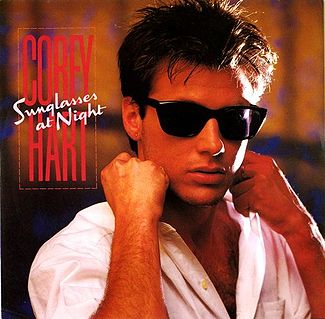
A nineteen-year-old from Montreal packed a pair of Ray-Bans for a recording trip to England and it rained almost every day, so he never got to wear them. The album was finished, twelve tracks short of a hit. Then a scrapped demo with an absurd title, "My Cigarette Got Wet," got a new lyric sung over it one night, and a career turned on a single line. Corey Hart has told the story of "Sunglasses at Night" for forty years, and the odd thing is that the people who made it do not all remember where the idea came from.
"Sunglasses at Night" was written by Corey Hart in 1983 as the last song for his debut album First Offense. He wrote it in Canada after finishing sessions near Manchester, England, reworking a rejected demo called "My Cigarette Got Wet" by singing "I wear my sunglasses at night" over its melody. Released as a single, it reached number 7 on the US Billboard Hot 100 in 1984, though it was only a minor hit in his native Canada.
The rain in England and the glasses he never wore
The setup to the story is a detail Hart repeats every time: he brought sunglasses to a country that would not give him any sun. "In the early Spring of '83, I was a starry-eyed 19-year-old kid from Montreal recording in a studio near Manchester, England," Hart told Songfacts. The album was nearly done, eleven songs finished. "It rained almost every day I was in the UK for those sessions," he said. "I had a pair of Ray Ban sunglasses with me but I never had the chance to use them." The glasses went home unused, and the idea, in his words, "had already begun a subterranean journey through my creative subconscious."
The demo called "My Cigarette Got Wet"
Back in Canada, the song arrived sideways, through a false start. Hart was writing constantly and began fiddling with a phrase that had nothing to do with sunglasses. "I started messing around with a melodic line and phrase called 'My Cigarette Got Wet,'" he told Songfacts. "It is an ironic lyric because I have never smoked in my life. It was the nascent embryo of 'Sunglasses' although I didn't realize it. I actually recorded a demo for 'Wet' which had many musical elements of 'Sunglasses' but I wasn't really sold on the song."
The turn came in a single moment. "One night I went back to the 'Wet' demo and sang out the lines 'I Wear My Sunglasses At Night' over the melody," Hart told Songfacts. "Wow. Just like that the song was born. It now spirited a cooler cadence from the new lyric that was missing before, plus I changed a few chord progressions." He knew immediately, and he had a problem. The album was done and the budget was spent. "I wanted to add it to my album on the spot. Impossible, I thought, we'd already spent the full recording budget," he said. He pleaded his case anyway. "To their credit and intuition, Aquarius Records sent me back to England. They trusted me when I told them, 'I think this one is really good.'"
Whose sunglasses were they, really
Here the story splits, and the split is worth keeping rather than smoothing. Hart's own tellings put the glasses at the center: the Ray-Bans he could not wear in England. In a 2024 American Songwriter interview for the book Playing Back the '80s, the version is that Hart bought Ray-Ban Wayfarers while recording in England, could not show them off because the sun barely appeared, and only started wearing them once he got back to Canada, which is when the phrase surfaced.
But one of the people in the room remembers it differently. According to co-producer Phil Chapman, as documented on Wikipedia, the album sessions took place in a studio whose air conditioning and heating vents sat directly above the mixing console, blowing air straight into the faces of the people working there. To protect their eyes, they wore sunglasses at the desk, and Hart, working on a new song, began improvising the line "I wear my sunglasses at night." Two accounts, one line: Hart's, where the idea travels home with him from a rainy England, and his producer's, where it starts at the console under the air vents. Both are told by people who were there.
What the song is about, and what the video is about
The song and its famous video are not about the same thing, and Hart has been consistent in keeping them separate. The lyric is not really about eyewear. The narrator is warning a lover that her deceptions are not slipping past him, with the shades standing in for his own insight and refusal to be fooled. American Songwriter summed up the gist in 2024: the narrator is telling his girl that "her deceptive practices aren't unnoticed," the sunglasses "just a symbol of his powers of insight and intuition."
The video went somewhere darker. Directed by Rob Quartly in Toronto, it plays out a dystopian "fashion" police state in which Hart is arrested and paraded through a prison, stripped of his sunglasses, surrounded by citizens forced to wear regulation shades. Wearing sunglasses at night becomes an act of rebellion the state punishes. That clip, in heavy rotation on the young MTV, did as much as the song. "I believe the video played a key role in establishing a strong image for me," Hart told Songfacts. "Within a few weeks of heavy MTV play your face and song would be known from coast to coast." It won the first Juno Award for Best Video in 1984, an evening Hart remembers less for the trophy than for his outfit. "I think I borrowed a suit of Rick Springfield's and it was too big for me," he told CBC in 2019. "I made a fashion error."
How the telling has grown over the decades
Because "Sunglasses at Night" is one man's song, its story is unusually well preserved, and Hart has retold it steadily: in the years right after the hit, in a detailed Songfacts account, to American Songwriter in 2024, and to CBC in 2019 when he entered the Canadian Music Hall of Fame. The spine never moves. There was a finished album, a rejected demo, a rainy trip, and a line that changed everything.
What drifts is the exact spark. Hart tells it as the glasses and the "My Cigarette Got Wet" demo. Phil Chapman tells it as the studio air vents. The two are not really in conflict, they are two people crediting different moments for the same idea, which is what happens to any origin story told enough times by enough of the people who lived it. The other thing time revealed is how wrong the label's caution was. A song added over budget, at the last minute, against the plan, became the track that carried the whole record.
The honest bottom line
Strip away the image and "Sunglasses at Night" is a salvage job: a scrapped demo with a silly title, rescued by one improvised line, tacked onto a finished album because a teenager would not let it go. It is easy to file Corey Hart under one-hit wonder, and easy to forget he charted nine US Top 40 hits and that "Never Surrender" reached number 3. But this is the one people know, and it earned that place. It is a genuinely strange pop record, minor-key and paranoid under its hook, built from a rewrite and a rainy accident, and it still sounds cool enough that its own writer grins when it comes on the radio.
FAQ
What is the story behind "Sunglasses at Night"? Corey Hart wrote it in 1983 after finishing his debut album near Manchester, England, where it rained so much he never got to wear the sunglasses he brought. Back in Canada, he reworked a rejected demo titled "My Cigarette Got Wet" by singing "I wear my sunglasses at night" over its melody, then convinced his label to let him add it to the album.
What does "Sunglasses at Night" mean? Despite the title, it is not about eyewear. The narrator is warning a partner that he sees through her deceptions, with the sunglasses standing in as a symbol of his insight and refusal to be fooled. The song's dystopian music video, about a police state, is a separate concept from the lyric's meaning.
Who wrote "Sunglasses at Night"? Corey Hart wrote it himself. It was the last song added to his 1983 debut album First Offense, produced in London by Phil Chapman and Jon Astley.
Was "Sunglasses at Night" a big hit? In the US, yes. It reached number 7 on the Billboard Hot 100 in 1984 and spent about half a year on the chart. Oddly, in Hart's native Canada it was only a minor hit, peaking around number 24.
Is Corey Hart a one-hit wonder? No. Although "Sunglasses at Night" is his best-known song in the US, Hart had nine US Top 40 hits between 1984 and 1990, and "Never Surrender" reached number 3. In Canada he had multiple number-one singles.
Sources
- Songfacts, "Sunglasses At Night by Corey Hart," including an extended first-person account and a 2012 quote from Hart
- American Songwriter, "The Meaning Behind Sunglasses at Night by Corey Hart," Jim Beviglia (from the book Playing Back the '80s), 2024
- CBC Music, "Corey Hart reflects on Sunglasses at Night," 2019
- Wikipedia, "Sunglasses at Night," including co-producer Phil Chapman's account and the music video description, chart tables citing Billboard and Library and Archives Canada
- Billboard Hot 100, week of September 1, 1984 (Sunglasses at Night at number 7)
We wear our skepticism at night, and always.
Part of Stories Behind the Songs. See also Jessie's Girl and The Boys of Summer.