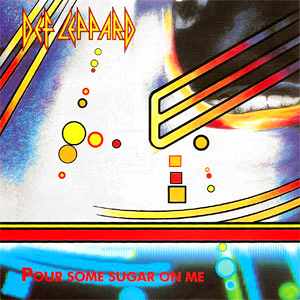
The most famous Def Leppard song almost never existed. It was thrown together in a matter of days at the very end of a four-year, three-million-dollar album the record company was desperate to shut down. The band nearly rolled their eyes at it. And the thing that finally turned it into a smash was not radio programmers or MTV, it was a group of strippers in Florida who kept calling their local station to request it. Everything about "Pour Some Sugar on Me" was an accident, including its success.
"Pour Some Sugar on Me" was written in about ten days near the end of Def Leppard's marathon Hysteria sessions, after singer Joe Elliott started strumming the chorus on an acoustic guitar during a break and producer Mutt Lange overheard it. The record label did not want another song added to the over-budget album. Released as a single, it reached number two on the Billboard Hot 100 on July 23, 1988, and became the band's signature hit.
An acoustic guitar during a coffee break
The whole song exists because a producer walked out for coffee and walked back in at the right second. Joe Elliott has told the moment many times, and the details stay consistent. "We took a break. Mutt went off to get a coffee or whatever producers do, and I picked up this acoustic guitar that sat in the corner of the room and just started playing this riff-chorus thing, three-chord turnaround, and singing the chorus," Elliott told Ultimate Classic Rock. Lange, the producer who had spent years chasing perfection on this record, heard it from the doorway. "And Mutt came back in and he said, 'What is that?'" Elliott downplayed it. "It's just this idea I've had knocking around." Lange did not downplay it at all. "No, that's the best hook I've heard for years, many a year. We should do this," Elliott remembers him saying.
The band was not immediately sold
It was not an instant yes from everyone in the room. The rest of the band had been living inside the Hysteria sessions for years, and a brand-new song at the finish line was not obviously welcome. "Eyes rolled a little bit from certain members of the band," Elliott told Ultimate Classic Rock. That skepticism did not survive contact with the demo. "Within a minute or so of this demo rolling past, everybody's like, 'Oh, yeah, we're in!'" The song came together fast by the standards of an album that had taken four years. Guitarist Phil Collen has said flatly that it "was probably the quickest song we ever recorded." Elliott has gone further, calling it "the most important song" on Hysteria and "maybe the most important song in our entire career."
Part of the speed came from the strange way the words got written. Elliott and Lange stationed themselves at opposite ends of the control room, spoke stream-of-consciousness phrases into two separate dictaphones while the backing track played, then swapped machines and tried to make out what the other had mumbled. The nonsense that survived that process became the lyric.
The label wanted it stopped, not started
By the time this song appeared, Hysteria was a financial emergency. The band has been blunt about how little the record company wanted one more track added to a budget that had already spiraled. On The Howard Stern Show in 2019, drummer Rick Allen put it plainly: "I don't think the record company really wanted us to put it on the record." Collen explained why. "They didn't because we'd spent like three million dollars already and we were so in the hole and they were like 'You got to get this thing out, it's ridiculous.'" Lange had to buy time to finish it, telling the label he needed roughly two more weeks to complete the track he was convinced would matter. The song most people now consider the reason to own Hysteria was, to the people paying for it, one more expensive delay.
The strippers who broke the record
Here is the part that belongs in every history of 80s radio. "Pour Some Sugar on Me" was not an immediate hit when Hysteria came out. It caught fire months later, from the ground up, through a request line. Phil Collen has told the story the same way for years. "The song became a hit because strippers in Florida started requesting it on the local radio station," he told Classic Rock in 2016. "It had a second lease of life. Hysteria was all over bar the shouting, and then all of a sudden this song just got popular." Dancers used it, audiences heard it, listeners called their local station to ask for it, the station played it to satisfy the requests, and the demand rippled outward until a song the label had nearly cut was climbing the national chart. It is one of the purest examples of the era's request-line economy, where a song could be pulled up the charts by ordinary people picking up the phone.
What it became
"Pour Some Sugar on Me" reached number two on the Billboard Hot 100 on July 23, 1988, roughly a year after Hysteria's release, and it dragged the whole album back up with it. It became the band's calling card, the song that defined their sound and their image, and it did all of that after nearly being left off the record entirely. A last-minute afterthought, written in a rush over the objections of the people financing it, turned into the most durable thing Def Leppard ever made.
How the telling has grown over the decades
The core beats of this story have held up across every retelling because so many band members tell them the same way. Joe Elliott's Ultimate Classic Rock account anchors the acoustic-guitar accident and Mutt Lange's "what is that" reaction. Phil Collen's Classic Rock interview in 2016 supplied the strip-club origin of its popularity, and the 2019 Howard Stern appearance is where Collen and Rick Allen confirmed the label's resistance and the three-million-dollar hole. The only real drift is in small numbers and staging. Some tellings clock the writing at ten days, others at roughly two weeks, and the exact spot where Elliott was strumming shifts between the corner of the control room and a corridor depending on who is talking. Those are the kinds of details that soften over thirty years of interviews. The load-bearing facts, the accident, the reluctant band, the hostile label, and the request-line rescue, never change.
The honest bottom line
Judged coldly, "Pour Some Sugar on Me" is a rush job, a hooky afterthought bolted onto an album that was already years and millions over, written with a lyric method closer to a party game than to craft. Nobody, not even the band, treated it as the centerpiece while they were making it. What redeems all of that is that it worked completely and honestly. The band admits the whole thing was luck, admits the label was right to be nervous, and admits it took strangers in a Florida club to see what they had. A song made by accident, saved by accident, and honest about both is a better story than any polished myth.
FAQ
How was "Pour Some Sugar on Me" written? Joe Elliott started strumming the chorus on an acoustic guitar during a break near the end of the Hysteria sessions. Producer Mutt Lange overheard it, insisted they finish it, and the band completed the song in roughly ten days to two weeks, writing much of the lyric by speaking stream-of-consciousness phrases into dictaphones.
Why didn't the record label want "Pour Some Sugar on Me"? Hysteria had already taken four years and about three million dollars to make, and the label wanted the album finished and released. Adding one more song meant more time and more money, so they resisted, even though it became the biggest hit on the record.
How did "Pour Some Sugar on Me" become a hit? Phil Collen has said the song took off because strippers in Florida began requesting it on a local radio station. The requests spread, radio play grew, and the song climbed the chart months after the album came out.
How high did "Pour Some Sugar on Me" chart? It reached number two on the Billboard Hot 100 on July 23, 1988, about a year after Hysteria was released, and revived sales of the entire album.
Was "Pour Some Sugar on Me" really a last-minute addition? Yes. It was one of the last songs written for Hysteria, created quickly at the end of the sessions after the acoustic-guitar accident, and the band and label nearly left it off the album.
Sources
- Ultimate Classic Rock, "How 'Pour Some Sugar on Me' Saved Def Leppard's 'Hysteria'" (Joe Elliott and Phil Collen quotes)
- Classic Rock, 2016, Phil Collen interview (the Florida strip-club origin of its popularity)
- The Howard Stern Show, March 26, 2019 (Rick Allen and Phil Collen on the label's resistance), via Loudwire
- Wikipedia, "Pour Some Sugar on Me" (dictaphone lyric method, sessions, and chart citations)
- Billboard Hot 100 weekly charts (number two, July 23, 1988)
Pour some sourcing on it, in the name of accuracy.
Part of Stories Behind the Songs. See also Sweet Child o' Mine and Eye of the Tiger.