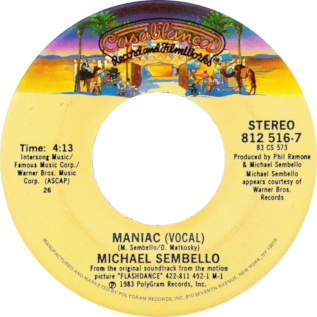
The most joyful workout anthem of 1983, the song about a girl dancing like she's never danced before, began life as a jokey little horror ditty about a murderer who moves in next door and kills your cat. It was never meant to be finished, never meant for a movie, and only ended up in Flashdance because a tape reached the wrong desk. Michael Sembello and Dennis Matkosky have told the story of "Maniac" for forty years, and the two of them do not even agree on where the idea came from.
"Maniac" was written by Michael Sembello and Dennis Matkosky as a darkly comic song about a serial killer. Sembello accidentally sent the demo to producer Phil Ramone, who was scoring Flashdance and heard a hit in it, on the condition that the horror lyrics be dropped. Rewritten as a song about a dancer possessed by ambition, it reached number 1 on the Billboard Hot 100 in September 1983 and was nominated for an Academy Award.
A song about a killer, not a movie
The lore around "Maniac" is that it was written for the notorious 1980 slasher film of the same name, directed by William Lustig. That is a myth, and the truth is stranger. The song began as a private joke between two Philadelphia friends who were writing together for Sembello's solo album. Matkosky brought in the spark. As he recalled in a 2022 interview on the YouTube series Starting Small Music, he was watching a television news report when the idea hit. "They found all these bodies in ... Gacy's backyard," Matkosky said, "and I just wrote down on a piece of paper, 'He's a maniac, he just moved next door. He'll kill your cat and nail it to the floor.'"
Sembello, a lifelong horror fan tired of writing love songs, was the perfect collaborator for it. He gave the Philadelphia Inquirer his own blunt version of the pitch in 1983: "I figured, 'Why not write a song about a mass murderer who goes around chopping people's heads off, like in Halloween III?'" The two fleshed it out fast, sitting in Sembello's Jacuzzi with Matkosky playing what Mental Floss described as "the weirdest chord [he] knew." The song took shape in about fifteen minutes, and they never even finished it, cutting a partial version as a joke to play for friends.
Where the two writers disagree
Here is the genuine fork in the story, and it is worth keeping instead of smoothing. The two men who wrote the song give different origins for it. In his Songfacts interview, Michael Sembello credited the horror movie directly: his partner, he said, "came up with the original kernel of inspiration" after seeing "the William Lustig movie Maniac, about a serial killer who stalks his victims in New York City." Dennis Matkosky, telling it himself in 2022, credited a true-crime news broadcast about John Wayne Gacy, not a film at all. By Matkosky's account, he only rented the 1980 movie later, because it happened to share a title with the song they were writing, and it had no real influence on the lyrics.
Both men agree on what the early chorus sounded like, though even the words drift between tellings. Sembello quoted it to Songfacts as: "He's a maniac, maniac that's for sure / He will kill your cat and nail him to the door." Mental Floss noted the last word is sometimes "floor" instead, and Matkosky's original scrawl ran darker still. The cat, at least, survives in every version.
The accidental hit
The song should have died as an inside joke. Instead it went out on a tape of Sembello's material and landed in front of exactly the right person. Phil Ramone, the celebrated producer serving as music supervisor on Flashdance, heard the demo while hunting for songs and wanted it, provided the murder was removed. According to a 1983 Los Angeles Times interview, Ramone asked the writers to drop the horror angle and refit the song to the movie's heroine, Alex Owens, a Pittsburgh welder who dreams of dancing.
Sembello has always given Ramone the credit for the save. "That direction obviously wasn't going to work at which point the genius of Phil Ramone, producer of the soundtrack who had the vision to see the potential of the song, asked us to change it to the present concept of a girl possessed with the passion of a gift for dance," Sembello told Songfacts. "Without Phil it would not have happened." The killer next door became a maniac on the floor, and one of the darkest premises in pop became one of its sunniest hits.
The devil in the music
For all its aerobics-class bounce, "Maniac" is built on genuine dissonance, a holdover from its horror origins. Sembello and Matkosky drew on a grisly 1971 track called "D.O.A." by the band Bloodrock, a song about a man dying after a plane crash, complete with an ambulance siren. That siren inspired the jarring interval that drives "Maniac," a tritone, the clashing gap between two notes that medieval musicians called diabolus in musica, the devil in music. The pulsing rhythm came from period gear: the cowbell-like ticks were made on a Linn LM-1 drum machine, the first loaded with samples of real instruments, over Simmons electronic drums. At 159 beats per minute, it was tailor-made for the workout craze it soundtracked.
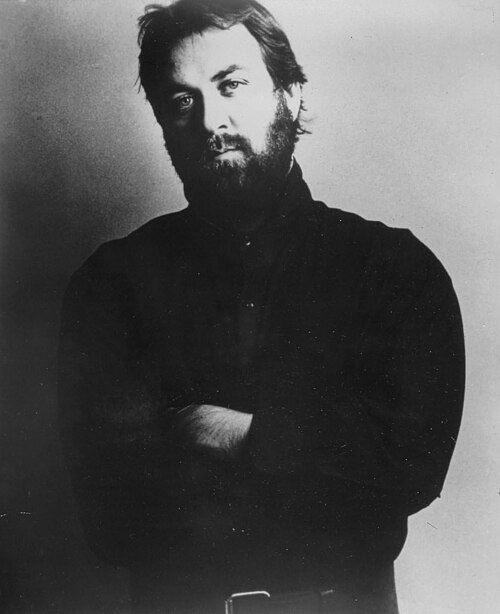
The video sealed the film-and-song fusion. It used nothing but scenes from Flashdance, with no footage of Sembello at all, making the clip essentially a movie trailer and keeping most of the public from ever knowing what the singer looked like. The on-screen dancing was performed by body double Marine Jahan, standing in for star Jennifer Beals, a secret kept quiet at the time.
How the telling has grown over the decades
The story of "Maniac" has been told, mythologized, and corrected for forty years. The earliest tellings, Sembello's 1983 newspaper interviews, already had the horror premise and the accidental path into Flashdance. Then the legend took over. A 1998 VH1 Pop Up Video episode claimed the original was "about a maniac who hacked off people's arms and feet." Radio countdowns spread a version where the song had been written for Texas Chainsaw Massacre 2. The film's own star, Joe Spinell, spent years insisting "Maniac" had been written for his movie, until director William Lustig finally drove to Sembello's home in May 2010 to settle it on camera for a Blu-ray release. The verdict: the song did start as a killer ditty, but it had almost nothing to do with Lustig's film.
The most useful correction came late. Matkosky's 2022 telling supplied the actual origin, a Gacy news report rather than a horror movie, contradicting the version his own writing partner had given for years. A 2024 Mental Floss investigation assembled all of it and confirmed the song was never written for any film. The spine held the whole time, a joke song about a murderer that got laundered into a dance anthem, but the details of the very first spark still depend on which writer is talking.
The honest bottom line
Strip away the leg warmers and "Maniac" is a novelty horror song with its lyrics swapped out, a fifteen-minute Jacuzzi joke that two friends never intended to release, saved by a producer who heard past the dead cat to the groove underneath. It should be a footnote. Instead it hit number 1, defined an aerobics era, and outlived the movie that adopted it. Sembello has one lingering grievance: he insists to this day that "Maniac" was disqualified from Oscar contention over academy rules, because it was not originally written for the film. The record disagrees with him. The song was a full nominee for Best Original Song at the 56th Academy Awards, and it simply lost to another Flashdance track, Irene Cara's "Flashdance... What a Feeling." A year later, Footloose would prove the formula could repeat, another movie title song bigger than the plot it served, written to a dancer's tempo and filed by critics as fluff while the charts said otherwise.
FAQ
Was "Maniac" really about a serial killer? Yes. Michael Sembello and Dennis Matkosky first wrote it as a darkly comic song about a murderer, with an early chorus about a maniac who moves in next door and kills your cat. Producer Phil Ramone had the horror lyrics rewritten to fit Flashdance before it was recorded for the film.
Was "Maniac" written for the 1980 horror movie Maniac? No. Despite a long-running legend, the song was not written for William Lustig's slasher film. The writers say it came from their own imaginations, sparked by a true-crime news report in Matkosky's telling, and it only shared the movie's title by coincidence.
Who wrote and sang "Maniac"? Michael Sembello, a former session guitarist who had played on Stevie Wonder's "Songs in the Key of Life," wrote it with his songwriting partner Dennis Matkosky and sang lead. Phil Ramone produced it for the Flashdance soundtrack.
How did "Maniac" end up in Flashdance? By accident. The demo was included on a tape of Sembello's material that reached Phil Ramone while he was assembling the Flashdance soundtrack. Ramone wanted the song on the condition that its horror lyrics be replaced with words fitting the film's dancer heroine.
Did "Maniac" win an Academy Award? No. It was nominated for Best Original Song at the 56th Academy Awards in 1984 and lost to "Flashdance... What a Feeling" by Irene Cara, another song from the same film. Sembello has said he believes it was disqualified, but records list it as a nominee that lost.
Sources
- Songfacts, "Maniac by Michael Sembello" (Michael Sembello interview quotes on the origin and rewrite)
- Mental Floss, "The Surprisingly Bizarre Origins of Michael Sembello's Pop Hit From Flashdance" (April Snellings), June 2024 (Matkosky's Starting Small Music telling; Lustig and Spinell history)
- The Philadelphia Inquirer and The Los Angeles Times, Michael Sembello interviews, 1983, as quoted by Mental Floss
- Billboard Hot 100 weekly charts, September 1983, and the 56th Academy Awards (chart peak and Oscar nomination)
We are maniacs about verification, certifiably.
Part of Stories Behind the Songs. See also Footloose and Eye of the Tiger.